

2 Scudi – San Marino
Non-circulating coins
Commemoration: The Republic
San Marino
Context
Material
References
KM: #Click to copy to clipboard61
Numista: #94751
Value
Bullion value: $917.72
Obverse
Description:
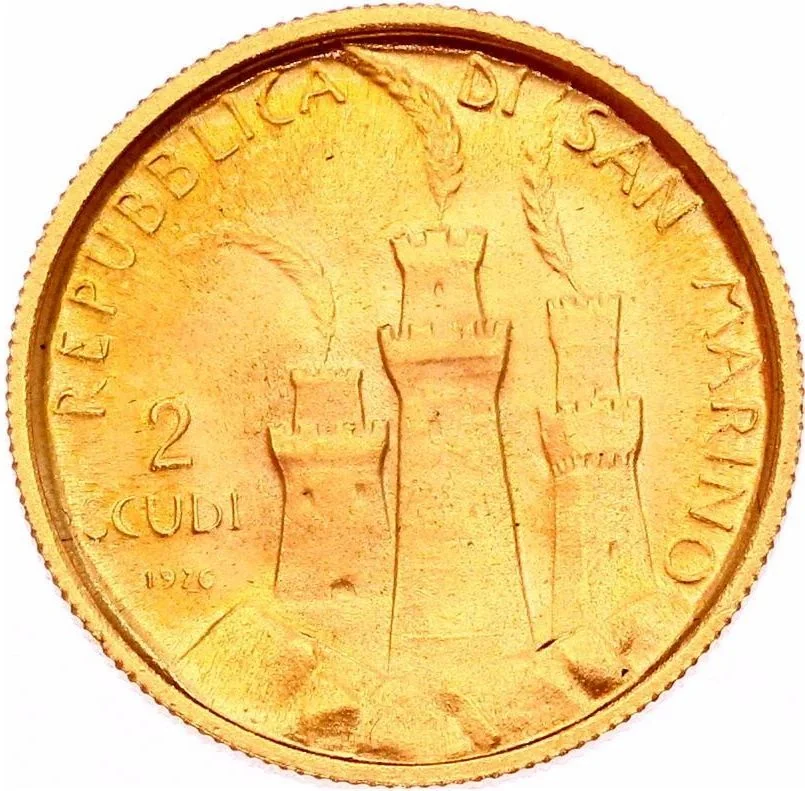
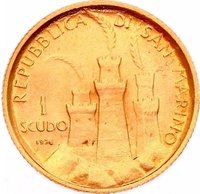
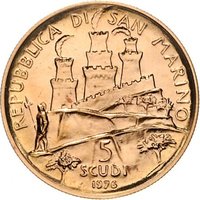
San Marino's three towers, left with value and date.
Inscription:
REPUBBLICA DI SAN MARINO
2 SCUDI
1976
2 SCUDI
1976
Translation:
REPUBLIC OF SAN MARINO
2 SCUDI
1976
2 SCUDI
1976
Script: Latin
Language: Italian
Engravers: Venanzo Crocetti, Guerrino Mattia Monassi
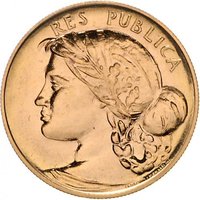
Reverse
Description:
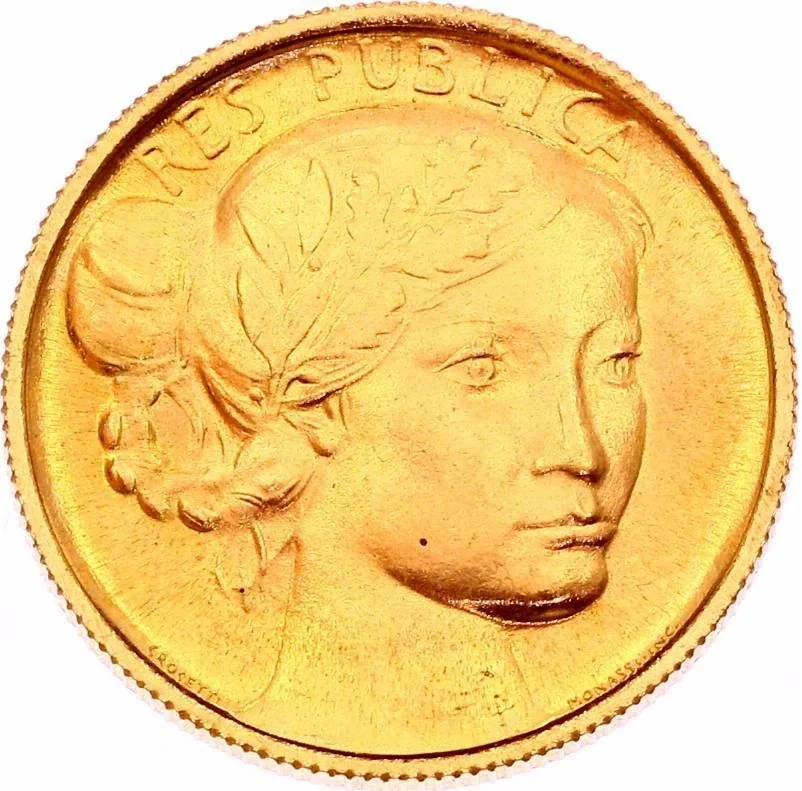
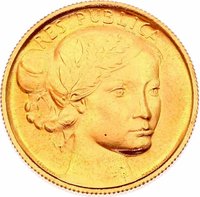
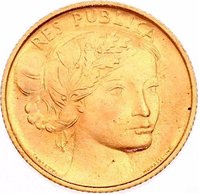
Bust of a woman in profile.
Inscription:
RES PUBLICA
Translation:
The Republic
Script: Latin
Language: Latin
Engravers: Venanzo Crocetti, Guerrino Mattia Monassi
Edge
Reeded
Mints
| Name | Mark |
|---|---|
| Rome | — |
Mintings
| Year | Mint Mark | Mintage | Quality | Collection |
|---|---|---|---|---|
| 1976 | — | 55,000 |
Historical background
In 1976, San Marino's currency situation was fundamentally defined by its close economic and monetary integration with Italy, a relationship formalized by a series of post-war treaties. The Republic used the Italian Lira (ITL) as its official legal tender, and there was no distinct Sammarinese currency in circulation. This arrangement provided monetary stability and facilitated seamless trade with its much larger neighbor, which entirely surrounded it. However, this integration also meant that San Marino had no independent monetary policy; its financial conditions were entirely subject to the decisions of the Bank of Italy and the turbulent economic climate of Italy in the 1970s.
The year 1976 occurred during a period of severe economic difficulty for Italy, known as the "Years of Lead," characterized by high inflation, political instability, and a weakening lira. San Marino, while more stable, was not insulated from these pressures. Inflation eroded purchasing power, and the lira's instability posed challenges for the Sammarinese economy, which relied heavily on tourism, postage stamp sales, and light industry. Within this framework, San Marino's limited monetary autonomy was exercised only through the issuance of limited-edition commemorative gold and silver coins, known as scudi, which were legal tender but intended primarily for collectors and not for everyday circulation.
Despite the constraints, the 1970s saw San Marino begin to cautiously assert more financial identity. Building on a 1971 agreement with Italy, the republic was expanding its capacity to issue its own commemorative coinage and had established a central financial institution, the Istituto di Credito Sammarinese, in 1970. The situation in 1976 can thus be seen as a point of transition—a state of complete dependency on the Italian lira amidst a crisis, but with the foundational institutions being laid for slightly greater financial self-determination in the decades to follow, culminating in later agreements with Italy and the eventual adoption of the Euro.
The year 1976 occurred during a period of severe economic difficulty for Italy, known as the "Years of Lead," characterized by high inflation, political instability, and a weakening lira. San Marino, while more stable, was not insulated from these pressures. Inflation eroded purchasing power, and the lira's instability posed challenges for the Sammarinese economy, which relied heavily on tourism, postage stamp sales, and light industry. Within this framework, San Marino's limited monetary autonomy was exercised only through the issuance of limited-edition commemorative gold and silver coins, known as scudi, which were legal tender but intended primarily for collectors and not for everyday circulation.
Despite the constraints, the 1970s saw San Marino begin to cautiously assert more financial identity. Building on a 1971 agreement with Italy, the republic was expanding its capacity to issue its own commemorative coinage and had established a central financial institution, the Istituto di Credito Sammarinese, in 1970. The situation in 1976 can thus be seen as a point of transition—a state of complete dependency on the Italian lira amidst a crisis, but with the foundational institutions being laid for slightly greater financial self-determination in the decades to follow, culminating in later agreements with Italy and the eventual adoption of the Euro.
✨ Legendary