

50 centimes – French Equatorial Africa
Add to wishlist
Context
Year: 1942
Country: Central African States
Issuer: French Equatorial Africa
Period:
(1940—1945)
Currency:
(1917—1945)
Demonetized: Yes
Total mintage: 8,000,000
Material
References
KM: #
Numista: #9437
Obverse
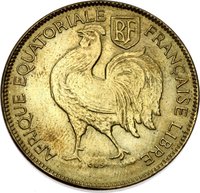
Description:
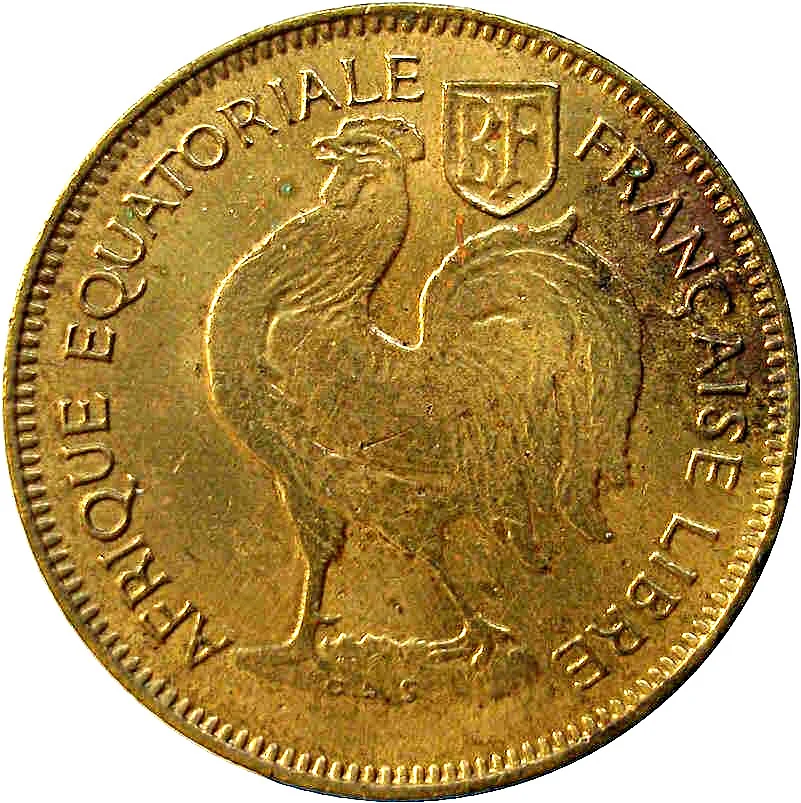
Rooster left, shield up.
Inscription:
RF
AFRIQUE EQUATORIALE FRANCAISE LIBRE
AFRIQUE EQUATORIALE FRANCAISE LIBRE
Script: Latin
Engraver: Coert Laurens Steynberg
Reverse
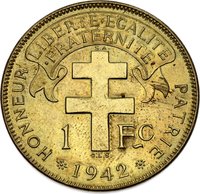
Description:
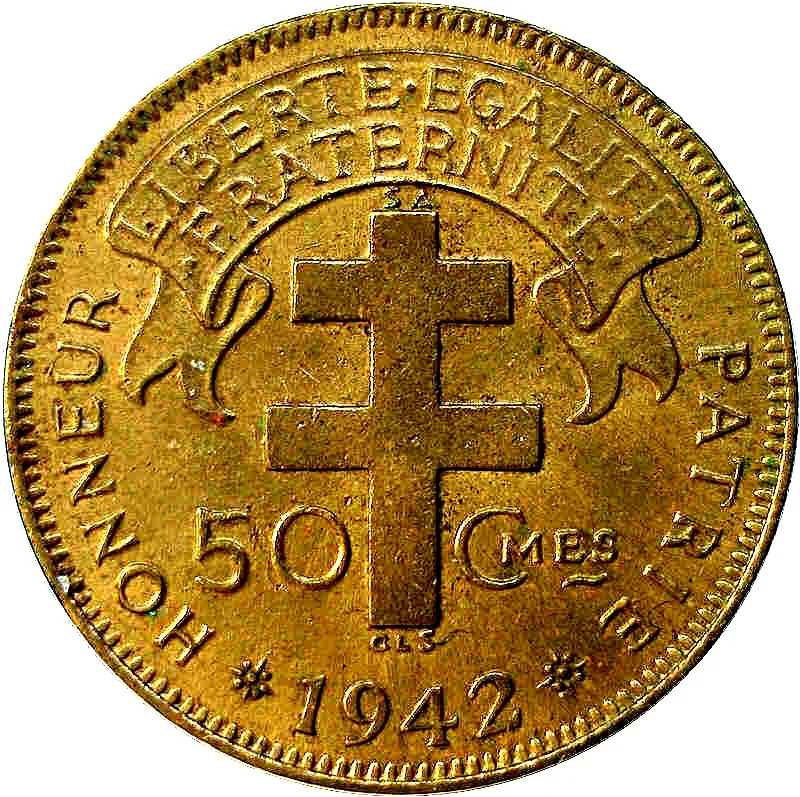
French motto, value, Cross of Lorraine, date, London government motto. Pretoria mint mark SA above cross.
Inscription:
LIBERTE.EGALITE.FRATERNITE.
SA
50 CMES
CLS
1942
HONNEUR PATRIE
SA
50 CMES
CLS
1942
HONNEUR PATRIE
Script: Latin
Engraver: Coert Laurens Steynberg
Edge
Plain
Mints
| Name | Mark |
|---|---|
| Pretoria | SA |
Mintings
| Year | Mint Mark | Mintage | Quality | Collection |
|---|---|---|---|---|
| 1942 | SA | 8,000,000 |
Historical background
In 1942, the currency situation in French Equatorial Africa (AEF) was defined by its allegiance to the Free French cause under Charles de Gaulle. Following the fall of France in 1940, the federation, led by Governor-General Félix Éboué, rejected the Vichy regime. This political rupture created a monetary schism, as AEF ceased to recognize the authority of the Banque de France and the Vichy-controlled currency issuing body. Consequently, the banknotes issued by the Banque de France Afrique and the older Banque de l'Afrique Occidentale (BAO) notes circulating in the territory were officially demonetized by the Free French administration to sever financial ties with Vichy.
To address the critical need for a legitimate circulating medium, the Free French authorities introduced emergency currency issues. The most notable was the "Trésorerie de l'A.E.F. et du Cameroun" series, simple printed notes that served as provisional legal tender. These were essentially occupation-style currency, authorized by the French National Committee in London, and were vital for funding local administration and the Allied war effort in the region. Simultaneously, British West African shillings also circulated, especially near military installations, as the territory became a crucial logistical hub for the Allies.
This period was one of significant monetary complexity and inflation. The demonetization of older notes, while politically necessary, caused disruption for the local population. The provisional nature of the new currency, combined with increased Allied military spending and supply shortages, led to inflationary pressures. Thus, the currency situation in AEF in 1942 was not merely an economic issue but a direct reflection of its contested political status, serving as a instrument of sovereignty for the Free French while creating challenging economic conditions on the ground.
To address the critical need for a legitimate circulating medium, the Free French authorities introduced emergency currency issues. The most notable was the "Trésorerie de l'A.E.F. et du Cameroun" series, simple printed notes that served as provisional legal tender. These were essentially occupation-style currency, authorized by the French National Committee in London, and were vital for funding local administration and the Allied war effort in the region. Simultaneously, British West African shillings also circulated, especially near military installations, as the territory became a crucial logistical hub for the Allies.
This period was one of significant monetary complexity and inflation. The demonetization of older notes, while politically necessary, caused disruption for the local population. The provisional nature of the new currency, combined with increased Allied military spending and supply shortages, led to inflationary pressures. Thus, the currency situation in AEF in 1942 was not merely an economic issue but a direct reflection of its contested political status, serving as a instrument of sovereignty for the Free French while creating challenging economic conditions on the ground.
🌱 Fairly Common