

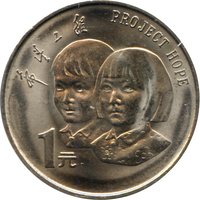
1 Yuan (Project Hope) – People's Republic of China
Circulating commemorative coins
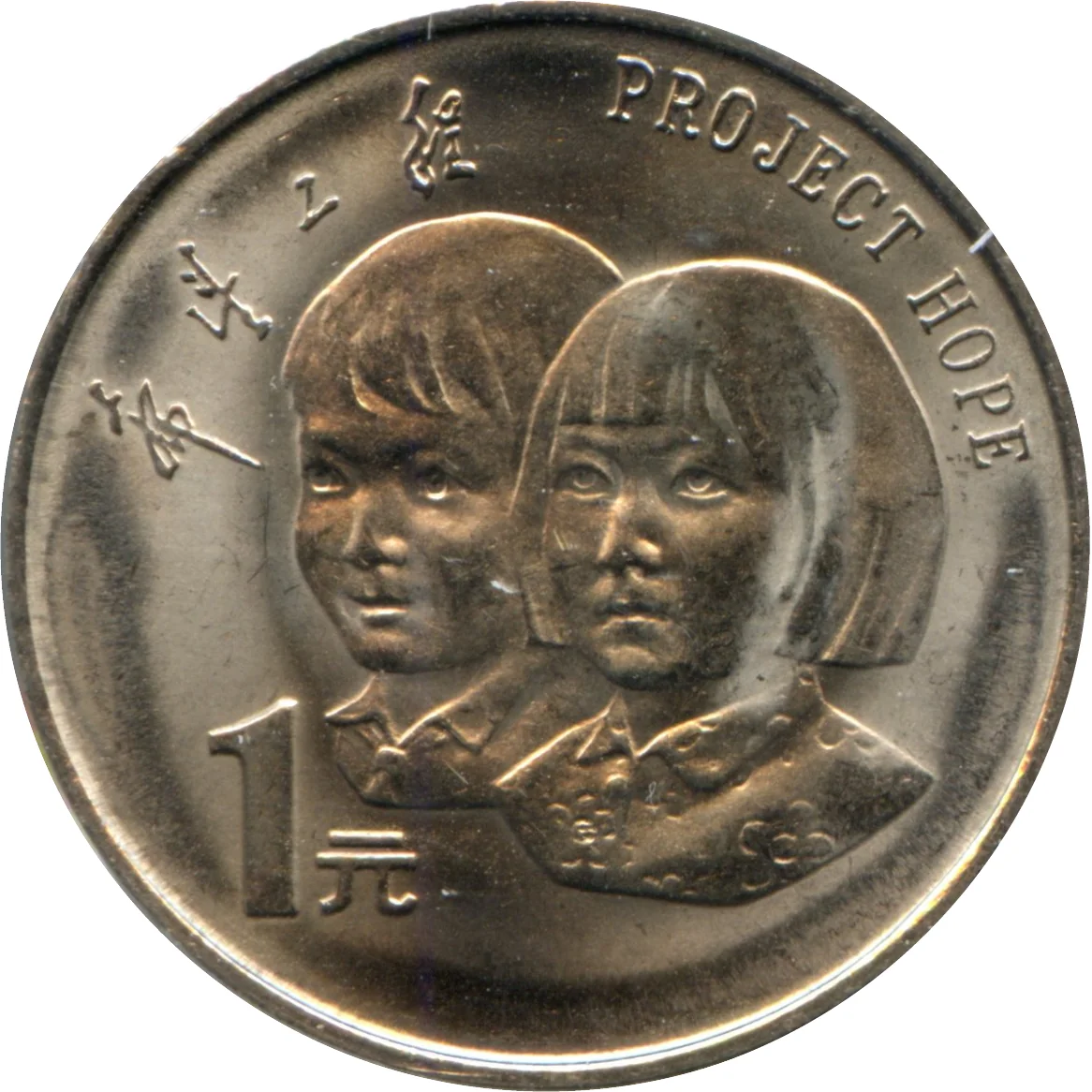
Commemoration: 5th Anniversary of Project Hope
China
Context
Year: 1994
Country: China 
Issuer: People's Republic of China
Period:
(since 1949)
Currency:
(since 1955)
Total mintage: 20,000,000
Material
References
KM: #Click to copy to clipboard610
Numista: #9385
Value
Exchange value: 1 CNY = $0.15
Inflation-adjusted value: 2.58 CNY
Obverse
Description:
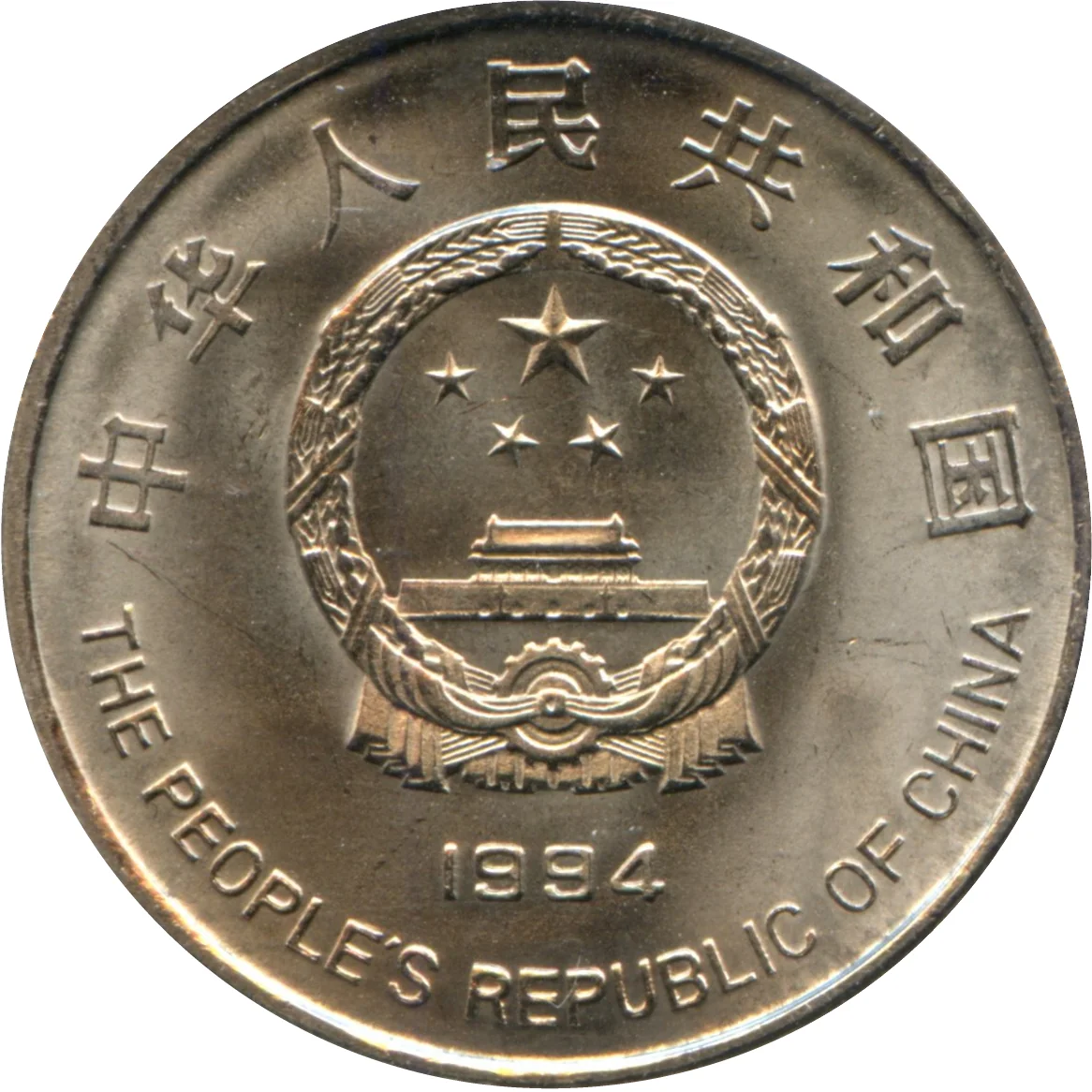
China's national emblem features Tiananmen Gate under five stars, encircled by wheat and rice with a cogwheel at the base.
Inscription:
中华人民共和国
1994
THE PEOPLE'S REPUBLIC OF CHINA
1994
THE PEOPLE'S REPUBLIC OF CHINA
Translation:
The People's Republic of China
1994
1994
Language: Chinese
Reverse
Edge
Plain
Mintings
| Year | Mint Mark | Mintage | Quality | Collection |
|---|---|---|---|---|
| 1994 | — | 20,000,000 |
Historical background
In 1994, the People's Republic of China implemented a landmark reform of its currency system, which fundamentally transformed its economic landscape and set the stage for its explosive growth. Prior to this, China operated a complex and fragmented dual-exchange rate system. This involved an official rate set by the state, used for planned economic transactions, alongside a much weaker and market-influenced swap centre rate used for most trade. This system created significant distortions, encouraged arbitrage, and was a major barrier to international trade and investment as China sought deeper integration into the global economy.
The core of the 1994 reform was the unification of these dual rates into a single, managed floating exchange rate system, initially pegged at approximately 8.28 yuan to the US dollar. Crucially, the reform also established a nationwide interbank foreign exchange market, replacing the regional swap centres. This move effectively devalued the official rate by over 30% to align with the market rate, making Chinese exports more competitive overnight. Furthermore, the government made the yuan convertible on the current account (for trade in goods and services), a major step toward its long-term internationalization goals, while maintaining strict controls on the capital account.
The immediate and profound success of the 1994 reforms provided monetary stability, boosted foreign direct investment, and fueled an export-led manufacturing boom. It established a credible and predictable framework that supported China's entry into the World Trade Organization in 2001. The managed peg to the dollar, maintained until 2005, became a cornerstone of China's macroeconomic policy, helping to control inflation and accumulate vast foreign exchange reserves. Thus, the 1994 currency reforms are widely regarded as a pivotal moment that cemented the yuan's modern foundation and accelerated China's rise as a global trading power.
The core of the 1994 reform was the unification of these dual rates into a single, managed floating exchange rate system, initially pegged at approximately 8.28 yuan to the US dollar. Crucially, the reform also established a nationwide interbank foreign exchange market, replacing the regional swap centres. This move effectively devalued the official rate by over 30% to align with the market rate, making Chinese exports more competitive overnight. Furthermore, the government made the yuan convertible on the current account (for trade in goods and services), a major step toward its long-term internationalization goals, while maintaining strict controls on the capital account.
The immediate and profound success of the 1994 reforms provided monetary stability, boosted foreign direct investment, and fueled an export-led manufacturing boom. It established a credible and predictable framework that supported China's entry into the World Trade Organization in 2001. The managed peg to the dollar, maintained until 2005, became a cornerstone of China's macroeconomic policy, helping to control inflation and accumulate vast foreign exchange reserves. Thus, the 1994 currency reforms are widely regarded as a pivotal moment that cemented the yuan's modern foundation and accelerated China's rise as a global trading power.
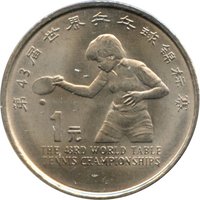
🌱 Fairly Common