

10 Cash – Republic of China
Circulating commemorative coins
Commemoration: Founding of the Republic
China
Context
Year: 1920
Country: China 
Issuer: Republic of China
Period:
(1912—1949)
Currency:
(1912—1948)
Demonetized: Yes
Material
References
Y: #Click to copy to clipboard303.3
Numista: #9379
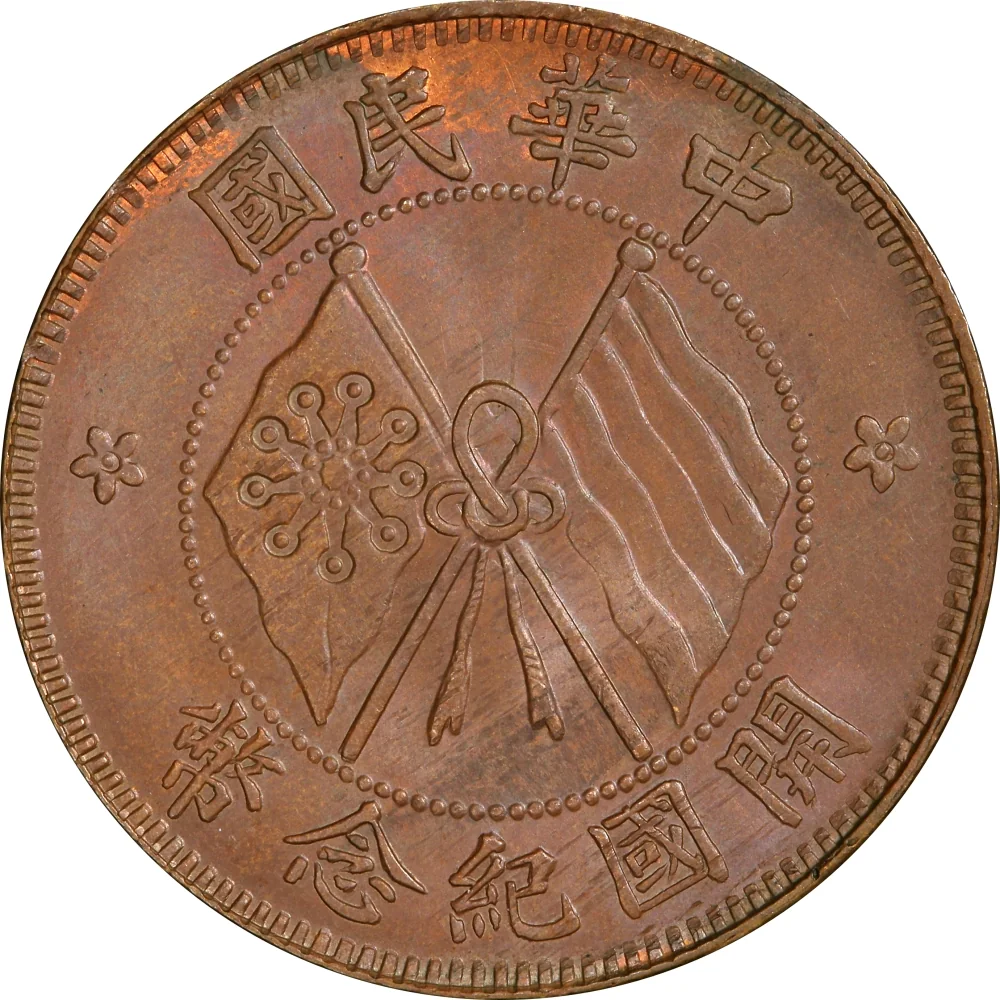
Obverse
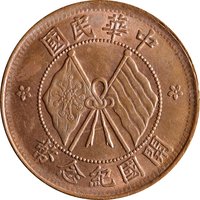
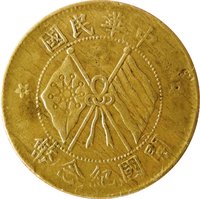
Description:
Flag of the Republic of China and its army with Chinese text.
Inscription:
國民華中
幣念紀國開
幣念紀國開
Translation:
In Commemoration of the Founding of the Nation, Republic of China
Scripts: Chinese (traditional, regular script)
Language: Chinese
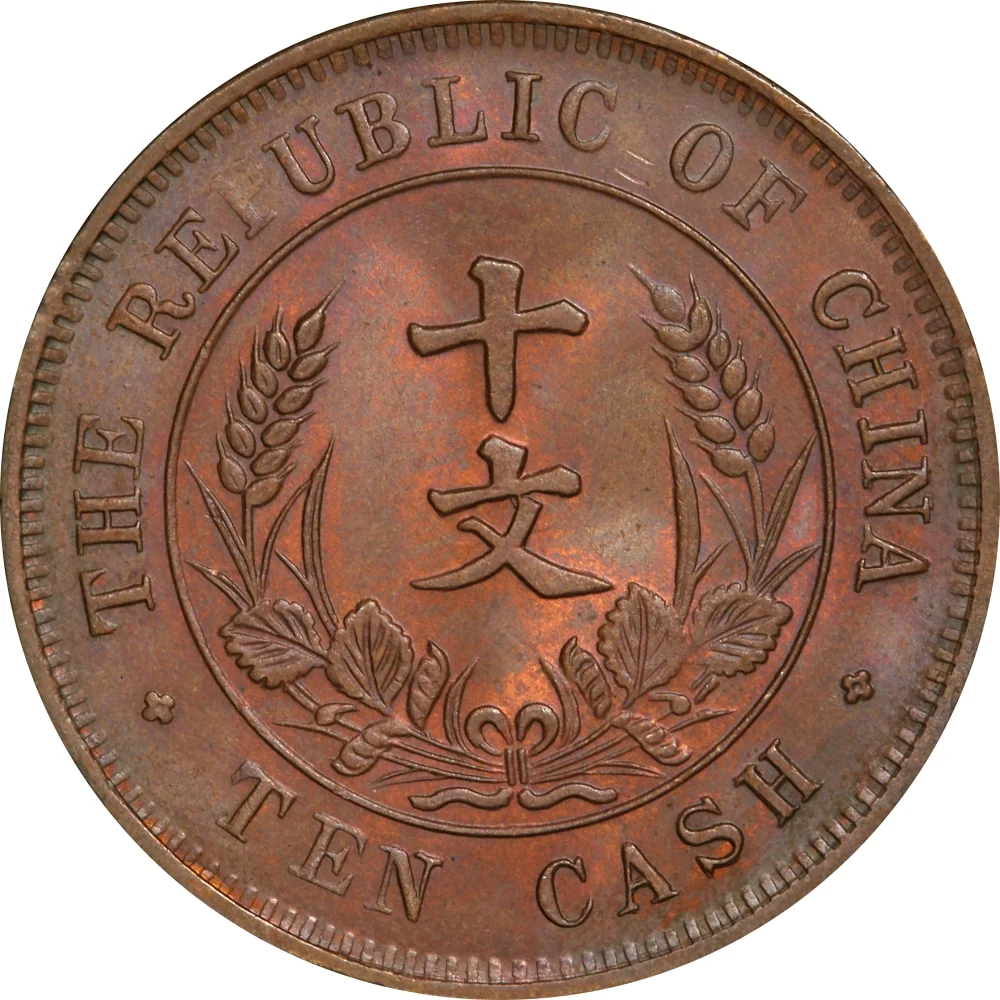
Reverse
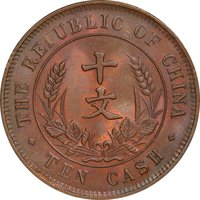
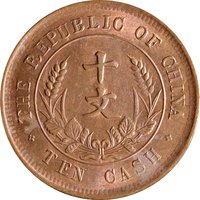
Description:
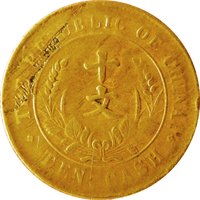
Two Chinese characters above floral and wheat motifs, encircled by an English inscription.
Inscription:
THE REPUBLIC OF CHINA
十
文
TEN CASH
十
文
TEN CASH
Translation:
THE REPUBLIC OF CHINA
TEN
CASH
TEN CASH
TEN
CASH
TEN CASH
Edge
Plain
Mintings
| Year | Mint Mark | Mintage | Quality | Collection |
|---|---|---|---|---|
| 1920 | — | — |
Historical background
In the early 1920s, the Republic of China was mired in a severe and complex monetary crisis, characterized by extreme fragmentation and hyperinflation. Following the collapse of the imperial system and the descent into the Warlord Era, there was no unified national currency. Instead, the financial landscape was a chaotic patchwork: old imperial silver coins (yuan), foreign banknotes (especially from British and Japanese banks), and a flood of unbacked paper notes issued by various provincial warlord governments and private banks. This lack of a central monetary authority meant exchange rates and values fluctuated wildly from region to region, crippling inter-provincial trade and economic stability.
The core of the problem was the relentless printing of paper currency, known as fabi (legal tender), by both the beleaguered Beiyang Government in Beijing and competing warlord regimes to finance their military campaigns and administrative costs. These notes were not backed by sufficient silver reserves, leading to a catastrophic loss of public confidence. As a result, the paper money depreciated rapidly, while silver coinage, seen as a reliable store of value, was hoarded, disappearing from circulation—a classic example of Gresham's Law. This divergence created a dual-system where daily transactions became a gamble, and prices could skyrocket within weeks.
This monetary disintegration had devastating social and economic consequences. Hyperinflation eroded savings and wages, plunging urban workers and civil servants into poverty and triggering widespread social unrest. It also severely handicapped any efforts for national industrial development or coherent fiscal policy. The currency chaos of the 1920s fundamentally undermined the legitimacy of the central government and highlighted the country's political disunity, setting the stage for the monetary reforms later attempted by the Nationalist Government (Kuomintang) after its nominal unification of China in 1927-28.
The core of the problem was the relentless printing of paper currency, known as fabi (legal tender), by both the beleaguered Beiyang Government in Beijing and competing warlord regimes to finance their military campaigns and administrative costs. These notes were not backed by sufficient silver reserves, leading to a catastrophic loss of public confidence. As a result, the paper money depreciated rapidly, while silver coinage, seen as a reliable store of value, was hoarded, disappearing from circulation—a classic example of Gresham's Law. This divergence created a dual-system where daily transactions became a gamble, and prices could skyrocket within weeks.
This monetary disintegration had devastating social and economic consequences. Hyperinflation eroded savings and wages, plunging urban workers and civil servants into poverty and triggering widespread social unrest. It also severely handicapped any efforts for national industrial development or coherent fiscal policy. The currency chaos of the 1920s fundamentally undermined the legitimacy of the central government and highlighted the country's political disunity, setting the stage for the monetary reforms later attempted by the Nationalist Government (Kuomintang) after its nominal unification of China in 1927-28.
🌱 Common