

1 scudo – San Marino
Add to wishlist
Non-circulating coins
Commemoration: Peace and Freedom
San Marino
Context
Material
References
KM: #
Numista: #93734
Value
Bullion value: $461.13
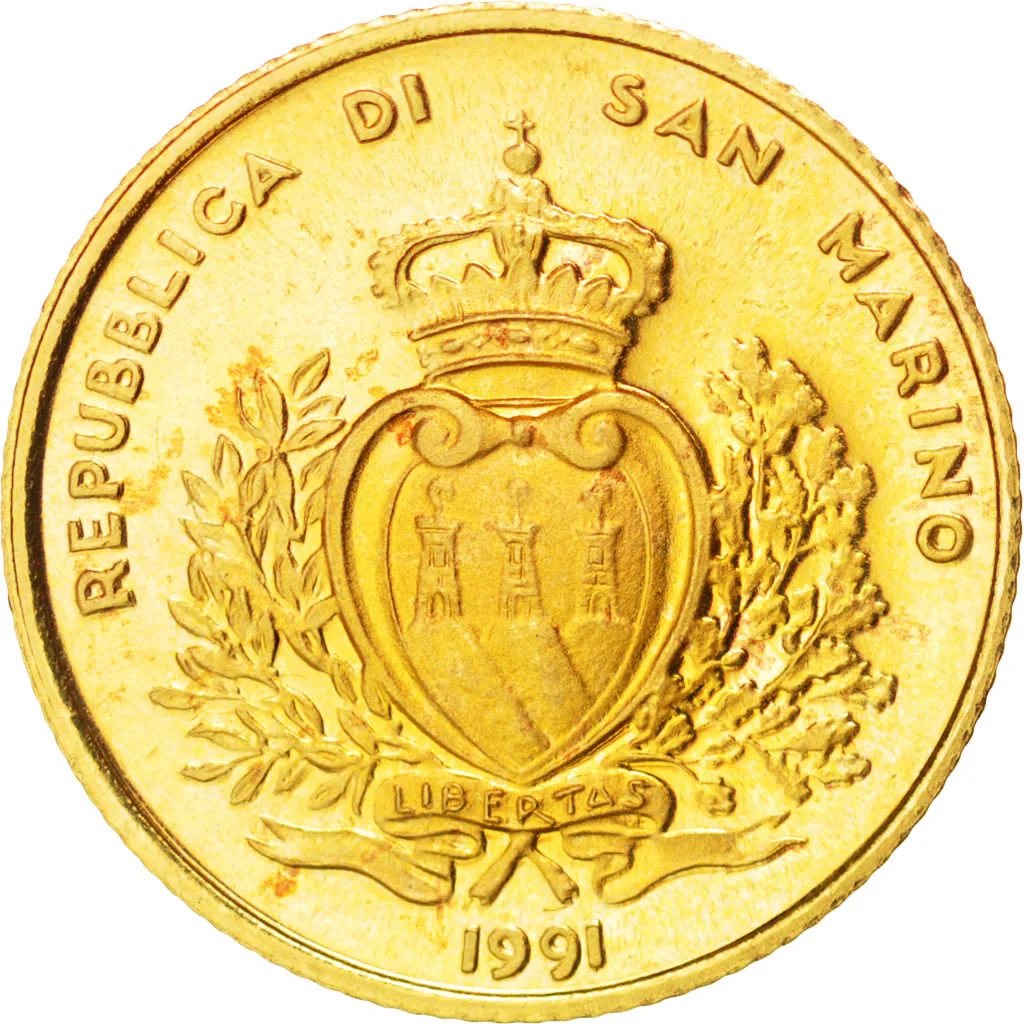
Obverse
Description:
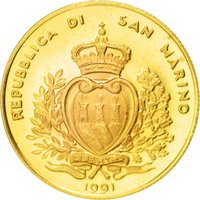
Crowned San Marino arms encircled by wreath.
Inscription:
REPUBBLICA DI SAN MARINO
1991
1991
Translation:
REPUBLIC OF SAN MARINO
1991
1991
Script: Latin
Language: Italian
Engravers: Bino Bini, Sergio Grossi
Reverse
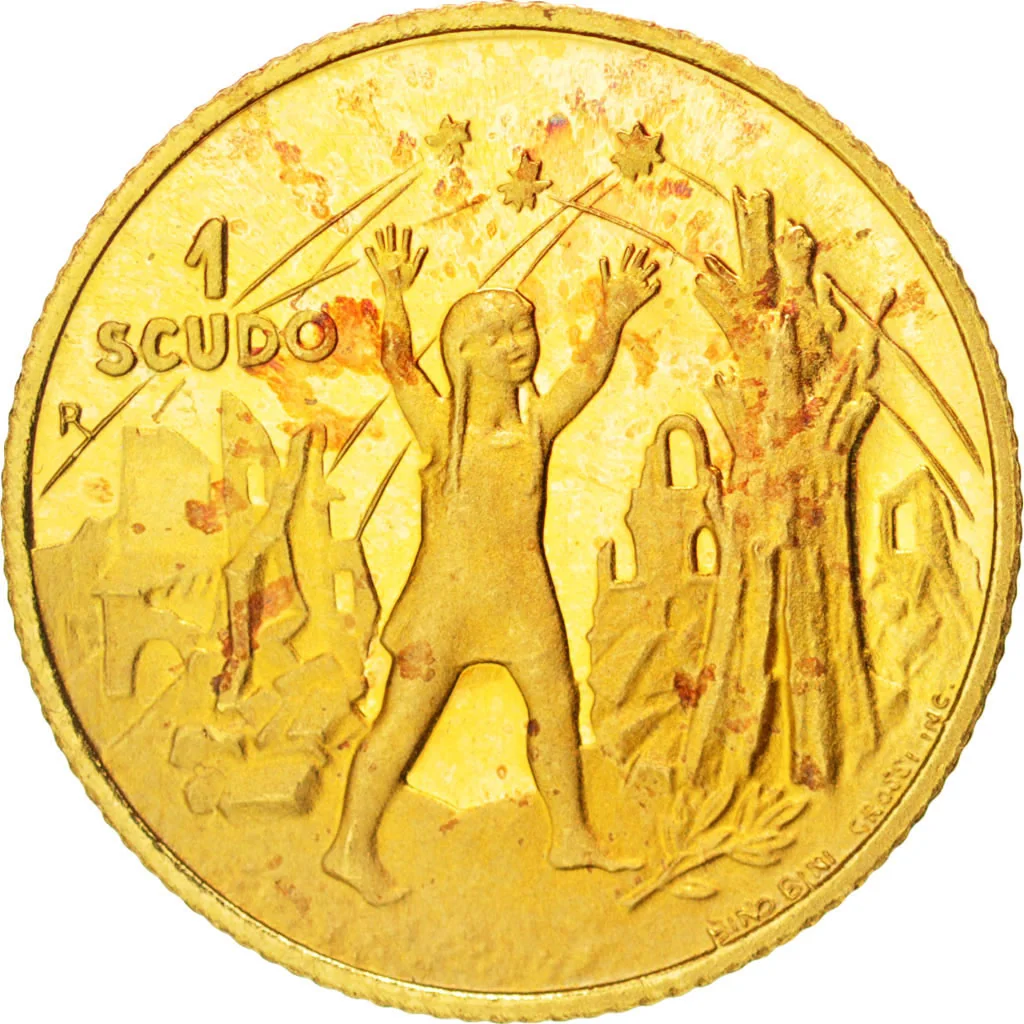
Description:
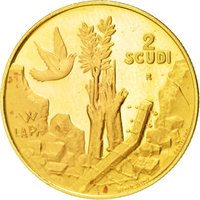
Child stands, arms raised, amid ruins. An olive branch lies at her feet.
Inscription:
1 SCUDO
Script: Latin
Engravers: Bino Bini, Sergio Grossi
Edge
Mints
| Name | Mark |
|---|---|
| Rome | R |
Mintings
| Year | Mint Mark | Mintage | Quality | Collection |
|---|---|---|---|---|
| 1991 | R | 6,800 | Proof |
Historical background
In 1991, the currency situation in the Republic of San Marino was defined by its long-standing and intricate monetary agreements with Italy, formalized in a 1939 Convention and subsequent accords. As a state completely surrounded by Italian territory, San Marino lacked its own central bank and did not issue an independent, circulating currency. Instead, its monetary system was fully integrated with Italy's, with the Italian Lira (ITL) serving as the official legal tender for all daily transactions. However, San Marino possessed the unique right to mint its own limited series of commemorative and collector coins, denominated in Lire, which were legal tender within its borders but primarily served numismatic purposes.
This arrangement provided monetary stability but came with significant constraints on economic sovereignty. San Marino could not conduct independent monetary policy, control money supply, or manage interest rates, as these were entirely determined by the Banca d'Italia. Furthermore, while the Sammarinese government earned seigniorage revenue from its special coin issues, it was dependent on Italy for the supply of circulating banknotes and coins. The system functioned smoothly due to the close economic and cultural ties between the two countries, but it inherently limited San Marino's fiscal and financial policy tools, tying its economy directly to Italy's economic performance and inflationary trends.
The year 1991 fell within a period of quiet continuity for this system, but it was also the calm before a significant change. The broader European movement toward Economic and Monetary Union (EMU), which would culminate in the Euro, was already underway with the Maastricht Treaty signed in 1992. Although not an EU member, San Marino's deep monetary integration with Italy meant that Italy's future adoption of the Euro would inevitably force a fundamental reconsideration of San Marino's currency status. Therefore, the lira-based system of 1991, while stable and operational, was on a path toward obsolescence, setting the stage for negotiations in the late 1990s that would allow San Marino to adopt the Euro as its currency under a new special agreement with the European Union.
This arrangement provided monetary stability but came with significant constraints on economic sovereignty. San Marino could not conduct independent monetary policy, control money supply, or manage interest rates, as these were entirely determined by the Banca d'Italia. Furthermore, while the Sammarinese government earned seigniorage revenue from its special coin issues, it was dependent on Italy for the supply of circulating banknotes and coins. The system functioned smoothly due to the close economic and cultural ties between the two countries, but it inherently limited San Marino's fiscal and financial policy tools, tying its economy directly to Italy's economic performance and inflationary trends.
The year 1991 fell within a period of quiet continuity for this system, but it was also the calm before a significant change. The broader European movement toward Economic and Monetary Union (EMU), which would culminate in the Euro, was already underway with the Maastricht Treaty signed in 1992. Although not an EU member, San Marino's deep monetary integration with Italy meant that Italy's future adoption of the Euro would inevitably force a fundamental reconsideration of San Marino's currency status. Therefore, the lira-based system of 1991, while stable and operational, was on a path toward obsolescence, setting the stage for negotiations in the late 1990s that would allow San Marino to adopt the Euro as its currency under a new special agreement with the European Union.
✨ Legendary