

1 Ruble (Friedrich Engels) – Soviet Union
Circulating commemorative coins
Commemoration: 165th Anniversary of the Birth of Friedrich Engels
Russia
Context
Years: 1983–1985
Country: Russia 
Issuer: Soviet Union 
Period:
(1922—1991)
Currency:
(1961—1991)
Demonetization: 1991
Total mintage: 2,040,000
Material
Diameter: 31 mm
Weight: 12.8 g
Thickness: 2.3 mm
Shape: Round
Composition: Nickel brass
Magnetic: No
Technique: Milled
Alignment: Medal alignment
flip
References
Y: #Click to copy to clipboard200.1
Numista: #11529
Value
Exchange value: 1 SUR
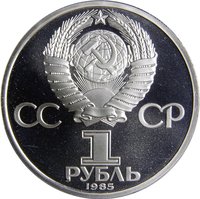
Obverse
Description:
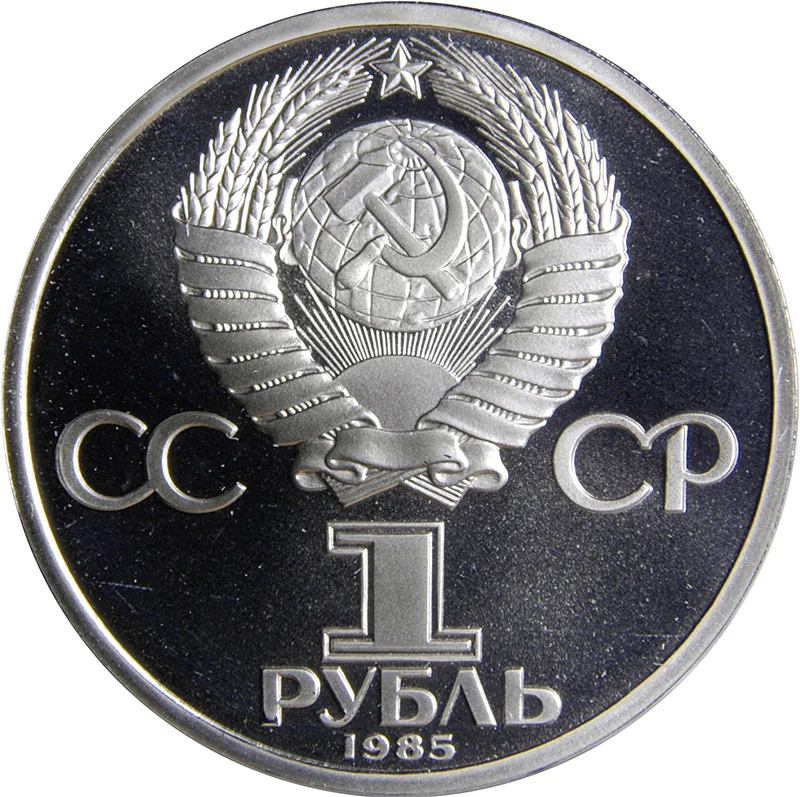
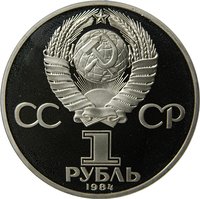
The Soviet Union's coat of arms; value.
Inscription:
СССР
1
РУБЛЬ
1985
1
РУБЛЬ
1985
Translation:
THE USSR
1
RUBLE
1985
1
RUBLE
1985
Script: Cyrillic
Language: Russian
Engraver: Sergey Mikhaylovich Ivanov
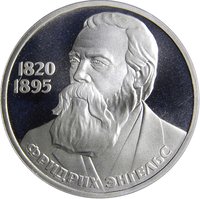
Reverse
Description:
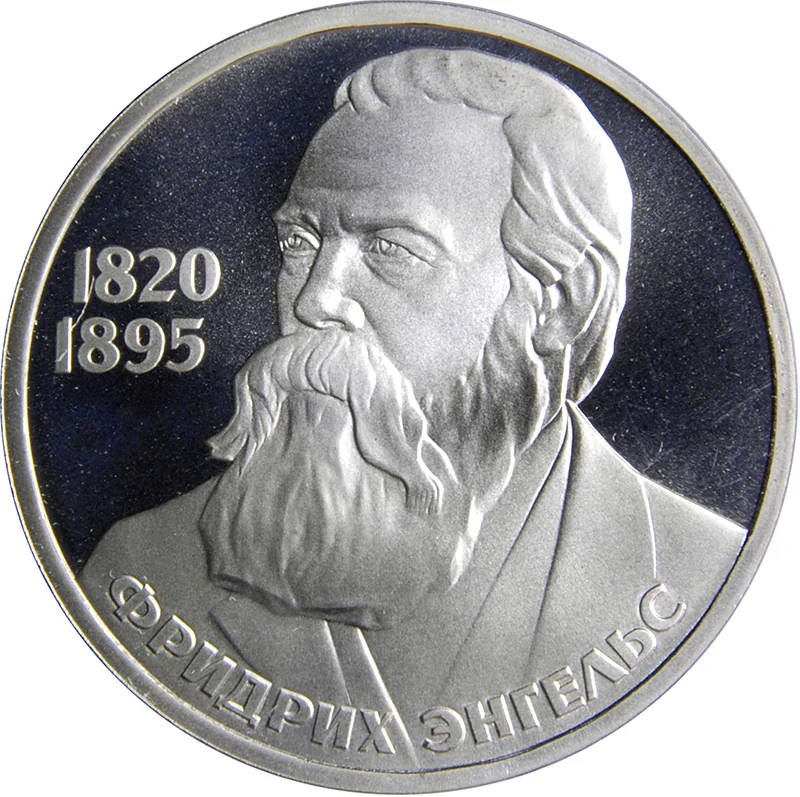
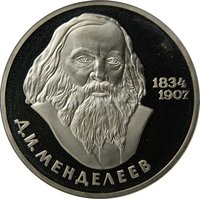
Bust 3/4 left, dated.
Inscription:
1820
1895
ФРИДРИХ ЭНГЕЛЬС
1895
ФРИДРИХ ЭНГЕЛЬС
Translation:
1820
1895
FRIEDRICH ENGELS
1895
FRIEDRICH ENGELS
Script: Cyrillic
Language: Russian
Engraver: Nikolay Alexandrovich Nosov
Edge
Smooth with inscription
Legend:
Y#200.1 : ОДИН РУБЛЬ • ОДИН РУБЛЬ •
Y#200.2 : ОДИН РУБЛЬ • 1988 • Н •
Y#200.2 : ОДИН РУБЛЬ • 1988 • Н •
Translation:
ONE RUBLE • ONE RUBLE •
ONE RUBLE • 1988 • N •
ONE RUBLE • 1988 • N •
Language: Russian
Categories
| Event> Birth anniversary |
Mints
| Name | Mark |
|---|---|
| Saint Petersburg | — |
Mintings
| Year | Mint Mark | Mintage | Quality | Collection |
|---|---|---|---|---|
| 1983 | — | — | Proof | |
| 1985 | — | 2,000,000 | ||
| 1985 | — | 40,000 | Proof |
Historical background
In 1983, the Soviet Union’s currency situation was characterized by a stark duality between the official, state-controlled economy and the pervasive shadow of the black market. Officially, the ruble was a non-convertible currency, meaning it could not be legally exchanged for foreign currencies or taken abroad. Its value was set by the state at an artificially high rate (around 0.67 rubles to 1 US dollar) for propaganda purposes, bearing no relation to its actual purchasing power or global market value. Within the domestic planned economy, money played a secondary role to state allocation; having rubles did not guarantee access to quality or even basic goods, as chronic shortages of consumer products were the norm.
This scarcity fueled a vast informal economy where the ruble’s real value was determined. Citizens routinely engaged in blat (connections) and black-market dealings to obtain anything from decent meat and jeans to spare auto parts. Here, a different exchange rate existed, with hard currencies like the US dollar commanding a massive premium on the illegal black market, where the dollar could fetch 5-10 rubles or more. This created a two-tier monetary reality: the "wooden ruble" of official transactions and savings, and the much more potent "commodity ruble" or foreign cash needed for real economic activity.
The situation in 1983 was stable but deeply pathological, masking severe structural economic decay. The state financed its massive military and industrial spending through hidden inflation, printing money while keeping retail prices administratively fixed, which only worsened goods shortages. Savings in ruble bank accounts grew but represented pent-up demand with little to purchase, a phenomenon known as the "monetary overhang." While the full crisis of hyperinflation and currency collapse would erupt later under perestroika, the foundations were firmly in place in 1983, with the rigid monetary system acting as both a control mechanism and a growing source of public disillusionment and economic distortion.
This scarcity fueled a vast informal economy where the ruble’s real value was determined. Citizens routinely engaged in blat (connections) and black-market dealings to obtain anything from decent meat and jeans to spare auto parts. Here, a different exchange rate existed, with hard currencies like the US dollar commanding a massive premium on the illegal black market, where the dollar could fetch 5-10 rubles or more. This created a two-tier monetary reality: the "wooden ruble" of official transactions and savings, and the much more potent "commodity ruble" or foreign cash needed for real economic activity.
The situation in 1983 was stable but deeply pathological, masking severe structural economic decay. The state financed its massive military and industrial spending through hidden inflation, printing money while keeping retail prices administratively fixed, which only worsened goods shortages. Savings in ruble bank accounts grew but represented pent-up demand with little to purchase, a phenomenon known as the "monetary overhang." While the full crisis of hyperinflation and currency collapse would erupt later under perestroika, the foundations were firmly in place in 1983, with the rigid monetary system acting as both a control mechanism and a growing source of public disillusionment and economic distortion.
🌱 Common