

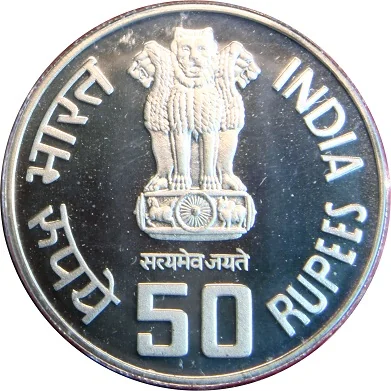
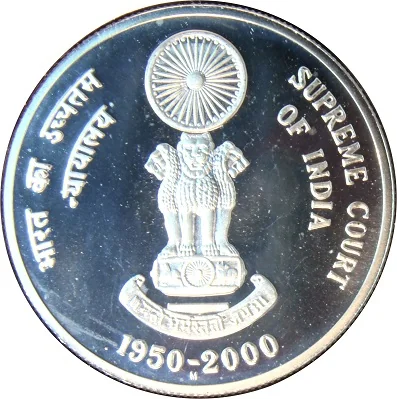
50 rupees (Supreme Court) – India
Add to wishlist
Non-circulating coins
Commemoration: 50th Anniversary of Supreme Court
India
Material
References
KM: #
Numista: #93131
Value
Exchange value: 50 INR
Bullion value: $28.05
Inflation-adjusted value: 227.84 INR
Obverse
Reverse
Edge
Reeded
Mints
| Name | Mark |
|---|---|
| Mumbai / Bombay | ♦ |
| Mumbai / Bombay | M |
Historical background
In the year 2000, India's currency situation was characterized by relative stability and a managed float exchange rate regime, a significant shift from the crisis-driven reforms of the previous decade. Following the balance of payments crisis of 1991, the Indian Rupee (INR) had been made convertible on the current account, but capital account convertibility remained restricted. The Reserve Bank of India (RBI) actively managed the rupee's value against a basket of currencies, primarily targeting the US Dollar, to maintain export competitiveness and control volatility. During this period, the rupee traded in a narrow band, averaging around ₹44-45 per US dollar, reflecting cautious economic management and growing foreign exchange reserves, which had rebounded to a more comfortable position.
This stability was underpinned by a broader macroeconomic context of steady, if unspectacular, growth and controlled inflation. The aftermath of the 1997 Asian Financial Crisis had instilled a sense of caution, leading the RBI to prioritize stability over rapid liberalization of the capital account. While current account transactions for trade and services were largely free, controls on foreign capital flows, both inbound and outbound, remained in place. This "partial convertibility" model aimed to attract foreign investment, particularly in the burgeoning IT and services sectors, while insulating the economy from speculative hot money flows that had destabilized other emerging markets.
Looking ahead, the currency situation in 2000 was at a crossroads, with ongoing debates about further liberalization. The decade that followed would see gradual steps towards fuller convertibility, increased two-way movement in the rupee's value, and a significant build-up of reserves. However, the year 2000 itself represented a period of consolidation—a deliberate pause to solidify the gains from the 1990s reforms before embarking on the next phase of India's integration into the global financial system. The focus was on maintaining a stable exchange rate as a foundation for sustained economic growth.
This stability was underpinned by a broader macroeconomic context of steady, if unspectacular, growth and controlled inflation. The aftermath of the 1997 Asian Financial Crisis had instilled a sense of caution, leading the RBI to prioritize stability over rapid liberalization of the capital account. While current account transactions for trade and services were largely free, controls on foreign capital flows, both inbound and outbound, remained in place. This "partial convertibility" model aimed to attract foreign investment, particularly in the burgeoning IT and services sectors, while insulating the economy from speculative hot money flows that had destabilized other emerging markets.
Looking ahead, the currency situation in 2000 was at a crossroads, with ongoing debates about further liberalization. The decade that followed would see gradual steps towards fuller convertibility, increased two-way movement in the rupee's value, and a significant build-up of reserves. However, the year 2000 itself represented a period of consolidation—a deliberate pause to solidify the gains from the 1990s reforms before embarking on the next phase of India's integration into the global financial system. The focus was on maintaining a stable exchange rate as a foundation for sustained economic growth.
💎 Extremely Rare