

100 Rupees (Birth of Bhagwan Mahavir) – India
Non-circulating coins
Commemoration: 2600th Anniversary of Birth of Bhagwan Mahavir Janma Kalyanak
India

Material

References
KM: #Click to copy to clipboard312
Numista: #93129
Value
Exchange value: 100 INR = $1.10
Bullion value: $50.84
Inflation-adjusted value: 438.10 INR
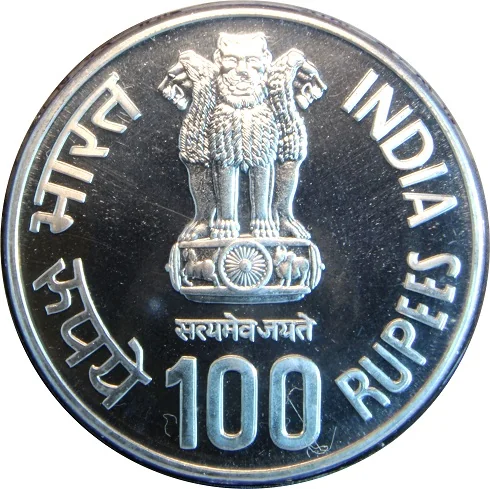
Obverse
Description:
Asoka lion with denomination.
Inscription:
भारत INDIA
सत्यमेव जयते
रूपये 100 RUPEES
सत्यमेव जयते
रूपये 100 RUPEES
Translation:
India
Truth Alone Triumphs
Rupees 100
Truth Alone Triumphs
Rupees 100
Scripts: Devanagari, Latin
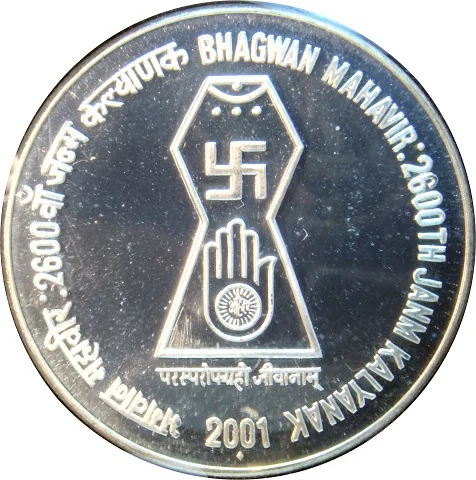
Reverse
Description:
Octagon with Swastika and Palm.
Inscription:
भगवान महावीर 2600वाँ जन्म कल्याणक
BHAGWAN MAHAVIR 2600TH JANM KALYANAK
परस्परोपग्रहो जीवानाम्
2001
BHAGWAN MAHAVIR 2600TH JANM KALYANAK
परस्परोपग्रहो जीवानाम्
2001
Translation:
Lord Mahavira 2600th Birth Anniversary
Mutual support of living beings
2001
Mutual support of living beings
2001
Scripts: Devanagari, Latin
Edge
Reeded
Mints
| Name | Mark |
|---|---|
| Mumbai / Bombay | ♦ |
Historical background
In 2001, India's currency situation was characterized by a managed exchange rate regime and a period of relative stability following the significant reforms of the early 1990s. The rupee was pegged to a basket of currencies, though with a heavy weighting on the US dollar, and the Reserve Bank of India (RBI) actively intervened in the foreign exchange market to manage volatility. This period saw moderate pressure on the rupee, influenced by global factors such as the dot-com bust and a slowing US economy, as well as domestic concerns including fiscal deficits and rising oil import bills. However, India's comfortable foreign exchange reserves position, which had grown steadily to over $45 billion, provided a substantial buffer against external shocks and speculative pressures.
A key development of the era was the ongoing transition towards fuller capital account convertibility, a process that had been cautiously advanced since the 1997 Tarapore Committee report. While current account transactions were fully convertible, restrictions remained on the capital account, governing flows of investment and foreign borrowing. This cautious approach is credited with insulating India from the worst of the 1997 Asian Financial Crisis. The year also witnessed the continuation of efforts to modernize the financial system, including upgrades in currency management and payment systems, setting the stage for future reforms.
Overall, 2001 represented a period of consolidation in India's currency management. The system prioritized stability over flexibility, using reserves to smooth exchange rate fluctuations while gradually integrating with the global financial system. This cautious stability would soon be tested in the coming years by accelerating globalization, greater capital inflows, and the eventual move to a market-determined exchange rate regime in the latter part of the decade.
A key development of the era was the ongoing transition towards fuller capital account convertibility, a process that had been cautiously advanced since the 1997 Tarapore Committee report. While current account transactions were fully convertible, restrictions remained on the capital account, governing flows of investment and foreign borrowing. This cautious approach is credited with insulating India from the worst of the 1997 Asian Financial Crisis. The year also witnessed the continuation of efforts to modernize the financial system, including upgrades in currency management and payment systems, setting the stage for future reforms.
Overall, 2001 represented a period of consolidation in India's currency management. The system prioritized stability over flexibility, using reserves to smooth exchange rate fluctuations while gradually integrating with the global financial system. This cautious stability would soon be tested in the coming years by accelerating globalization, greater capital inflows, and the eventual move to a market-determined exchange rate regime in the latter part of the decade.
💎 Very Rare