

10 francs – French Polynesia
Add to wishlist
France
Context
Years: 1972–2005
Country: France
Issuer: French Polynesia
Issuing organization: Overseas Institution of Issue
Period:
(1957—2003)
Currency:
(since 1945)
Demonetization: 30 November 2022
Total mintage: 13,577,370
Material
References
KM: #
Numista: #930
Value
Exchange value: 10 XPF
Inflation-adjusted value: 79.97 XPF
Obverse
Description:
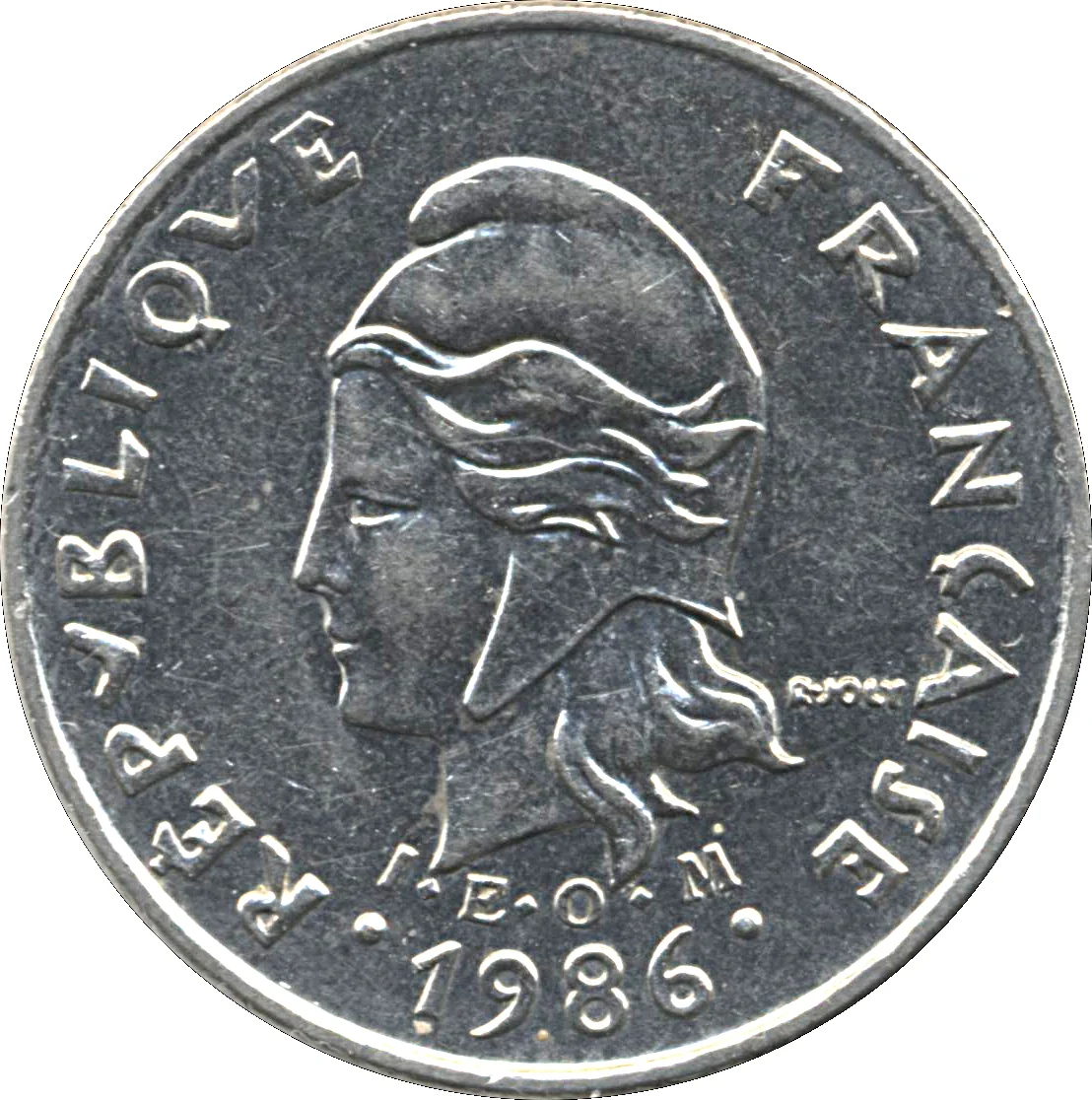
Marianne left, bust capped, date below.
Inscription:
RÉPUBLIQUE FRANÇAISE
R. JOLY
I·E·O·M
1986
R. JOLY
I·E·O·M
1986
Translation:
FRENCH REPUBLIC
R. JOLY
INSTITUTE FOR OVERSEAS ISSUING AND MINTING
1986
R. JOLY
INSTITUTE FOR OVERSEAS ISSUING AND MINTING
1986
Script: Latin
Engraver: Raymond Joly
Reverse
Description:
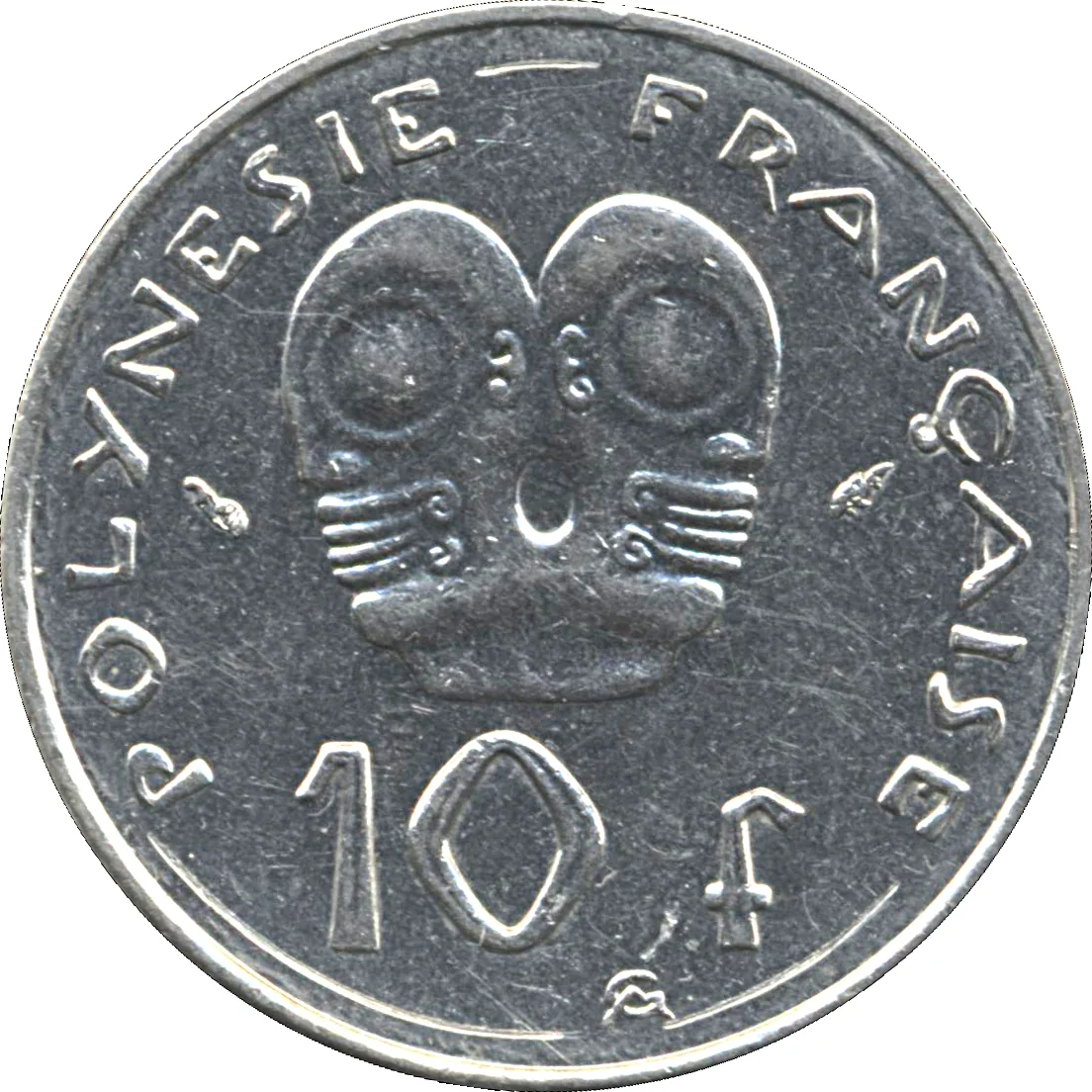
Tribal mask atop value.
Inscription:
POLYNESIE FRANÇAISE
10 f
AG
10 f
AG
Translation:
French Polynesia
10 francs
10 francs
Script: Latin
Language: French
Engraver: Aleth Guzman-Nageotte
Edge
Reeded
Mints
| Name | Mark |
|---|---|
| Monnaie de Paris | — |
Mintings
| Year | Mint Mark | Mintage | Quality | Collection |
|---|---|---|---|---|
| 1972 | — | 300,270 | ||
| 1973 | — | 400,100 | ||
| 1975 | — | 1,000,000 | ||
| 1979 | — | 500,200 | ||
| 1982 | — | 500,200 | ||
| 1983 | — | 1,000,200 | ||
| 1984 | — | 800,200 | ||
| 1985 | — | 800,200 | ||
| 1986 | — | 800,000 | ||
| 1991 | — | 600,000 | ||
| 1992 | — | 400,000 | ||
| 1993 | — | 636,000 | ||
| 1995 | — | 540,000 | ||
| 1996 | — | 328,000 | ||
| 1997 | — | 348,000 | ||
| 1998 | — | 960,000 | ||
| 1999 | — | 240,000 | ||
| 2000 | — | 1,228,000 | ||
| 2001 | — | 476,000 | ||
| 2002 | — | — | ||
| 2003 | — | 960,000 | ||
| 2004 | — | 560,000 | ||
| 2005 | — | 200,000 |
Historical background
In 1972, French Polynesia's currency situation was firmly anchored within the Franc Zone, operating under the CFP franc (Franc des Colonies Françaises du Pacifique). This currency, created in 1945, was not a sovereign currency but a colonial monetary instrument guaranteed by the French Treasury. Its value was pegged to the French franc at a fixed rate, which provided monetary stability and facilitated trade with the metropole but also meant that French Polynesia had no independent monetary policy. All currency issuance and major financial decisions were controlled from Paris.
The early 1970s were a period of significant transition for the CFP franc. In 1972, the system was still reeling from a major reform enacted just a year prior. In 1971, the CFP franc's peg was shifted from a fixed rate against the French franc to a fixed rate against the French nouveau franc, but more importantly, its international guarantee was transferred from the French franc to the French Treasury directly. This change was largely technical but underscored the territory's complete financial dependence on France. Furthermore, the global monetary turmoil of the era, including the collapse of the Bretton Woods system and the devaluation of the US dollar, indirectly affected the territory through its link to France, though the fixed peg provided a buffer against direct exchange rate volatility.
Economically, this currency regime supported the booming nuclear testing program at the Centre d'Expérimentation du Pacifique (CEP), which was the dominant economic force in the territory at the time. The fixed and stable CFP franc facilitated the influx of French military personnel, infrastructure investments, and subsidies, creating an artificial economic boom centered on Tahiti. However, this also tied the local economy's health directly to French political and strategic interests, limiting economic diversification and leaving the currency system as a symbol of enduring colonial control amidst growing local political movements advocating for greater autonomy.
The early 1970s were a period of significant transition for the CFP franc. In 1972, the system was still reeling from a major reform enacted just a year prior. In 1971, the CFP franc's peg was shifted from a fixed rate against the French franc to a fixed rate against the French nouveau franc, but more importantly, its international guarantee was transferred from the French franc to the French Treasury directly. This change was largely technical but underscored the territory's complete financial dependence on France. Furthermore, the global monetary turmoil of the era, including the collapse of the Bretton Woods system and the devaluation of the US dollar, indirectly affected the territory through its link to France, though the fixed peg provided a buffer against direct exchange rate volatility.
Economically, this currency regime supported the booming nuclear testing program at the Centre d'Expérimentation du Pacifique (CEP), which was the dominant economic force in the territory at the time. The fixed and stable CFP franc facilitated the influx of French military personnel, infrastructure investments, and subsidies, creating an artificial economic boom centered on Tahiti. However, this also tied the local economy's health directly to French political and strategic interests, limiting economic diversification and leaving the currency system as a symbol of enduring colonial control amidst growing local political movements advocating for greater autonomy.
🌱 Very Common