

5 Dollars – United States
Non-circulating coins
Commemoration: George Washington Death Bicentennial
United States
Context
Material

References
KM: #Click to copy to clipboard300
Numista: #92508
Value
Exchange value: 5 USD = $5.00
Bullion value: $1254.50
Inflation-adjusted value: 9.85 USD
Obverse
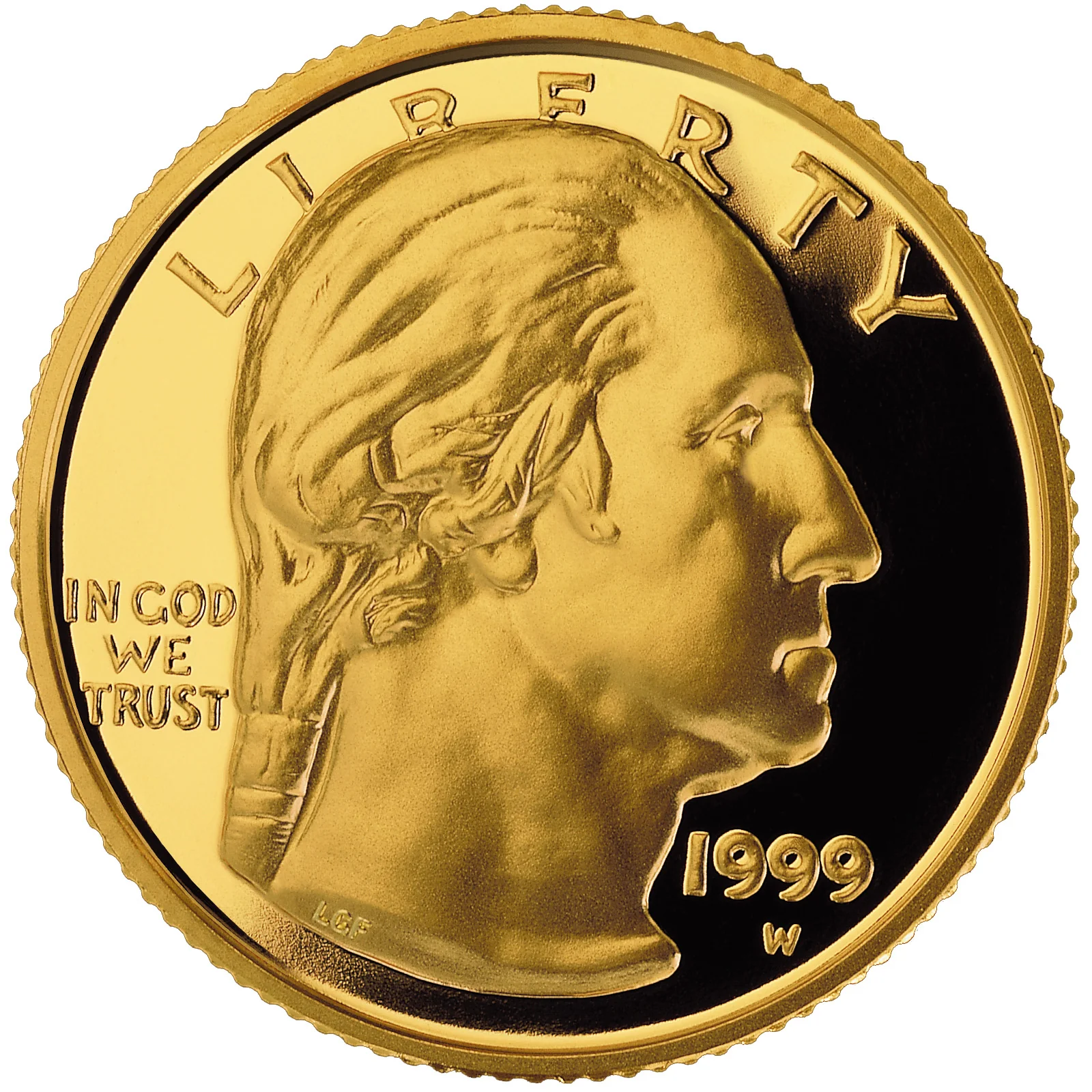
Description:
George Washington facing right.
Inscription:
LIBERTY
IN GOD WE TRUST
1999
W
IN GOD WE TRUST
1999
W
Script: Latin
Designer: Laura Gardin Fraser
Reverse
Description:
Heraldic eagle, wings outspread, thirteen stars above.
Inscription:
UNITED STATES OF AMERICA
E PLURIBUS UNUM
FIVE DOLLARS
E PLURIBUS UNUM
FIVE DOLLARS
Translation:
UNITED STATES OF AMERICA
OUT OF MANY, ONE
FIVE DOLLARS
OUT OF MANY, ONE
FIVE DOLLARS
Script: Latin
Designer: Laura Gardin Fraser
Edge
Reeded
Categories
| Animal> Bird> Eagle |
| Event> Death anniversary |
| Person> Military leader |
| Person> Politician |
Mints
| Name | Mark |
|---|---|
| United States Mint of West Point | W |
Historical background
In 1999, the United States currency situation was characterized by robust economic confidence and a strong U.S. dollar, but it was also a year of significant transition and underlying concern. The decade-long economic expansion, fueled by the dot-com boom, low inflation, and fiscal discipline, had solidified the dollar's position as the world's dominant reserve currency. Domestically, the focus was on the practical management of cash, marked by the successful introduction of the redesigned $5, $10, $20, and $50 bills featuring enhanced, off-center portraits to deter counterfeiting—a quiet but crucial ongoing effort.
Internationally, the year presented a major symbolic challenge with the launch of the euro on January 1st. While the euro was initially only an electronic currency for financial markets, its creation represented the first real potential competitor to the dollar's hegemony in decades. U.S. policymakers and economists monitored this development closely, though the dollar's supremacy remained unchallenged in practice. More immediate concerns centered on global financial stability, as the U.S. had recently orchestrated bailouts to contain the 1997-1998 Asian and Russian financial crises, which had threatened to destabilize the international system underpinned by the dollar.
Beneath this surface strength, however, debates were brewing about long-term sustainability. A growing current account deficit, reflecting the nation's appetite for imported goods and foreign investment capital, was viewed by some as a vulnerability. Furthermore, the Federal Reserve, under Chairman Alan Greenspan, was in a tightening cycle, having raised interest rates to cool an "overheating" economy perceived to be at risk of inflation. This monetary policy aimed to ensure the dollar's stability and prolong the expansion, setting the stage for the economic crossroads that would arrive with the dot-com bust in the following year.
Internationally, the year presented a major symbolic challenge with the launch of the euro on January 1st. While the euro was initially only an electronic currency for financial markets, its creation represented the first real potential competitor to the dollar's hegemony in decades. U.S. policymakers and economists monitored this development closely, though the dollar's supremacy remained unchallenged in practice. More immediate concerns centered on global financial stability, as the U.S. had recently orchestrated bailouts to contain the 1997-1998 Asian and Russian financial crises, which had threatened to destabilize the international system underpinned by the dollar.
Beneath this surface strength, however, debates were brewing about long-term sustainability. A growing current account deficit, reflecting the nation's appetite for imported goods and foreign investment capital, was viewed by some as a vulnerability. Furthermore, the Federal Reserve, under Chairman Alan Greenspan, was in a tightening cycle, having raised interest rates to cool an "overheating" economy perceived to be at risk of inflation. This monetary policy aimed to ensure the dollar's stability and prolong the expansion, setting the stage for the economic crossroads that would arrive with the dot-com bust in the following year.


💎 Very Rare