

1 penny – Southern Rhodesia
Add to wishlist
Zimbabwe
Context
Years: 1942–1947
Country: Zimbabwe
Issuer: Southern Rhodesia
Ruler: George VI
Currency:
(1932—1955)
Demonetization: 1 January 1973
Total mintage: 9,600,000
Material
Diameter: 27 mm
Weight: 6.48 g
Thickness: 1.5 mm
Shape: Round with a round hole
Composition: Bronze
Magnetic: No
Technique: Milled
Alignment: Medal alignment
flip
References
KM: #
Numista: #11514
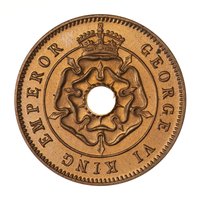
Obverse
Description:
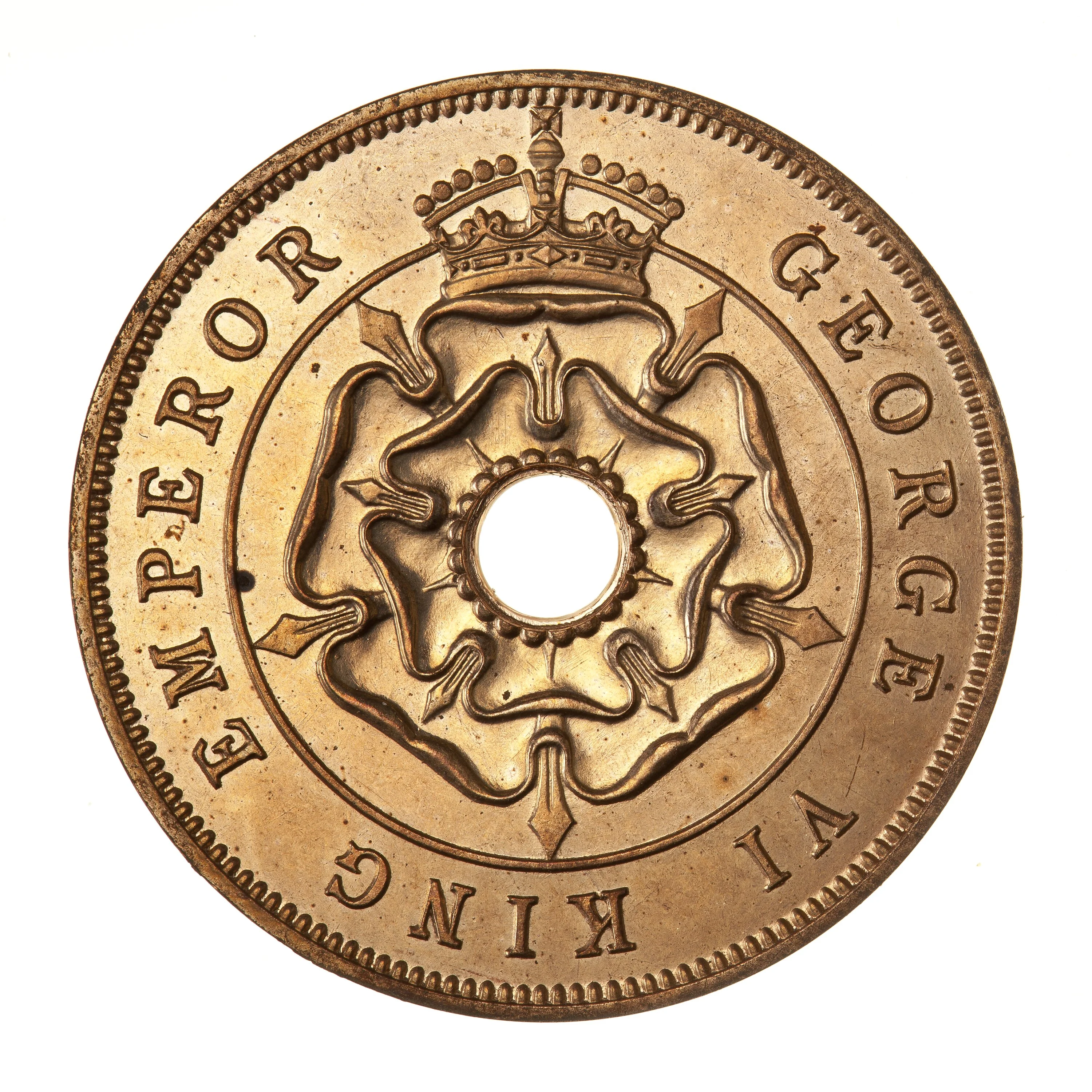
Crowned flower encircling hole, text around.
Inscription:
GEORGE VI KING EMPEROR
Translation:
GEORGE VI KING EMPEROR
Script: Latin
Language: English
Engraver: Derwent Wood
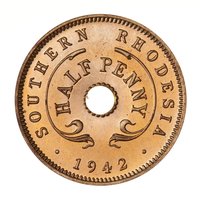
Reverse
Description:
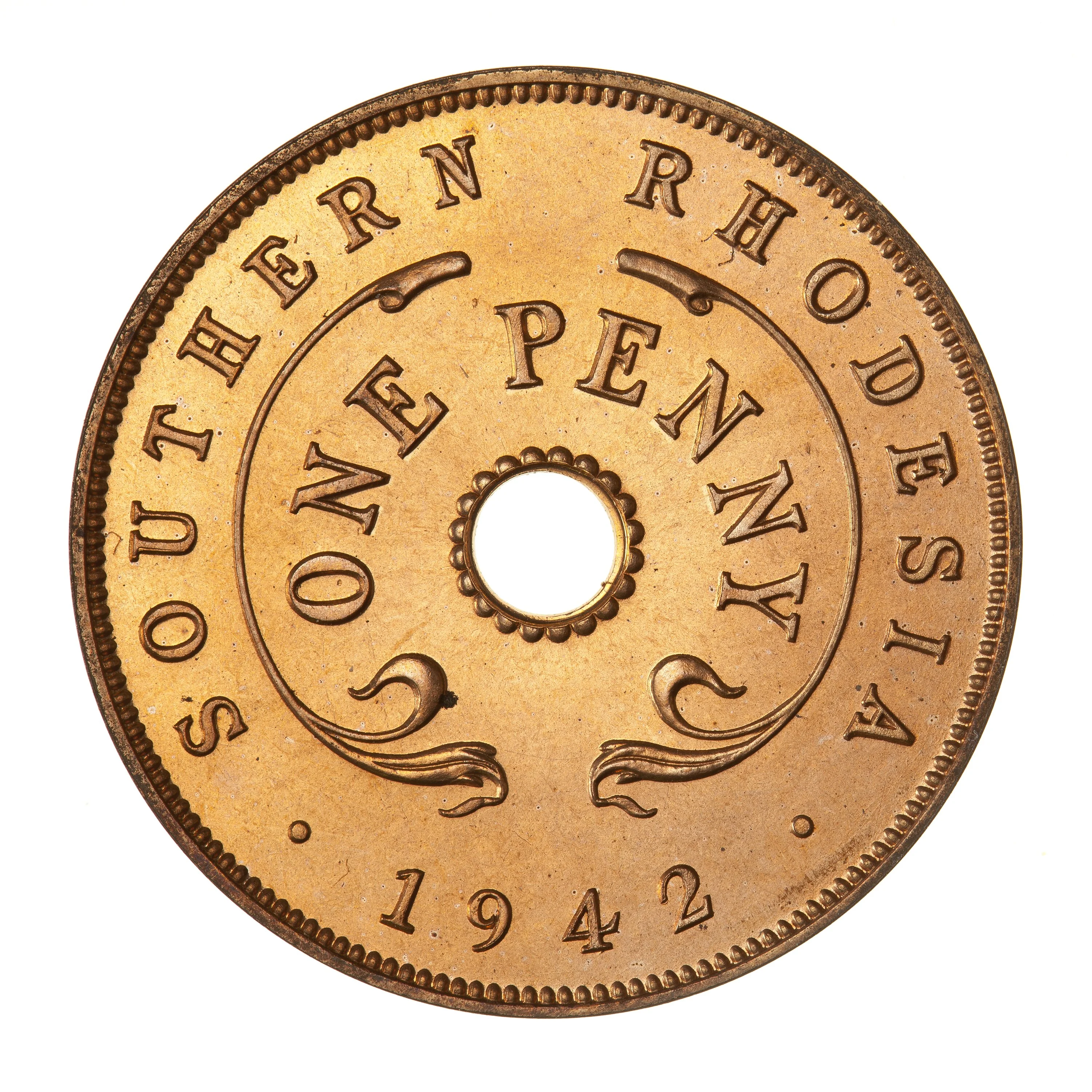
Sprig design: name encircles, date below, value in sprigs, central hole.
Inscription:
SOUTHERN RHODESIA
ONE PENNY
· 1943 ·
ONE PENNY
· 1943 ·
Script: Latin
Engraver: Royal Mint Engravers
Edge
Plain
Mints
| Name | Mark |
|---|---|
| Royal Mint (Tower Hill) | — |
Mintings
| Year | Mint Mark | Mintage | Quality | Collection |
|---|---|---|---|---|
| 1942 | — | 480,000 | ||
| 1942 | — | — | Proof | |
| 1943 | — | 3,120,000 | ||
| 1944 | — | 2,400,000 | ||
| 1944 | — | — | Proof | |
| 1947 | — | 3,600,000 | ||
| 1947 | — | — | Proof |
Historical background
In 1942, Southern Rhodesia, a self-governing British colony, operated within the sterling area and its currency was pegged to the British pound sterling. The local currency was the Southern Rhodesian pound (SR£), which was at parity with the UK pound and issued by the Southern Rhodesia Currency Board based in London. This arrangement meant the colony's money supply and reserves were effectively managed in support of the British war effort, with its foreign exchange earnings pooled in London.
The wartime economy created significant financial pressures. Southern Rhodesia experienced increased government expenditure for its own defense and contributions to the Allied war, leading to budget deficits. Like many economies, it faced inflationary pressures due to rising import costs, supply chain disruptions, and increased domestic demand from heightened economic activity in mining and agriculture. However, strict wartime price controls and import regulations were implemented in an attempt to manage this inflation and conserve foreign exchange for essential goods.
Despite these challenges, the fixed peg to sterling remained stable, underpinned by the colony's strong export performance in key minerals like chrome and asbestos, which were vital for Allied munitions and industry. The currency situation in 1942 was thus characterized by a stable but constrained system, fully integrated into Britain's wartime financial machinery, with local policy focused on managing the domestic economic side-effects of a global conflict.
The wartime economy created significant financial pressures. Southern Rhodesia experienced increased government expenditure for its own defense and contributions to the Allied war, leading to budget deficits. Like many economies, it faced inflationary pressures due to rising import costs, supply chain disruptions, and increased domestic demand from heightened economic activity in mining and agriculture. However, strict wartime price controls and import regulations were implemented in an attempt to manage this inflation and conserve foreign exchange for essential goods.
Despite these challenges, the fixed peg to sterling remained stable, underpinned by the colony's strong export performance in key minerals like chrome and asbestos, which were vital for Allied munitions and industry. The currency situation in 1942 was thus characterized by a stable but constrained system, fully integrated into Britain's wartime financial machinery, with local policy focused on managing the domestic economic side-effects of a global conflict.
🌱 Common