

10 escudos – Mozambique
Add to wishlist
Mozambique
Context
Years: 1968–1974
Issuer: Mozambique
Period:
(1951—1975)
Currency:
(1911—1974)
Demonetized: Yes
Total mintage: 12,366,000
Material
Diameter: 28 mm
Weight: 9.01 g
Shape: Round
Composition: Copper-nickel
Technique: Milled
Alignment: Coin alignment
flip
References
KM: #
Numista: #9237
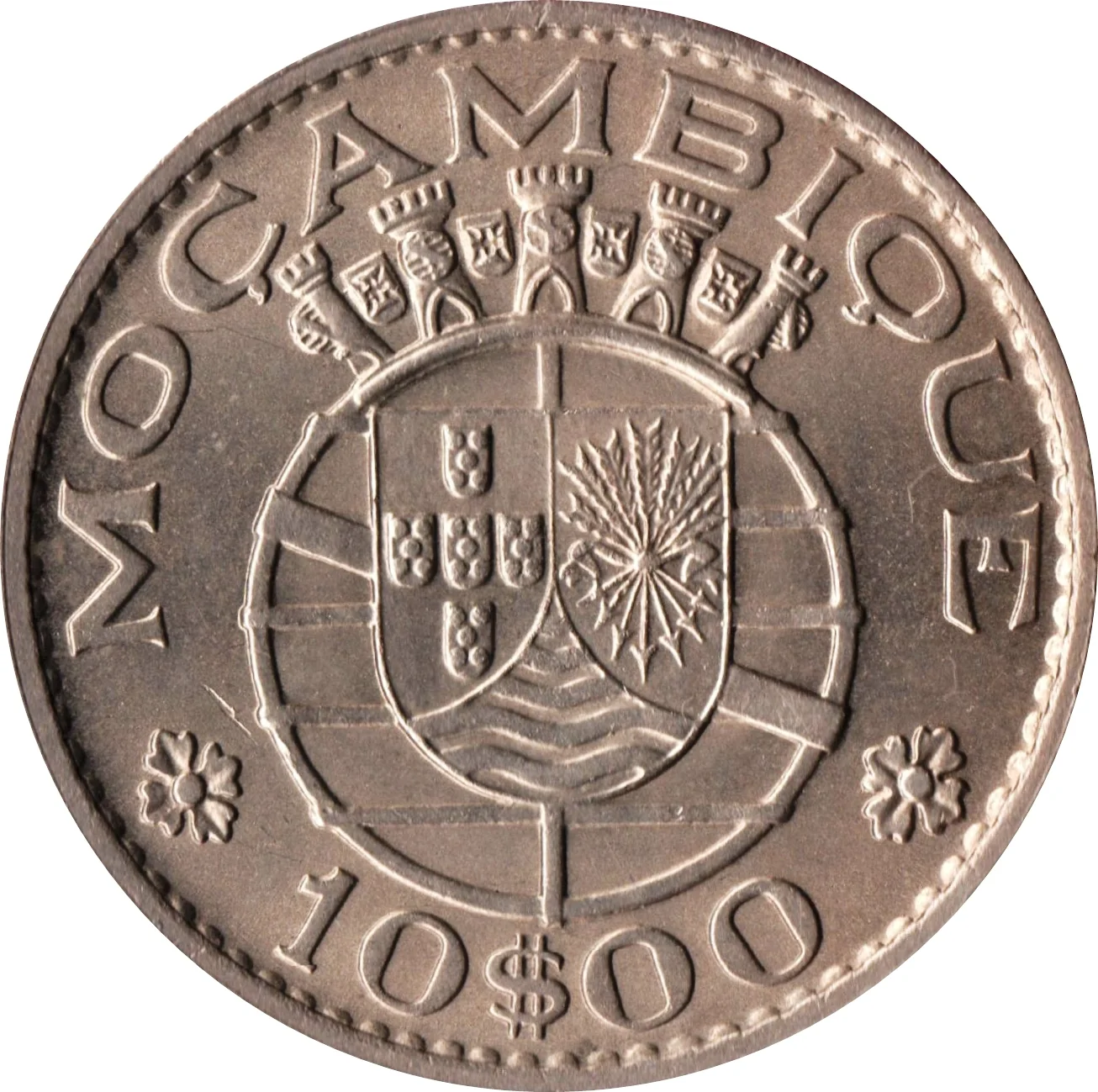
Obverse
Description:
Portuguese coat of arms on crowned globe, value below.
Inscription:
MOÇAMBIQUE
10$00
10$00
Translation:
MOZAMBIQUE
10.00 Meticais
10.00 Meticais
Script: Latin
Language: Portuguese
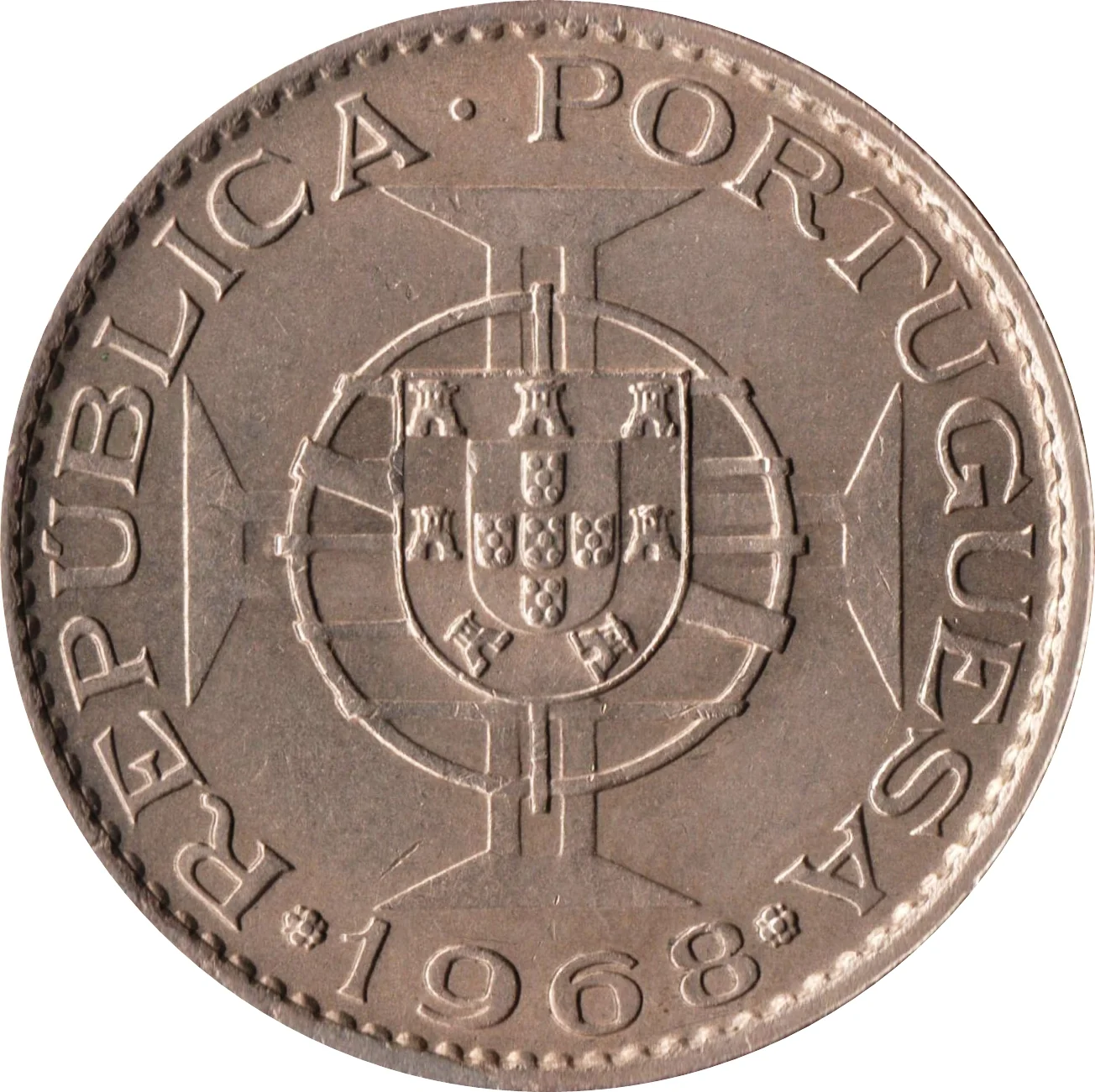
Reverse
Description:
Portuguese coat of arms on a globe over a cross, with date below.
Inscription:
REPÚBLICA·PORTUGUESA
·1968·
·1968·
Translation:
PORTUGUESE REPUBLIC
·1968·
·1968·
Script: Latin
Language: Portuguese
Edge
Reeded
Mintings
| Year | Mint Mark | Mintage | Quality | Collection |
|---|---|---|---|---|
| 1968 | — | 5,000,000 | ||
| 1970 | — | 4,000,000 | ||
| 1974 | — | 3,366,000 |
Historical background
In 1968, Mozambique, then known as the Overseas Province of Mozambique under Portuguese colonial rule, operated within a tightly controlled monetary system dictated by Lisbon. The official currency was the Portuguese escudo (PTE), which circulated interchangeably with the Mozambican escudo (MZE) at a fixed 1:1 parity. This arrangement was managed by the Bank of Portugal and the locally active Bank of Angola (Banco de Angola), which issued the Mozambican notes, firmly integrating the colony's economy into Portugal's broader "escudo area." The primary function of this system was to facilitate the extraction of resources and capital to the metropole while financing the colonial administration and infrastructure projects that served Portuguese interests.
The currency regime existed against the backdrop of the escalating War of Independence, which had begun in 1964. The conflict, led by the Mozambique Liberation Front (FRELIMO), created significant economic strain and geographic fragmentation. While the escudo remained stable and legal tender in Portuguese-controlled urban centers and the south, its practical authority was challenged in rural and northern war zones. Military spending drained Lisbon's resources, and the war disrupted key agricultural exports, such as cotton and cashews, which were vital for earning foreign exchange. Nevertheless, Portugal's authoritarian Estado Novo regime maintained strict capital controls and fixed exchange rates to project an image of stability and normalcy.
Consequently, the monetary situation in 1968 was one of superficial colonial control masking underlying fragility. The escudo's fixed parity and integration with Portugal provided stability for Portuguese settlers and companies involved in export sectors. However, this stability was artificial, dependent on Lisbon's subsidies and military expenditure, and increasingly disconnected from the realities of a territory engulfed in a war for independence. The system would remain in place until the 1974 Carnation Revolution in Portugal, which led to Mozambique's independence in 1975 and the subsequent introduction of the metical as a symbol of national sovereignty.
The currency regime existed against the backdrop of the escalating War of Independence, which had begun in 1964. The conflict, led by the Mozambique Liberation Front (FRELIMO), created significant economic strain and geographic fragmentation. While the escudo remained stable and legal tender in Portuguese-controlled urban centers and the south, its practical authority was challenged in rural and northern war zones. Military spending drained Lisbon's resources, and the war disrupted key agricultural exports, such as cotton and cashews, which were vital for earning foreign exchange. Nevertheless, Portugal's authoritarian Estado Novo regime maintained strict capital controls and fixed exchange rates to project an image of stability and normalcy.
Consequently, the monetary situation in 1968 was one of superficial colonial control masking underlying fragility. The escudo's fixed parity and integration with Portugal provided stability for Portuguese settlers and companies involved in export sectors. However, this stability was artificial, dependent on Lisbon's subsidies and military expenditure, and increasingly disconnected from the realities of a territory engulfed in a war for independence. The system would remain in place until the 1974 Carnation Revolution in Portugal, which led to Mozambique's independence in 1975 and the subsequent introduction of the metical as a symbol of national sovereignty.
🌱 Very Common