

1 denar (Food and Agriculture Organization) – North Macedonia
Add to wishlist
Circulating commemorative coins
Commemoration: 50th Anniversary of the Food and Agriculture Organization
North Macedonia
Context
Year: 1995
Issuer: North Macedonia
Period:
(since 1993)
Currency:
(since 1993)
Total mintage: 1,001,000
Material
References
KM: #
Numista: #9218
Value
Exchange value: 1 MKD
Obverse
Description:
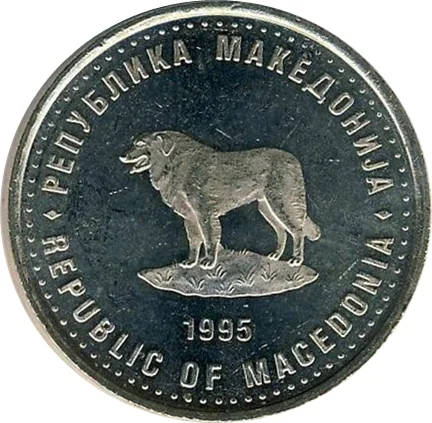
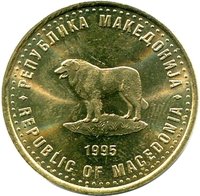
Macedonian sheepdog, date below.
Inscription:
РЕПУБЛИКА МАКЕДОНИЈА
1995
REPUBLIC OF MACEDONIA
1995
REPUBLIC OF MACEDONIA
Translation:
REPUBLIC OF MACEDONIA
1995
REPUBLIC OF MACEDONIA
1995
REPUBLIC OF MACEDONIA
Languages: English, Macedonian
Engraver: Biljana Unkovska
Reverse
Description:
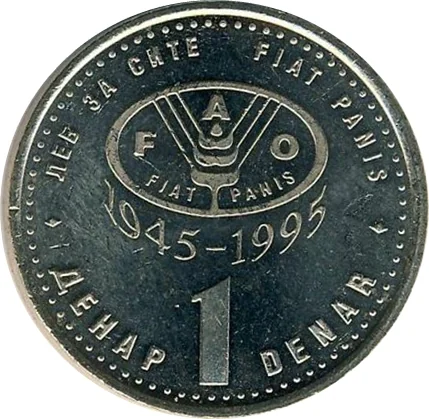
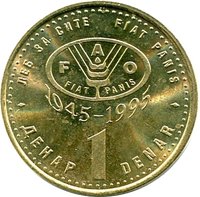
FAO emblem (wheat ear) with currency value, FAO's founding date, its 50th anniversary, and Latin and Cyrillic text.
Inscription:
FAO
1945-1995
1
DENAR FIAT PANIS
ДЕНАР ЛЕБ ЗА СИТЕ
1945-1995
1
DENAR FIAT PANIS
ДЕНАР ЛЕБ ЗА СИТЕ
Translation:
FAO
1945-1995
1
LET THERE BE BREAD DENAR
BREAD FOR ALL DENAR
1945-1995
1
LET THERE BE BREAD DENAR
BREAD FOR ALL DENAR
Languages: Macedonian, Latin
Engraver: Biljana Unkovska
Edge
Plain
Categories
| Animal> Dog |
| Organization> FAO |
Mints
| Name | Mark |
|---|---|
| Fabrika Suvenir | — |
Mintings
| Year | Mint Mark | Mintage | Quality | Collection |
|---|---|---|---|---|
| 1995 | — | 1,001,000 |
Historical background
In 1995, the Republic of Macedonia (as it was then named) was navigating a complex economic landscape in its early years of independence, with its currency situation defined by stability amidst external pressures. The country had introduced its own national currency, the Macedonian denar (MKD), in 1992 to replace the Yugoslav dinar, establishing the National Bank of the Republic of Macedonia (NBRM) as the central monetary authority. For its first three years, the denar operated under a managed float, but to combat high inflation and instill confidence, the NBRM made a pivotal shift in 1995 by pegging the denar to the German Deutsche Mark (DEM), the anchor currency of Europe at the time.
This pegging policy was the cornerstone of Macedonia's monetary strategy in 1995, aimed at providing a nominal anchor to control inflation, which had been a severe problem during the post-Yugoslav transition. The fixed exchange rate regime successfully imported monetary discipline and helped stabilize prices, fostering greater predictability for trade and investment. However, maintaining the peg required significant foreign currency reserves and constrained the central bank's ability to use monetary policy for domestic stimulus, as interest rates were largely aligned to defend the currency's value against the strong Deutsche Mark.
The broader context of 1995 was also dominated by a major external political and economic event: the Greek economic embargo. Imposed in 1994 over the dispute regarding the country's name, the blockade severely disrupted Macedonia's trade and access to the port of Thessaloniki, its primary maritime outlet. This external shock created balance-of-payments challenges and put additional strain on the economy, testing the resilience of the new currency peg. Therefore, while the denar itself was institutionally stable by 1995, the national economy operating with it faced significant headwinds, navigating between a disciplined monetary framework and a difficult geopolitical reality.
This pegging policy was the cornerstone of Macedonia's monetary strategy in 1995, aimed at providing a nominal anchor to control inflation, which had been a severe problem during the post-Yugoslav transition. The fixed exchange rate regime successfully imported monetary discipline and helped stabilize prices, fostering greater predictability for trade and investment. However, maintaining the peg required significant foreign currency reserves and constrained the central bank's ability to use monetary policy for domestic stimulus, as interest rates were largely aligned to defend the currency's value against the strong Deutsche Mark.
The broader context of 1995 was also dominated by a major external political and economic event: the Greek economic embargo. Imposed in 1994 over the dispute regarding the country's name, the blockade severely disrupted Macedonia's trade and access to the port of Thessaloniki, its primary maritime outlet. This external shock created balance-of-payments challenges and put additional strain on the economy, testing the resilience of the new currency peg. Therefore, while the denar itself was institutionally stable by 1995, the national economy operating with it faced significant headwinds, navigating between a disciplined monetary framework and a difficult geopolitical reality.
🌱 Common