

5 Euro – Italy
Non-circulating coins
Commemoration: Semester of Italian presidency of the Council of the European Union
Italy
Context
Material
References
KM: #Click to copy to clipboard371
Numista: #91984
Value
Exchange value: 5 EUR = $5.91
Bullion value: $47.65
Inflation-adjusted value: 6.05 EUR
Obverse
Description:
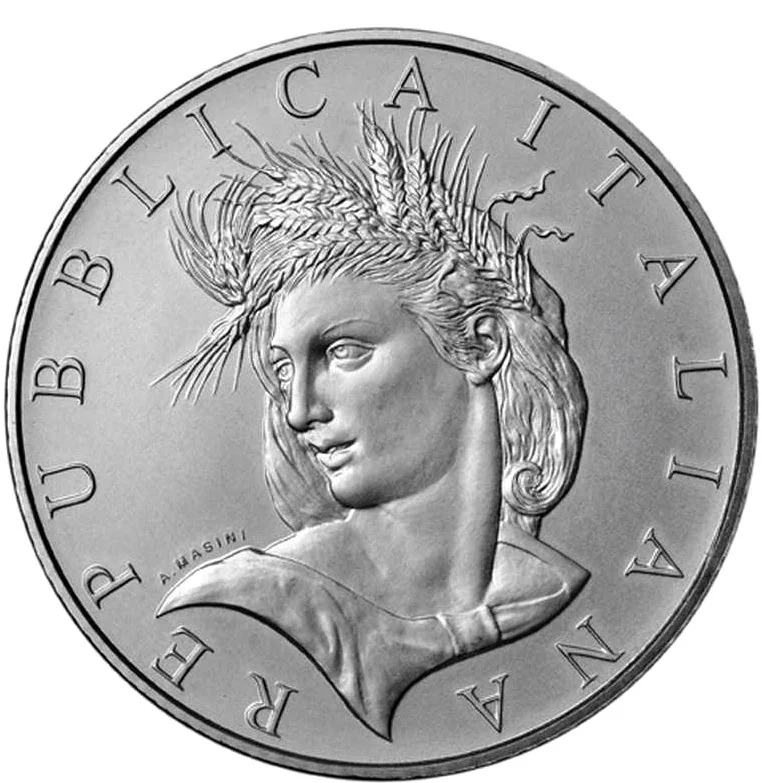
Bust of Ceres, allegorizing Italy, from the fresco "Venus, Juno and Ceres." The work, from Raphael's school after his designs for the Villa Farnesina, bears the author's name above her left shoulder.
Inscription:
REPUBBLICA ITALIANA
A.MASINI
A.MASINI
Translation:
Italian Republic
A.Masini
A.Masini
Script: Latin
Language: Italian
Engraver: Annalisa Masini
Reverse
Description:
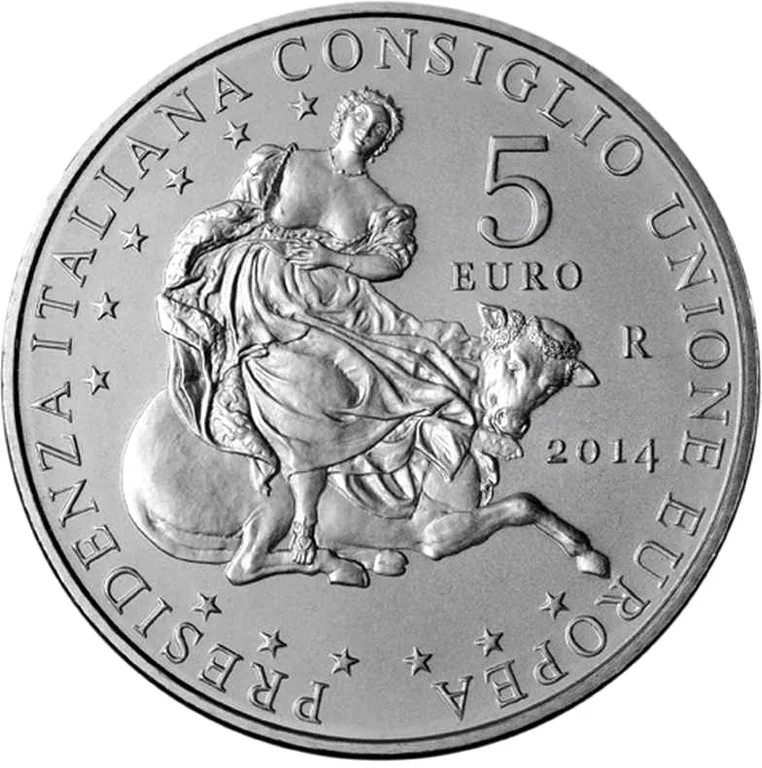
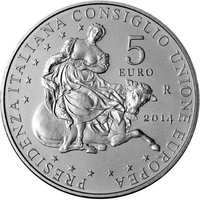
Veronese's "Abduction of Europa" detail (Capitoline Gallery, Rome), flanked by Europe's twelve stars at right. Value, date, and mintmark at left.
Inscription:
PRESIDENZA ITALIANA CONSIGLIO UNIONE EUROPEA
5
EURO
R
2014
5
EURO
R
2014
Translation:
Italian Presidency Council European Union
5
EURO
R
2014
5
EURO
R
2014
Script: Latin
Language: Italian
Engraver: Annalisa Masini
Edge
Continuous coarse milled.
Mints
| Name | Mark |
|---|---|
| Rome | R |
Mintings
| Year | Mint Mark | Mintage | Quality | Collection |
|---|---|---|---|---|
| 2014 | R | 4,500 | BU |
Historical background
In 2014, Italy’s currency situation was defined by its membership in the Eurozone, having adopted the euro (EUR) in 1999 (physically in 2002). The country was therefore subject to the monetary policy set by the European Central Bank (ECB), which focused on low inflation and price stability for the entire currency bloc. This framework removed Italy's ability to devalue its own currency or set independent interest rates, tools that could have been used to boost competitiveness during a period of economic stagnation. The primary financial context was the aftermath of the Eurozone sovereign debt crisis, with Italy under significant market pressure due to its massive public debt, which exceeded 130% of GDP.
Domestically, the currency situation was a point of political and public debate. The prolonged recession following the 2008 global financial crisis and the 2011-2012 debt crisis fueled a rise in euroscepticism. Some political figures and segments of the public questioned the benefits of the euro, arguing that the fixed exchange rate and tight monetary policy hampered Italy's recovery and export potential by keeping the currency stronger than a hypothetical reinstated lira might have been. However, a return to a national currency was widely seen as economically catastrophic, likely triggering capital flight, a debt crisis (as most debt was denominated in euros), and severe inflation.
The year 2014 saw a shift as the ECB, under new President Mario Draghi, moved toward more aggressive monetary stimulus to combat deflationary risks and support the fragile Eurozone economy. This included cutting key interest rates to historic lows and announcing plans for quantitative easing (QE), which was ultimately launched in early 2015. These actions helped lower Italy's sovereign borrowing costs and provided crucial liquidity, temporarily easing the immediate pressure on the currency union and offering Italy some breathing room for much-needed structural reforms, which remained largely unaddressed.
Domestically, the currency situation was a point of political and public debate. The prolonged recession following the 2008 global financial crisis and the 2011-2012 debt crisis fueled a rise in euroscepticism. Some political figures and segments of the public questioned the benefits of the euro, arguing that the fixed exchange rate and tight monetary policy hampered Italy's recovery and export potential by keeping the currency stronger than a hypothetical reinstated lira might have been. However, a return to a national currency was widely seen as economically catastrophic, likely triggering capital flight, a debt crisis (as most debt was denominated in euros), and severe inflation.
The year 2014 saw a shift as the ECB, under new President Mario Draghi, moved toward more aggressive monetary stimulus to combat deflationary risks and support the fragile Eurozone economy. This included cutting key interest rates to historic lows and announcing plans for quantitative easing (QE), which was ultimately launched in early 2015. These actions helped lower Italy's sovereign borrowing costs and provided crucial liquidity, temporarily easing the immediate pressure on the currency union and offering Italy some breathing room for much-needed structural reforms, which remained largely unaddressed.
💎 Extremely Rare