

50 Dirhams (Securities and Commodities Authority) – United Arab Emirates
Non-circulating coins
Commemoration: The 10th Anniversary of the Securities and Commodities Authority
United Arab Emirates
Context
Year: 2010
Issuer: United Arab Emirates 
Ruler: Khalifa bin Zayed Al Nahyan
Currency:
(since 1973)
Total mintage: 2,000
Material
References
Numista: #91967
Value
Exchange value: 50 AED
Bullion value: $107.32
Obverse
Description:
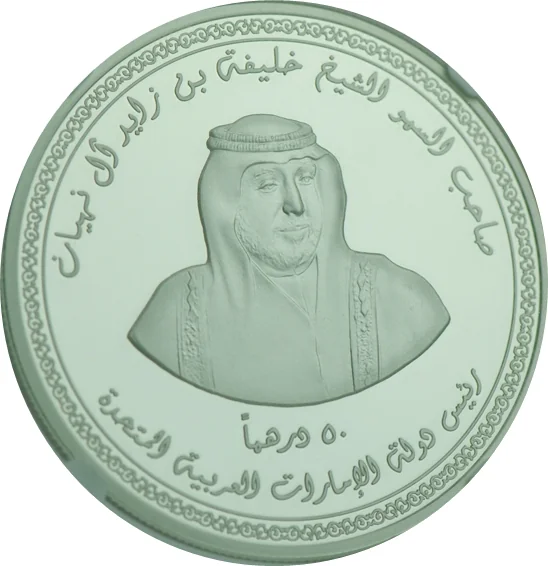
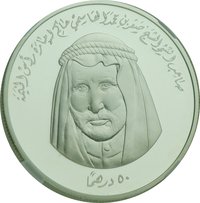
Bust of Sheikh Khalifa bin Zayed Al Nahyan, turned slightly right.
Inscription:
صاحب السمو الشيخ خليفة بن زايد آل نهيان
٥٠ درهماً
رئيس دولة الإمارات العربية المتحدة
٥٠ درهماً
رئيس دولة الإمارات العربية المتحدة
Translation:
His Highness Sheikh Khalifa bin Zayed Al Nahyan
50 Dirhams
President of the United Arab Emirates
50 Dirhams
President of the United Arab Emirates
Script: Arabic
Language: Arabic
Reverse
Description:
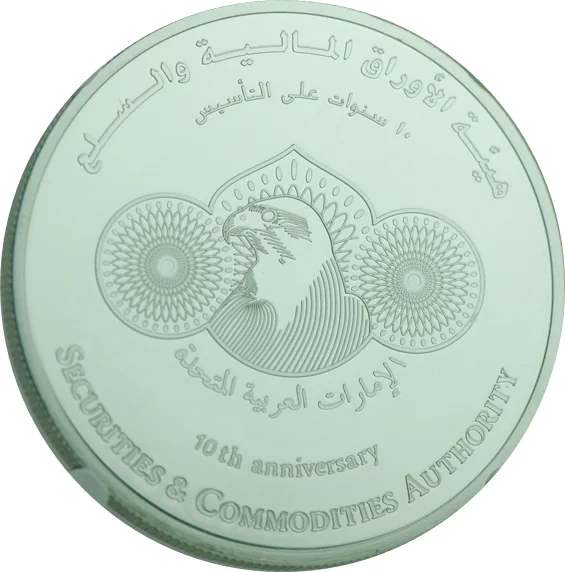
Securities and Commodities Authority logo
Inscription:
هيئة الأوراق المالية والسلع
١٠ سنوات على التأسيس
الإمارات العربية المتحدة
10th anniversary
SECURITIES & COMMODITIES AUTHORITY
١٠ سنوات على التأسيس
الإمارات العربية المتحدة
10th anniversary
SECURITIES & COMMODITIES AUTHORITY
Translation:
Securities and Commodities Authority
10 Years Since Establishment
United Arab Emirates
10th Anniversary
SECURITIES & COMMODITIES AUTHORITY
10 Years Since Establishment
United Arab Emirates
10th Anniversary
SECURITIES & COMMODITIES AUTHORITY
Language: Arabic
Edge
Reeded
Mintings
| Year | Mint Mark | Mintage | Quality | Collection |
|---|---|---|---|---|
| 2010 | — | 2,000 | Proof |
Historical background
In 2010, the currency situation in the United Arab Emirates remained firmly anchored to the US Dollar, a policy established in the late 1970s. The UAE dirham (AED) was pegged at a fixed rate of approximately 3.6725 dirhams to one dollar. This peg provided significant stability, fostering confidence for foreign investment and trade in a nation heavily reliant on imports and international finance. It was a cornerstone of the economic policy, particularly for Dubai and Abu Dhabi, insulating the local currency from volatile oil price swings and aligning the UAE's monetary policy with that of the United States.
However, the period leading up to 2010 was not without currency-related challenges. The global financial crisis of 2007-2008 and the subsequent Dubai World debt crisis in late 2009 placed the peg under intense market scrutiny. Speculation arose about a potential revaluation or even a devaluation of the dirham, as pressure mounted due to lower oil prices and regional economic stress. Despite this, the UAE Central Bank, backed by the substantial hydrocarbon wealth of Abu Dhabi, forcefully reaffirmed its commitment to the dollar peg, which remained unwavering throughout 2010.
Consequently, by 2010, the currency landscape was one of restored calm and reinforced stability. The successful navigation of the debt crisis had demonstrated the resilience of the peg and the federal commitment to it. The primary monetary policy focus for the UAE that year was therefore not on the exchange rate itself, but on managing the domestic implications of the dollar link—namely, importing the US Federal Reserve's low interest rates, which contributed to asset inflation and high liquidity within the local economy. The dollar peg was firmly re-established as an immutable feature of the UAE's financial framework.
However, the period leading up to 2010 was not without currency-related challenges. The global financial crisis of 2007-2008 and the subsequent Dubai World debt crisis in late 2009 placed the peg under intense market scrutiny. Speculation arose about a potential revaluation or even a devaluation of the dirham, as pressure mounted due to lower oil prices and regional economic stress. Despite this, the UAE Central Bank, backed by the substantial hydrocarbon wealth of Abu Dhabi, forcefully reaffirmed its commitment to the dollar peg, which remained unwavering throughout 2010.
Consequently, by 2010, the currency landscape was one of restored calm and reinforced stability. The successful navigation of the debt crisis had demonstrated the resilience of the peg and the federal commitment to it. The primary monetary policy focus for the UAE that year was therefore not on the exchange rate itself, but on managing the domestic implications of the dollar link—namely, importing the US Federal Reserve's low interest rates, which contributed to asset inflation and high liquidity within the local economy. The dollar peg was firmly re-established as an immutable feature of the UAE's financial framework.
✨ Legendary