

1000 dirhams – United Arab Emirates
Add to wishlist
Non-circulating coins
Commemoration: Commemoration of Late His Highness Sheikh Zayed bin Sultan Al Nahyan
United Arab Emirates
Context
Year: 2004
Issuer: United Arab Emirates
Ruler: Khalifa bin Zayed Al Nahyan
Currency:
(since 1973)
Total mintage: 2,000
Material
References
Numista: #91942
Value
Exchange value: 1000 AED
Bullion value: $5632.65
Obverse
Description:
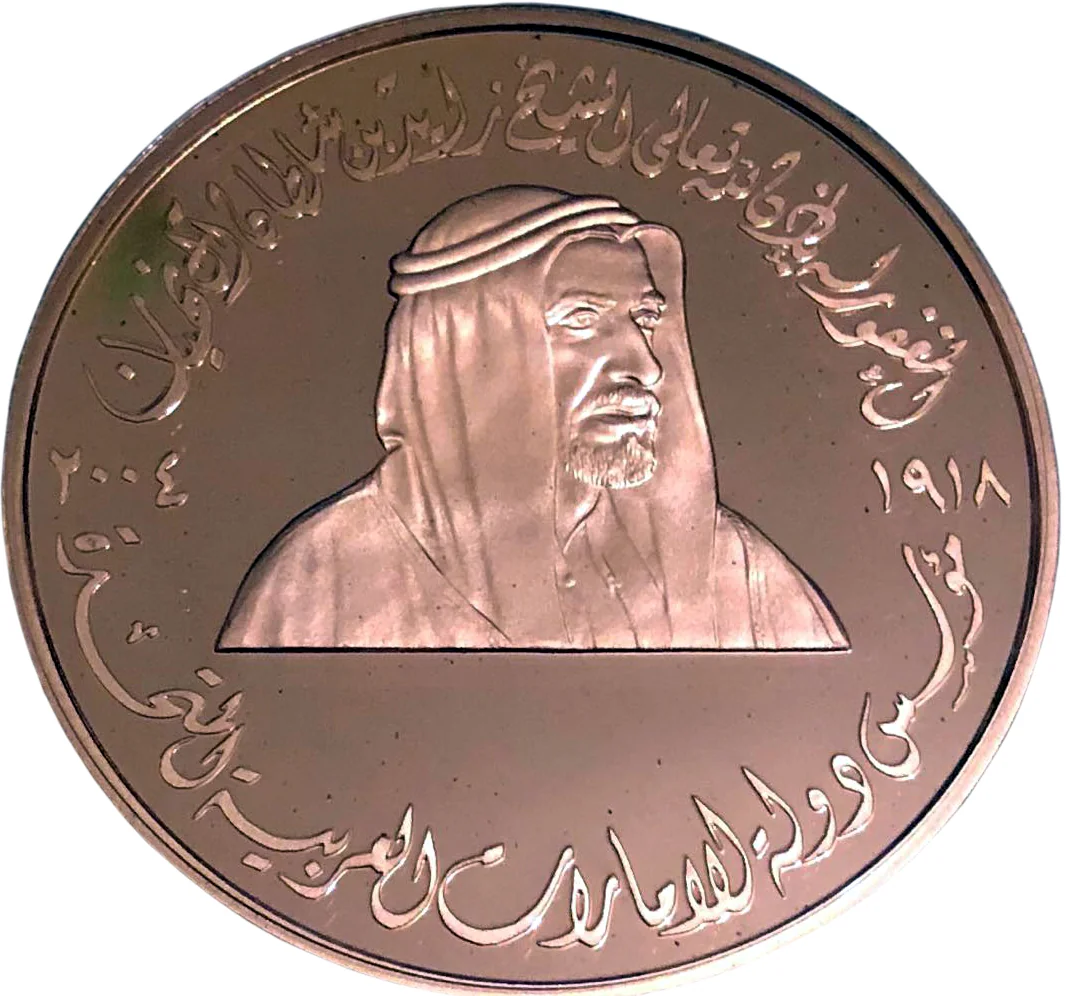
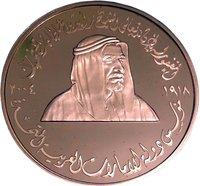
Sheikh Zayed bust, facing right. No denomination.
Inscription:
المغفور له بإذن الله تعالى الشيخ زايد بن سُلطان آل نهيان
١٩١٨ ٢٠٠٤
مؤسس دولة الامارات العربية المتحدة
١٩١٨ ٢٠٠٤
مؤسس دولة الامارات العربية المتحدة
Translation:
The late, by the permission of God Almighty, Sheikh Zayed bin Sultan Al Nahyan
1918 2004
Founder of the United Arab Emirates
1918 2004
Founder of the United Arab Emirates
Script: Arabic
Language: Arabic
Reverse
Edge
Reeded
Mintings
| Year | Mint Mark | Mintage | Quality | Collection |
|---|---|---|---|---|
| 2004 | — | 2,000 | Proof |
Historical background
In 2004, the currency situation in the United Arab Emirates was defined by its long-standing and stable peg to the United States Dollar. This policy, formally established in 1997, fixed the UAE Dirham (AED) at a rate of approximately 3.6725 per USD. This peg was a cornerstone of the country's economic policy, providing crucial stability for an economy heavily reliant on oil exports (priced in dollars) and foreign investment, while also anchoring low inflation and facilitating international trade and finance.
The context of 2004, however, was marked by growing regional debate and external pressures. With the US Federal Reserve maintaining low interest rates to stimulate the economy, the UAE and other Gulf Cooperation Council (GCC) states were effectively importing an accommodative monetary policy that was increasingly misaligned with their own booming, oil-fueled economies. This contributed to rising domestic inflation and asset prices, particularly in real estate, while diminishing the returns on local currency deposits. Furthermore, there was public discussion about the potential for a collective GCC currency union, which was then targeted for 2010, raising questions about the future of the individual dollar pegs.
Consequently, while the peg itself remained unwavering and unquestioned in its immediate application throughout 2004, it was a period of underlying economic tension and forward-looking policy discussion. The UAE authorities consistently reaffirmed their commitment to the dollar peg as a source of stability, even as economists began to more openly weigh its costs against its benefits. The situation set the stage for subsequent years of increasing inflationary pressure and intensified debate that would eventually lead the UAE to reaffirm its individual peg decisively when the GCC currency union project stalled.
The context of 2004, however, was marked by growing regional debate and external pressures. With the US Federal Reserve maintaining low interest rates to stimulate the economy, the UAE and other Gulf Cooperation Council (GCC) states were effectively importing an accommodative monetary policy that was increasingly misaligned with their own booming, oil-fueled economies. This contributed to rising domestic inflation and asset prices, particularly in real estate, while diminishing the returns on local currency deposits. Furthermore, there was public discussion about the potential for a collective GCC currency union, which was then targeted for 2010, raising questions about the future of the individual dollar pegs.
Consequently, while the peg itself remained unwavering and unquestioned in its immediate application throughout 2004, it was a period of underlying economic tension and forward-looking policy discussion. The UAE authorities consistently reaffirmed their commitment to the dollar peg as a source of stability, even as economists began to more openly weigh its costs against its benefits. The situation set the stage for subsequent years of increasing inflationary pressure and intensified debate that would eventually lead the UAE to reaffirm its individual peg decisively when the GCC currency union project stalled.
✨ Legendary