

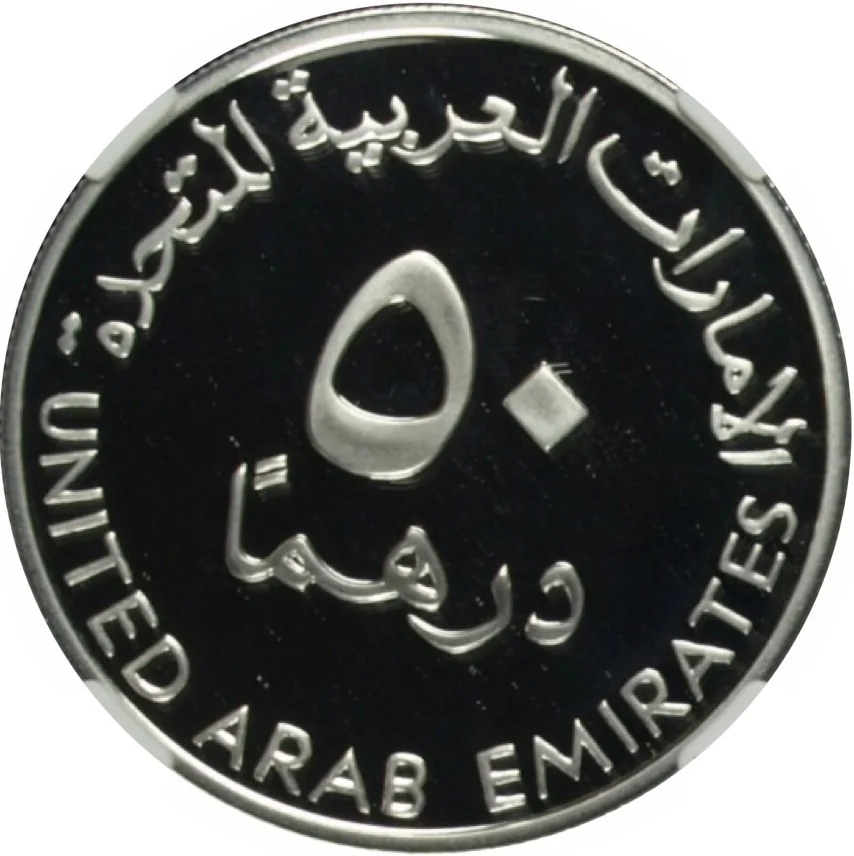
50 dirhams – United Arab Emirates
Add to wishlist
Non-circulating coins
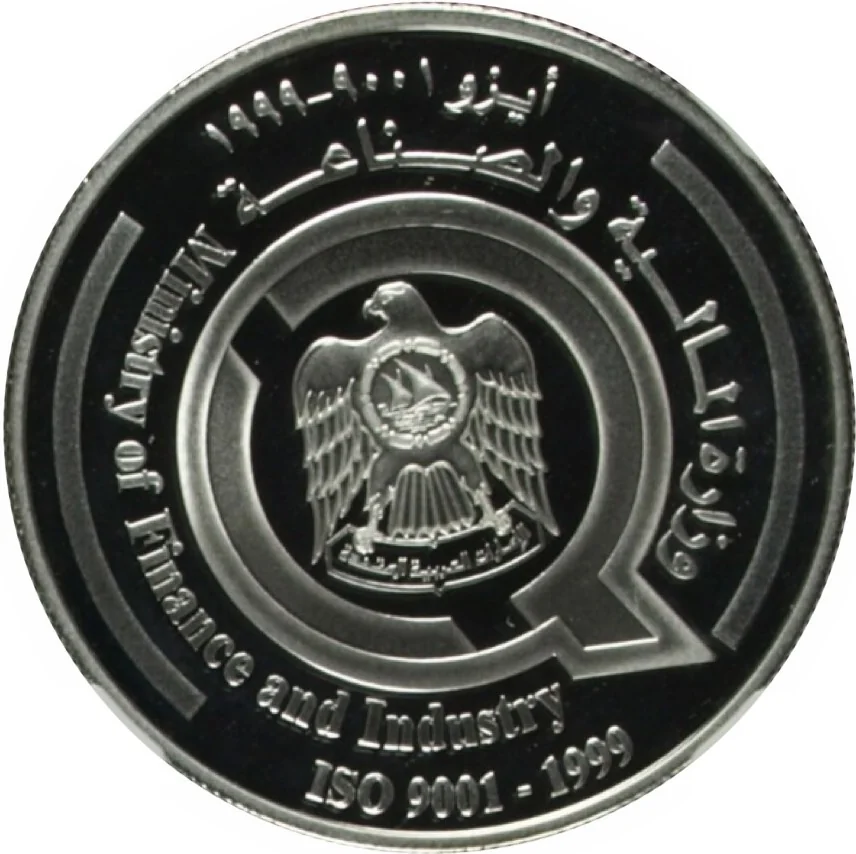
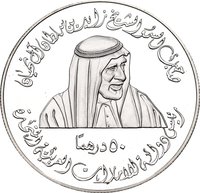
Commemoration: Granting of the Ministry of Finance and Industry the Quality Certificate (ISO-9001) for the Year 1999
United Arab Emirates
Context
Year: 1999
Issuer: United Arab Emirates
Ruler: Zayed bin Sultan Al Nahyan
Currency:
(since 1973)
Total mintage: 3,000
Material
References
KM: #
Numista: #91909
Value
Exchange value: 50 AED
Bullion value: $93.81
Obverse
Reverse
Description:
The former UAE emblem features Saladin's falcon holding a disk with an Arab sailboat, encircled by a chain. Its talons grip a parchment bearing the federation's name in Kufic script.
Inscription:
أيزو ٩٠٠١-١٩٩٩
وزارة المالية والصناعة
[الامارات العربية المتحدة]
Ministry of Finance and Industry
ISO 9001 - 1999
وزارة المالية والصناعة
[الامارات العربية المتحدة]
Ministry of Finance and Industry
ISO 9001 - 1999
Translation:
ISO 9001-1999
Ministry of Finance and Industry
[United Arab Emirates]
Ministry of Finance and Industry
ISO 9001 - 1999
Ministry of Finance and Industry
[United Arab Emirates]
Ministry of Finance and Industry
ISO 9001 - 1999
Language: Arabic
Edge
Reeded
Mintings
| Year | Mint Mark | Mintage | Quality | Collection |
|---|---|---|---|---|
| 1999 | — | 3,000 | Proof |
Historical background
In 1999, the United Arab Emirates' currency situation was defined by stability and a firm, long-standing peg to a foreign benchmark. Since 1978, the UAE dirham (AED) had been officially fixed to the International Monetary Fund's Special Drawing Rights (SDR), a basket of major currencies. However, in practice, for over two decades, it was effectively and unofficially pegged to the United States dollar at a steady rate of approximately AED 3.67 per USD 1. This dollar linkage provided crucial stability for the UAE's open, trade-dependent economy, anchoring inflation and simplifying transactions in key sectors like oil exports and international finance.
This monetary policy was a cornerstone of the country's rapid development strategy. The fixed exchange rate eliminated currency risk for foreign investors and businesses, fostering the massive capital inflows that were fueling the diversification and infrastructure boom visible in cities like Dubai and Abu Dhabi. It also provided a predictable environment for the large expatriate workforce, whose remittances were a significant outflow. The system was managed by the UAE Central Bank, which held substantial foreign currency reserves, primarily in US dollars, to maintain the peg with full credibility.
There was no serious public debate or pressure to alter this arrangement in 1999. The economy was benefiting from a recovery in oil prices after the 1998 slump, reinforcing the viability of the peg. While the upcoming launch of the euro in January 1999 prompted global financial discussions, it did not immediately challenge the dirham's dollar orientation. The prevailing consensus among policymakers and economic actors was that the dollar peg had served the federation well, providing a bedrock of financial stability during its dramatic transformation, and there was no impetus for change as the country approached the new millennium.
This monetary policy was a cornerstone of the country's rapid development strategy. The fixed exchange rate eliminated currency risk for foreign investors and businesses, fostering the massive capital inflows that were fueling the diversification and infrastructure boom visible in cities like Dubai and Abu Dhabi. It also provided a predictable environment for the large expatriate workforce, whose remittances were a significant outflow. The system was managed by the UAE Central Bank, which held substantial foreign currency reserves, primarily in US dollars, to maintain the peg with full credibility.
There was no serious public debate or pressure to alter this arrangement in 1999. The economy was benefiting from a recovery in oil prices after the 1998 slump, reinforcing the viability of the peg. While the upcoming launch of the euro in January 1999 prompted global financial discussions, it did not immediately challenge the dirham's dollar orientation. The prevailing consensus among policymakers and economic actors was that the dollar peg had served the federation well, providing a bedrock of financial stability during its dramatic transformation, and there was no impetus for change as the country approached the new millennium.
✨ Legendary