

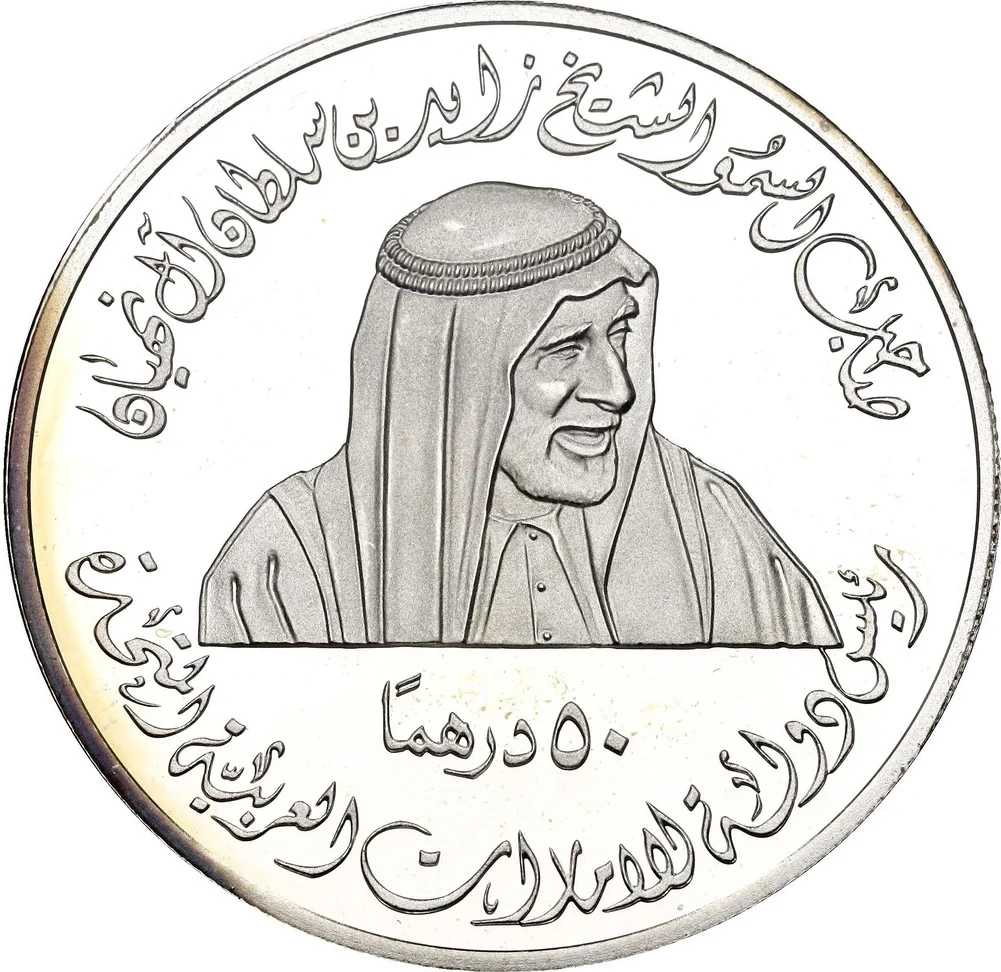

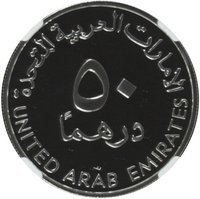
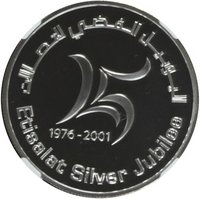
50 dirhams (Al Ain National Museum) – United Arab Emirates
Add to wishlist
Non-circulating coins
Commemoration: The 30th Anniversary of Al Ain National Museum
United Arab Emirates
Context
Year: 2001
Issuer: United Arab Emirates
Ruler: Zayed bin Sultan Al Nahyan
Currency:
(since 1973)
Total mintage: 5,000
Material

References
KM: #
Numista: #91903
Value
Exchange value: 50 AED
Bullion value: $92.88
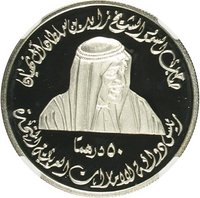
Obverse
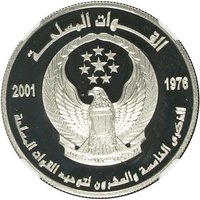
Reverse
Edge
Reeded
Mintings
| Year | Mint Mark | Mintage | Quality | Collection |
|---|---|---|---|---|
| 2001 | — | 5,000 | Proof |
Historical background
In 2001, the currency situation in the United Arab Emirates was defined by its long-standing and unwavering peg to the United States Dollar. This fixed exchange rate regime, established in 1978, set the value of the UAE Dirham (AED) at approximately 3.6725 per USD. This policy was a cornerstone of the country's economic strategy, providing critical stability for an economy heavily reliant on hydrocarbon exports, which are priced in dollars. The peg ensured predictable exchange rates, minimized transaction costs, and fostered a favorable environment for foreign investment and trade, which was particularly important as Dubai accelerated its transformation into a global commercial hub.
The monetary system operated under the auspices of the UAE Currency Board, which was established in 1973. However, a significant institutional evolution was on the horizon in 2001. Plans were advanced to establish a more robust central banking institution, leading to the creation of the Central Bank of the United Arab Emirates in late 1980, which would formally begin operations in 1981. The Currency Board's primary function was to maintain the dollar peg, which it managed by holding substantial foreign exchange reserves, primarily in US dollars, to back the dirham in circulation and ensure full convertibility.
This dollar peg, while a source of stability, also meant that the UAE's monetary policy was effectively imported from the United States Federal Reserve. In 2001, this linkage was beneficial, as the UAE indirectly benefited from the Fed's interest rate cuts implemented to counteract the US economic slowdown and the aftermath of the September 11 attacks. There was no serious domestic debate about abandoning the peg; it was widely viewed as an essential anchor for the economy. The policy choice underscored the UAE's strategic orientation towards global markets and its prioritization of macroeconomic stability over independent monetary tools, a stance that remained firmly in place throughout the year and beyond.
The monetary system operated under the auspices of the UAE Currency Board, which was established in 1973. However, a significant institutional evolution was on the horizon in 2001. Plans were advanced to establish a more robust central banking institution, leading to the creation of the Central Bank of the United Arab Emirates in late 1980, which would formally begin operations in 1981. The Currency Board's primary function was to maintain the dollar peg, which it managed by holding substantial foreign exchange reserves, primarily in US dollars, to back the dirham in circulation and ensure full convertibility.
This dollar peg, while a source of stability, also meant that the UAE's monetary policy was effectively imported from the United States Federal Reserve. In 2001, this linkage was beneficial, as the UAE indirectly benefited from the Fed's interest rate cuts implemented to counteract the US economic slowdown and the aftermath of the September 11 attacks. There was no serious domestic debate about abandoning the peg; it was widely viewed as an essential anchor for the economy. The policy choice underscored the UAE's strategic orientation towards global markets and its prioritization of macroeconomic stability over independent monetary tools, a stance that remained firmly in place throughout the year and beyond.
💎 Extremely Rare