

500 dirhams – United Arab Emirates
Add to wishlist
Non-circulating coins
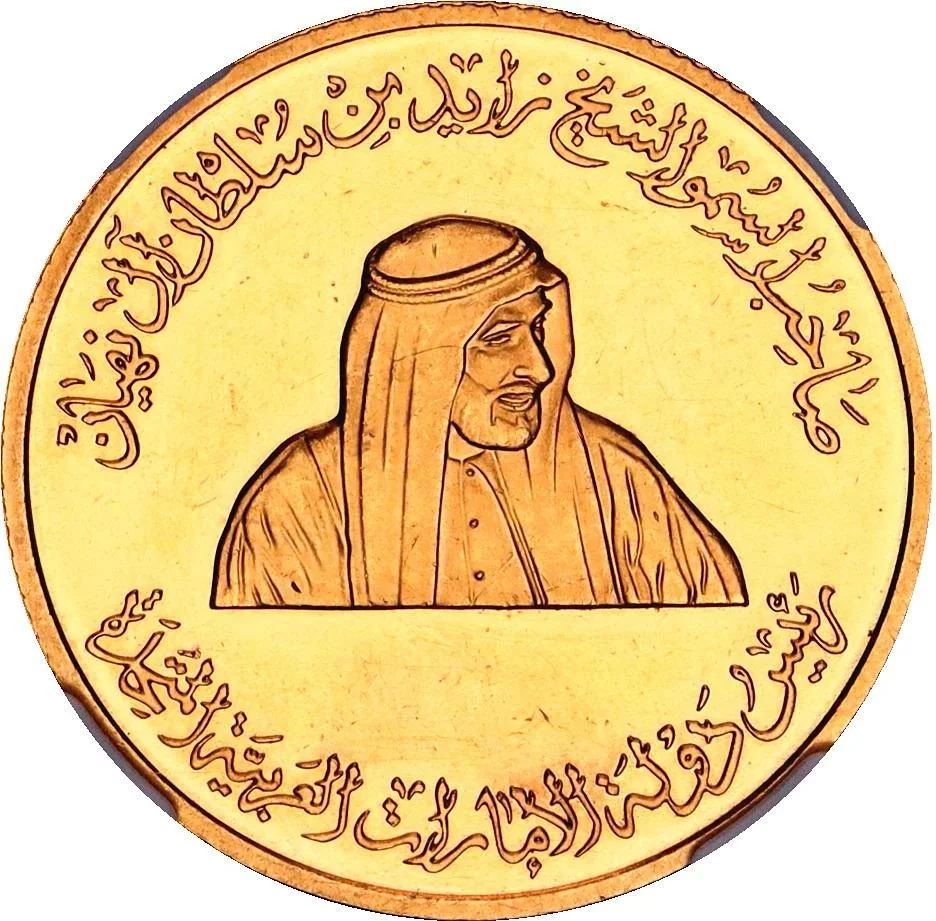
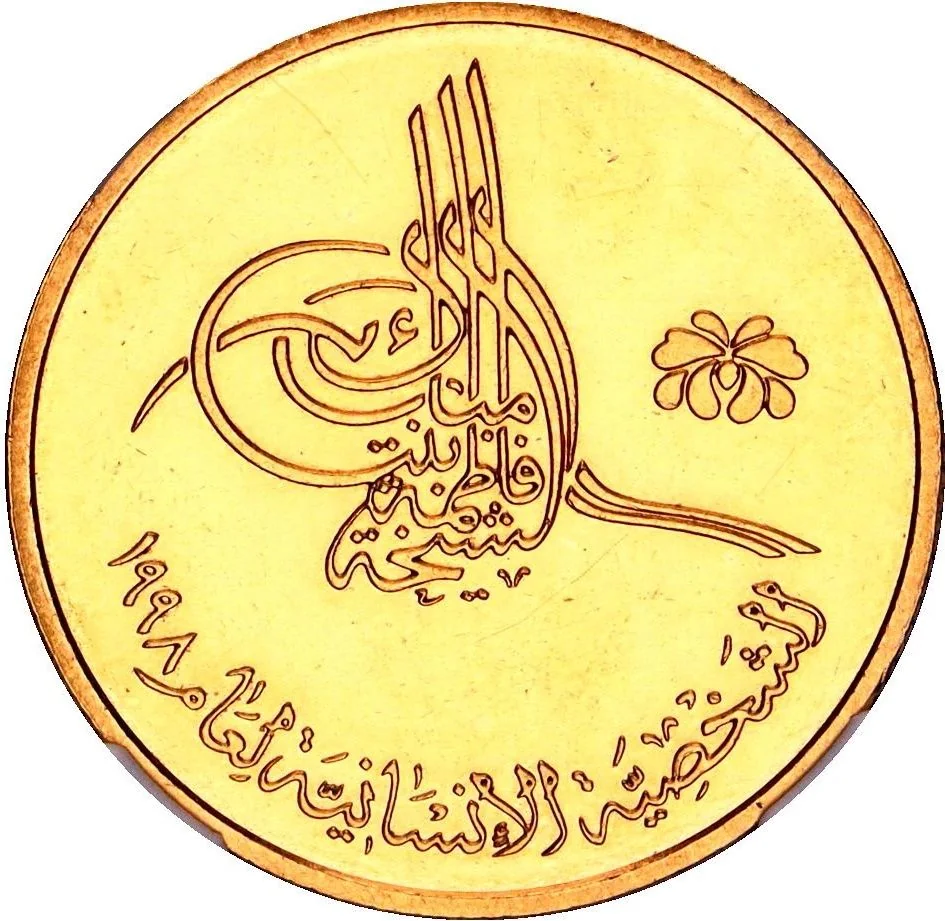
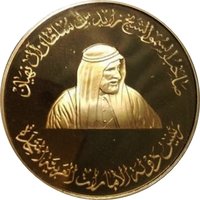
Commemoration: Selection of Her Highness Sheikha Fatima bint Mubarak as the Humanitarian Personality for 1998
United Arab Emirates
Context
Year: 1998
Issuer: United Arab Emirates
Ruler: Zayed bin Sultan Al Nahyan
Currency:
(since 1973)
Total mintage: 1,000
Material
References
Numista: #91878
Value
Exchange value: 500 AED
Bullion value: $2812.44
Obverse
Reverse
Description:
Tughra: a stylized royal signature in Ottoman calligraphy.
Inscription:
الشيخة فاطمة بنت مبارك
الشَخصِيَّة الإِنسَانيَّة لِعَام ١٩٩٨
الشَخصِيَّة الإِنسَانيَّة لِعَام ١٩٩٨
Translation:
Her Highness Fatima bint Mubarak
Humanitarian Personality of the Year 1998
Humanitarian Personality of the Year 1998
Scripts: Arabic, Arabic (tughra)
Language: Arabic
Edge
Reeded
Mintings
| Year | Mint Mark | Mintage | Quality | Collection |
|---|---|---|---|---|
| 1998 | — | 1,000 | Proof |
Historical background
In 1998, the currency situation in the United Arab Emirates was defined by a long-standing and unwavering peg of the UAE dirham (AED) to the US dollar. This fixed exchange rate regime, established in the late 1970s and formally pegged at AED 3.6725 per USD 1 since 1997, provided crucial stability for the oil-dependent economy. The peg anchored monetary policy, minimized exchange rate risk for foreign investors, and facilitated predictable pricing for the UAE's primary export: hydrocarbons. This was particularly significant in 1998, as the global economy was reeling from the Asian Financial Crisis, which had caused severe currency volatility across emerging markets.
The year 1998 presented a specific test for this peg due to a sharp decline in oil prices, which fell to around $10 per barrel—a stark drop that significantly pressured government revenues. Historically, such a shock would have strained a currency peg, potentially leading to devaluation discussions. However, the UAE's substantial financial reserves, accumulated during periods of higher oil prices, provided a robust buffer. The Central Bank of the UAE maintained the peg without deviation, using its reserves to defend the currency's value and demonstrating a deep institutional commitment to the dollar link. This action reinforced investor confidence during a period of regional economic uncertainty.
Consequently, the dominant narrative of 1998 was not one of currency crisis but of successful stability maintenance. The fixed peg proved its value as a stabilizing mechanism, insulating the domestic economy from the worst of the era's financial turbulence. This experience further cemented the policy consensus within the UAE that the dollar peg was essential for economic planning and integration into global trade, setting a course that would remain unchallenged for decades and support the nation's rapid diversification and growth in the following years.
The year 1998 presented a specific test for this peg due to a sharp decline in oil prices, which fell to around $10 per barrel—a stark drop that significantly pressured government revenues. Historically, such a shock would have strained a currency peg, potentially leading to devaluation discussions. However, the UAE's substantial financial reserves, accumulated during periods of higher oil prices, provided a robust buffer. The Central Bank of the UAE maintained the peg without deviation, using its reserves to defend the currency's value and demonstrating a deep institutional commitment to the dollar link. This action reinforced investor confidence during a period of regional economic uncertainty.
Consequently, the dominant narrative of 1998 was not one of currency crisis but of successful stability maintenance. The fixed peg proved its value as a stabilizing mechanism, insulating the domestic economy from the worst of the era's financial turbulence. This experience further cemented the policy consensus within the UAE that the dollar peg was essential for economic planning and integration into global trade, setting a course that would remain unchallenged for decades and support the nation's rapid diversification and growth in the following years.

✨ Legendary