

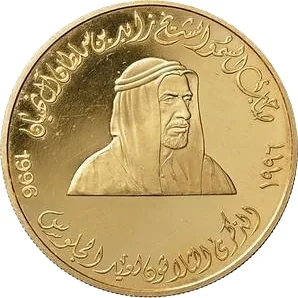
5000 Dirhams (Accession Day of Sheikh Zayed as Ruler of Abu Dhabi) – United Arab Emirates
Non-circulating coins
Commemoration: The 30th Anniversary of the Accession Day of President His Highness Sheikh Zayed bin Sultan Al Nahyan as Ruler of Abu Dhabi
United Arab Emirates
Context
Year: 1996
Issuer: United Arab Emirates 
Ruler: Zayed bin Sultan Al Nahyan
Currency:
(since 1973)
Total mintage: 1,000
Material
References
Numista: #91870
Value
Exchange value: 5000 AED
Bullion value: $30519.05
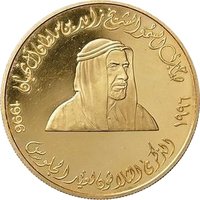
Obverse
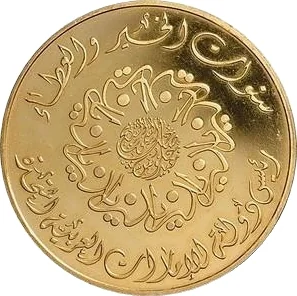
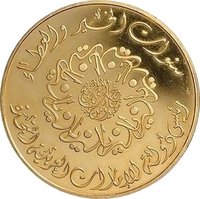
Reverse
Description:
Circular design. The inner Arabic circle reads "Accession day of His Highness Sheikh," surrounded by an outer circle with "Zayed" repeated eight times in Arabic.
Inscription:
سنوات الخَير والعطاء
عيد جُلوس صاحب السمو الشيخ]
[زايد زايد زايد زايد زايد زايد زايد زايد
رئيس دَولَة الإمارات العربيَّة المتحدَة
عيد جُلوس صاحب السمو الشيخ]
[زايد زايد زايد زايد زايد زايد زايد زايد
رئيس دَولَة الإمارات العربيَّة المتحدَة
Translation:
Years of Benevolence and Giving
Anniversary of the Accession of His Highness Sheikh
Zayed Zayed Zayed Zayed Zayed Zayed Zayed Zayed
President of the United Arab Emirates
Anniversary of the Accession of His Highness Sheikh
Zayed Zayed Zayed Zayed Zayed Zayed Zayed Zayed
President of the United Arab Emirates
Script: Arabic
Language: Arabic
Edge
Reeded
Mintings
| Year | Mint Mark | Mintage | Quality | Collection |
|---|---|---|---|---|
| 1996 | — | 1,000 | Proof |
Historical background
In 1996, the currency situation in the United Arab Emirates was one of notable stability and confidence, underpinned by the UAE Dirham's (AED) firm peg to the US Dollar. This peg, established in 1978 at a rate of approximately AED 3.6725 to USD 1, provided a crucial anchor for the booming economy, which was diversifying beyond oil into trade, tourism, and finance. The fixed exchange rate eliminated currency risk for foreign investors and importers, facilitated predictable fiscal planning for the government whose oil revenues were dollar-denominated, and supported the UAE's growing role as a global trading and re-export hub, particularly through ports like Dubai's Jebel Ali.
This monetary framework was managed by the UAE Central Bank, which maintained substantial foreign currency reserves to defend the peg. The system functioned smoothly, with the dirham's stability being a cornerstone of economic policy. There was no serious public debate or pressure to alter the arrangement, as it was widely seen as a key factor in the nation's rapid development and integration into the global economy. The currency's credibility was high, both domestically and internationally, with no parallel market or significant deviation from the official rate.
Looking at the broader regional context, 1996 fell within a period of quiet preparation for the future. While the Gulf Cooperation Council (GCC) had long discussed monetary union, concrete steps towards a single currency were still in early theoretical stages, with the UAE fully committed to its independent but dollar-linked dirham. Furthermore, the year preceded the impending 1997-98 Asian Financial Crisis, an event that would later test the resilience of pegged regimes worldwide but ultimately reinforce the UAE's commitment to its chosen monetary path due to the stability it provided during regional volatility.
This monetary framework was managed by the UAE Central Bank, which maintained substantial foreign currency reserves to defend the peg. The system functioned smoothly, with the dirham's stability being a cornerstone of economic policy. There was no serious public debate or pressure to alter the arrangement, as it was widely seen as a key factor in the nation's rapid development and integration into the global economy. The currency's credibility was high, both domestically and internationally, with no parallel market or significant deviation from the official rate.
Looking at the broader regional context, 1996 fell within a period of quiet preparation for the future. While the Gulf Cooperation Council (GCC) had long discussed monetary union, concrete steps towards a single currency were still in early theoretical stages, with the UAE fully committed to its independent but dollar-linked dirham. Furthermore, the year preceded the impending 1997-98 Asian Financial Crisis, an event that would later test the resilience of pegged regimes worldwide but ultimately reinforce the UAE's commitment to its chosen monetary path due to the stability it provided during regional volatility.
✨ Legendary