

50 dirhams (Arab League) – United Arab Emirates
Add to wishlist
Non-circulating coins
Commemoration: The 50th Anniversary of the Arab League
United Arab Emirates
Context
Year: 1995
Issuer: United Arab Emirates
Ruler: Zayed bin Sultan Al Nahyan
Currency:
(since 1973)
Total mintage: 2,000
Material
References
KM: #
Numista: #91867
Value
Exchange value: 50 AED
Bullion value: $92.88
Obverse
Description:
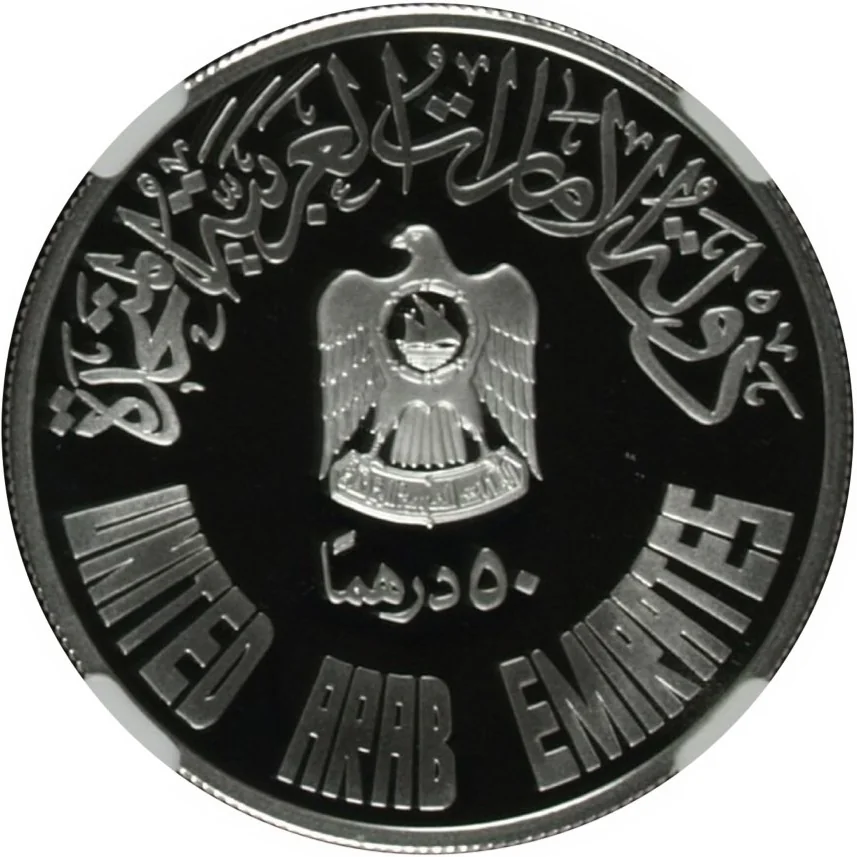
The former UAE emblem features Saladin's falcon holding a disk with an Arab sailboat, encircled by a chain. Its talons grip a parchment bearing the federation's name in Kufic script.
Inscription:
دَوْلَةُ الامَاراتُ العَرَبيَّةُ المتَحدَة
[الامارات العربية المتحدة]
٥٠ درهماً
UNITED ARAB EMIRATES
[الامارات العربية المتحدة]
٥٠ درهماً
UNITED ARAB EMIRATES
Translation:
State of the United Arab Emirates
[United Arab Emirates]
50 Dirhams
UNITED ARAB EMIRATES
[United Arab Emirates]
50 Dirhams
UNITED ARAB EMIRATES
Language: Arabic
Reverse
Description:
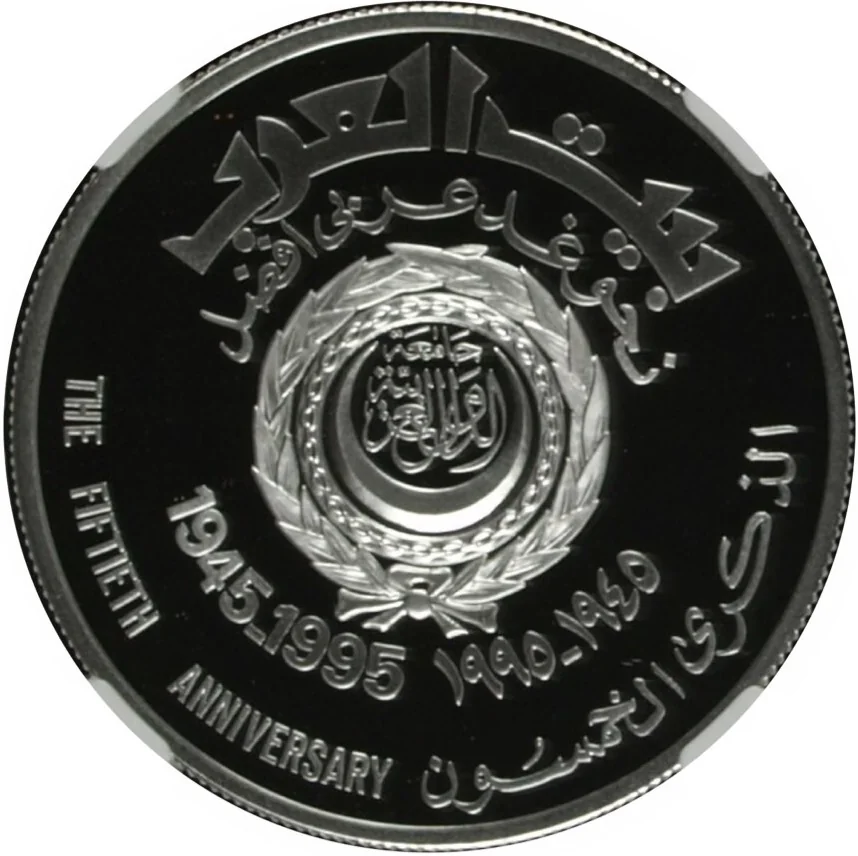
Arab League emblem
Inscription:
بيت العرب
نحو غد عربى افضل
جَامِعَة]
[ِالدوَلِ العَرَبِيَّة
1945-1995 ١٩٤٥-١٩٩٥
THE FIFTIETH ANNIVERSARY الذكرى الخمسُون
نحو غد عربى افضل
جَامِعَة]
[ِالدوَلِ العَرَبِيَّة
1945-1995 ١٩٤٥-١٩٩٥
THE FIFTIETH ANNIVERSARY الذكرى الخمسُون
Translation:
The Arab House
Towards a Better Arab Tomorrow
[The] League [of] Arab States
1945-1995
THE FIFTIETH ANNIVERSARY
Towards a Better Arab Tomorrow
[The] League [of] Arab States
1945-1995
THE FIFTIETH ANNIVERSARY
Language: Arabic
Edge
Reeded
Mintings
| Year | Mint Mark | Mintage | Quality | Collection |
|---|---|---|---|---|
| 1995 | — | 2,000 | Proof |
Historical background
In 1995, the currency situation in the United Arab Emirates was one of notable stability, underpinned by the UAE Dirham's firm peg to the US Dollar. This peg, established in 1978, fixed the exchange rate at approximately AED 3.67 per USD 1. This policy was a cornerstone of the country's economic framework, providing predictability for foreign trade and investment, which were vital for the UAE's rapidly diversifying, oil-dependent economy. The link to the dollar helped control inflation and facilitated the UAE's integration into the global financial system, particularly as the country positioned itself as a burgeoning hub for commerce and finance in the Gulf region.
The monetary system was managed by the UAE Central Bank, which maintained substantial foreign exchange reserves, primarily in US dollars, to defend the fixed parity. This period saw little to no speculative pressure on the dirham, as the economy was buoyed by steady oil revenues and growing confidence in the federation's political and economic direction following the 1990-91 Gulf War. The currency's stability was further reinforced by the UAE's membership in the Gulf Cooperation Council (GCC), where discussions about a potential common currency—inspired by the European Union—were in their early, conceptual stages.
Consequently, the currency landscape in 1995 was characterized by quiet confidence. There were no significant devaluations or exchange rate crises, unlike in some emerging markets of the era. The dirham functioned as a reliable medium of exchange and store of value domestically, while its dollar peg simplified transactions in the dominant hydrocarbons sector and the expanding import-export trade. This stable environment provided a solid financial foundation for the massive infrastructure projects and economic diversification efforts that would accelerate in the lead-up to the new millennium.
The monetary system was managed by the UAE Central Bank, which maintained substantial foreign exchange reserves, primarily in US dollars, to defend the fixed parity. This period saw little to no speculative pressure on the dirham, as the economy was buoyed by steady oil revenues and growing confidence in the federation's political and economic direction following the 1990-91 Gulf War. The currency's stability was further reinforced by the UAE's membership in the Gulf Cooperation Council (GCC), where discussions about a potential common currency—inspired by the European Union—were in their early, conceptual stages.
Consequently, the currency landscape in 1995 was characterized by quiet confidence. There were no significant devaluations or exchange rate crises, unlike in some emerging markets of the era. The dirham functioned as a reliable medium of exchange and store of value domestically, while its dollar peg simplified transactions in the dominant hydrocarbons sector and the expanding import-export trade. This stable environment provided a solid financial foundation for the massive infrastructure projects and economic diversification efforts that would accelerate in the lead-up to the new millennium.
✨ Legendary