

50 Dirhams – United Arab Emirates
Non-circulating coins
Commemoration: Commemoration of Late His Highness Sheikh Rashid bin Saeed Al Maktoum
United Arab Emirates
Context
Year: 1990
Issuer: United Arab Emirates 
Ruler: Zayed bin Sultan Al Nahyan
Currency:
(since 1973)
Total mintage: 4,000
Material
References
KM: #Click to copy to clipboard17
Numista: #91853
Value
Exchange value: 50 AED
Bullion value: $106.74
Obverse
Description:
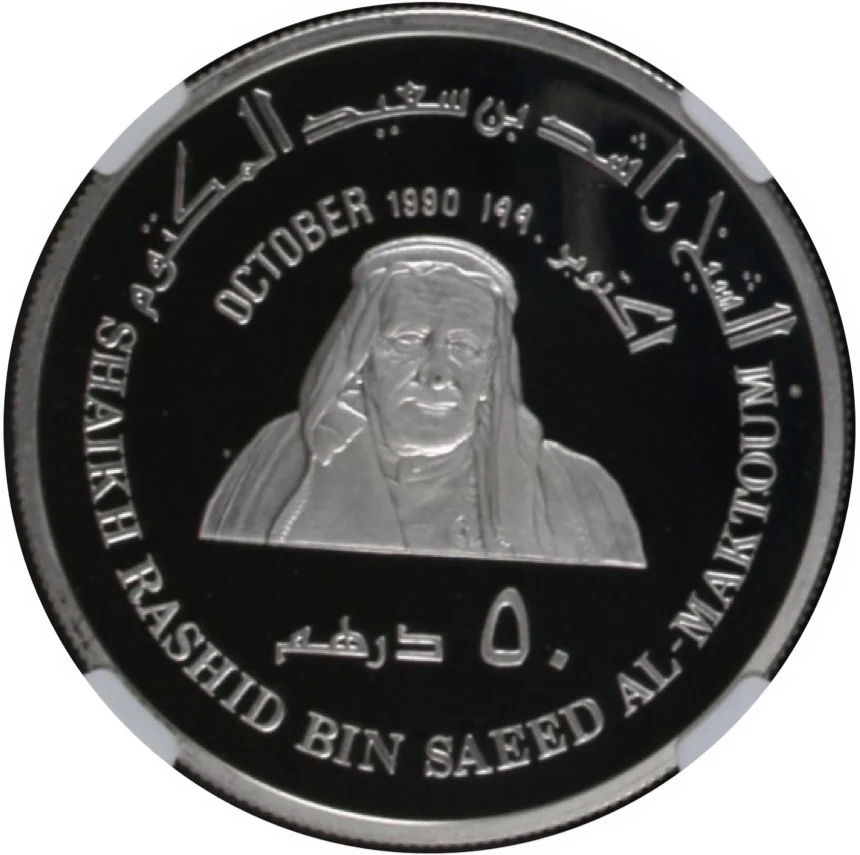
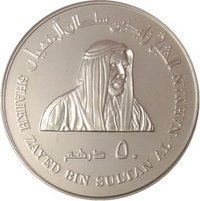
Portrait bust of Sheikh Rashid bin Saeed Al Maktoum.
Inscription:
الشيخ راشد بن سعيد المكتوم
OCTOBER 1990 اكتوبر ١٩٩٠
٥٠ درهم
SHAIKH RASHID BIN SAEED AL-MAKTOUM
OCTOBER 1990 اكتوبر ١٩٩٠
٥٠ درهم
SHAIKH RASHID BIN SAEED AL-MAKTOUM
Translation:
Shaikh Rashid bin Saeed Al-Maktoum
October 1990 October 1990
50 Dirhams
Shaikh Rashid bin Saeed Al-Maktoum
October 1990 October 1990
50 Dirhams
Shaikh Rashid bin Saeed Al-Maktoum
Reverse
Edge
Reeded
Mints
| Name | Mark |
|---|---|
| Royal Mint | — |
Mintings
| Year | Mint Mark | Mintage | Quality | Collection |
|---|---|---|---|---|
| 1990 | — | 4,000 | Proof |
Historical background
In 1990, the currency situation in the United Arab Emirates was defined by the stability of the UAE Dirham (AED), which had been pegged to the International Monetary Fund's Special Drawing Rights (SDR) since 1978. This basket peg, which included the US Dollar, provided a stable monetary anchor for the federation's rapidly growing, oil-driven economy. However, this period also coincided with the early stages of the First Gulf War, triggered by Iraq's invasion of Kuwait in August 1990. This geopolitical shock introduced significant regional uncertainty, testing the resilience of the UAE's financial system and its currency peg.
The immediate economic impact of the crisis included a sharp, though temporary, spike in global oil prices, which initially boosted revenues for oil-exporting nations like the UAE. Despite this influx, the conflict created financial market volatility and raised concerns over regional security. The UAE Central Bank, established just a decade earlier in 1980, played a crucial role in maintaining confidence by ensuring ample liquidity in the banking system and firmly upholding the dirham's peg. This demonstrated the young federation's commitment to monetary stability amidst external shocks.
Ultimately, the currency regime emerged from the 1990-1991 period intact, but the experience underscored the economy's exposure to regional instability. The successful defense of the peg reinforced its credibility, setting a precedent for the future. Within a few years, this stability would lead to a significant policy shift: in November 1997, the UAE would formally re-peg the dirham solely to the US Dollar at a fixed rate of 3.6725 AED, a move seen as simplifying trade and financial relations and solidifying the monetary framework that continues to this day.
The immediate economic impact of the crisis included a sharp, though temporary, spike in global oil prices, which initially boosted revenues for oil-exporting nations like the UAE. Despite this influx, the conflict created financial market volatility and raised concerns over regional security. The UAE Central Bank, established just a decade earlier in 1980, played a crucial role in maintaining confidence by ensuring ample liquidity in the banking system and firmly upholding the dirham's peg. This demonstrated the young federation's commitment to monetary stability amidst external shocks.
Ultimately, the currency regime emerged from the 1990-1991 period intact, but the experience underscored the economy's exposure to regional instability. The successful defense of the peg reinforced its credibility, setting a precedent for the future. Within a few years, this stability would lead to a significant policy shift: in November 1997, the UAE would formally re-peg the dirham solely to the US Dollar at a fixed rate of 3.6725 AED, a move seen as simplifying trade and financial relations and solidifying the monetary framework that continues to this day.
✨ Legendary