

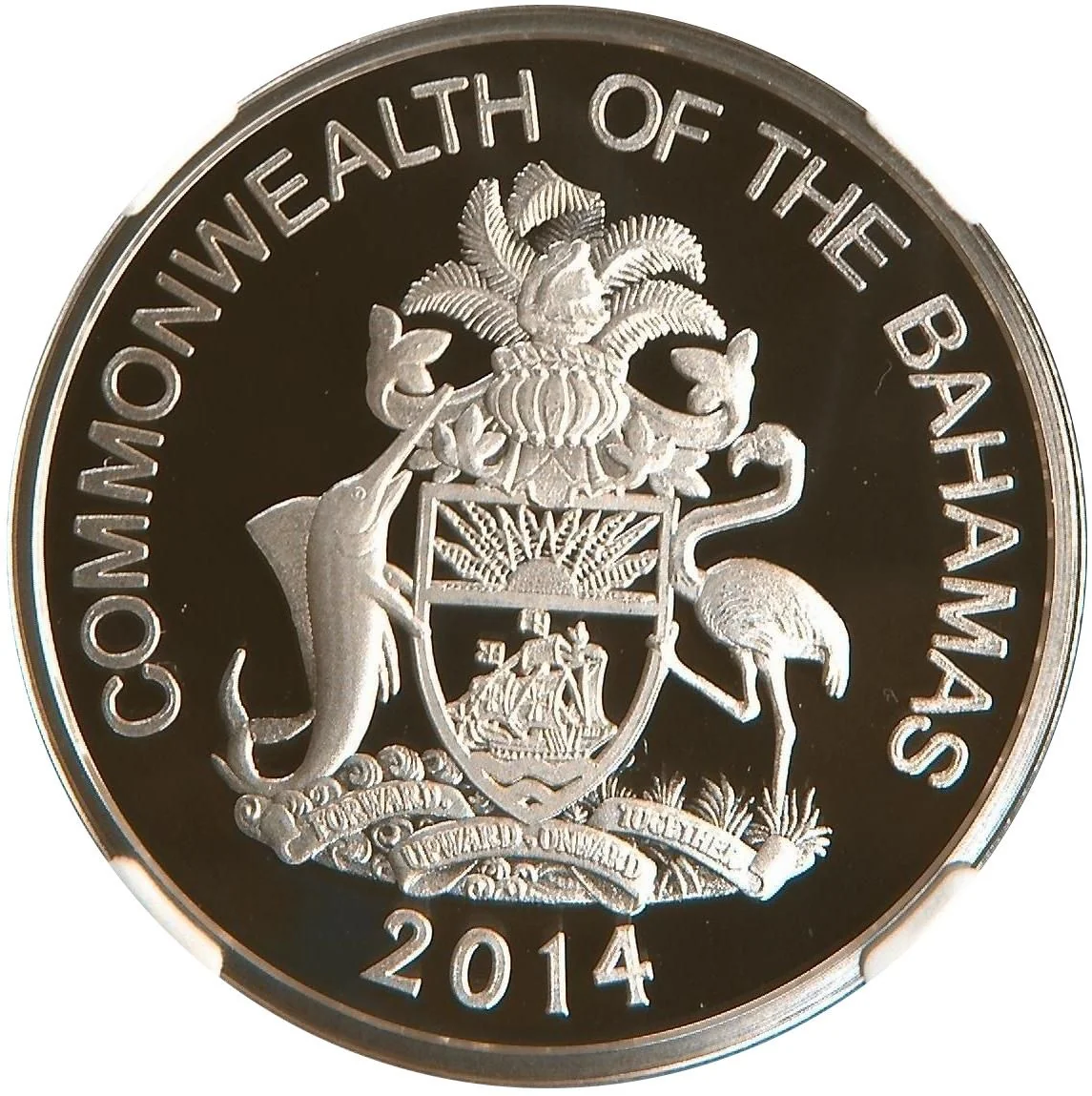
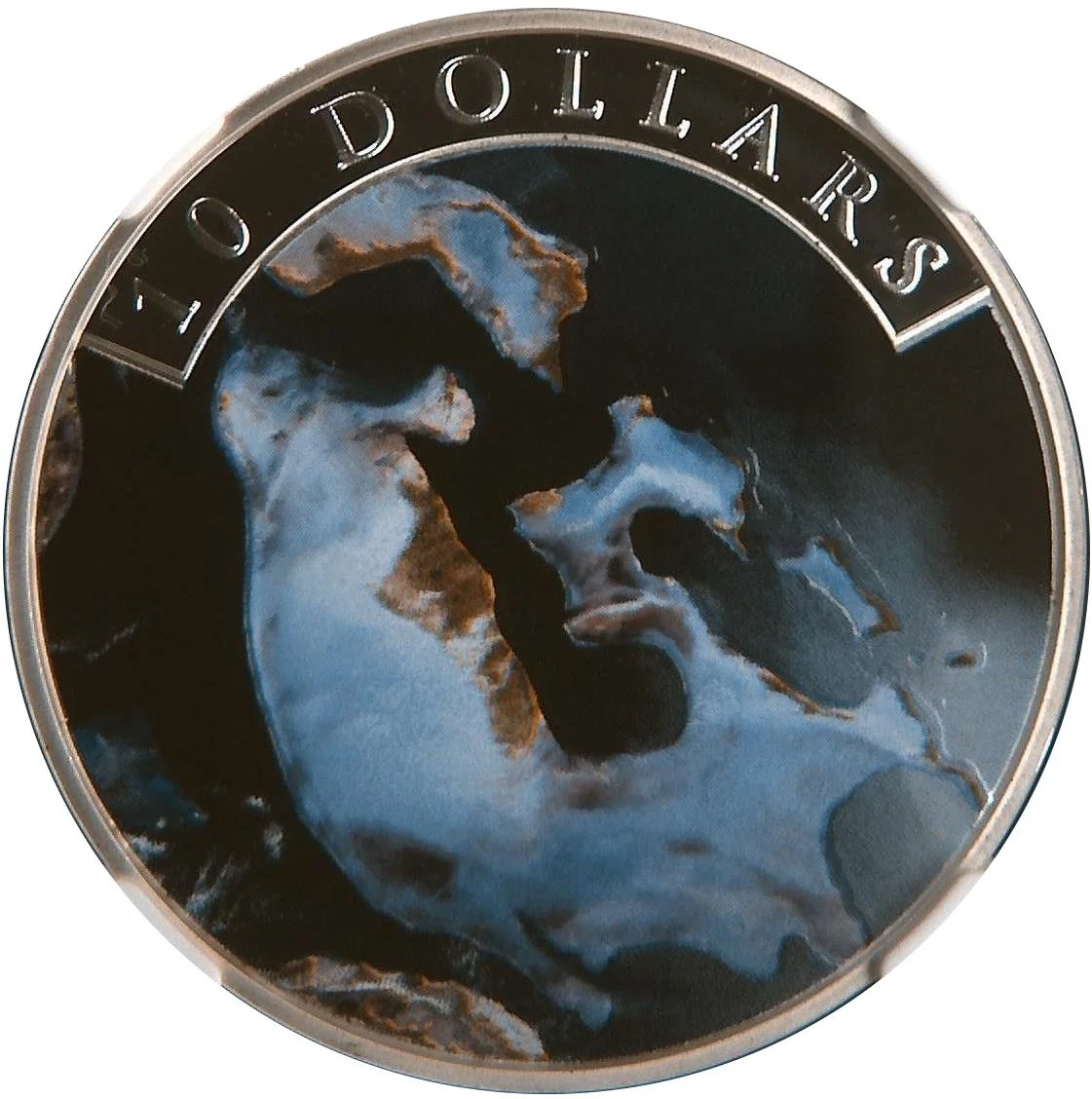
10 Dollars – The Bahamas
Non-circulating coins
Commemoration: Aerial view of the Bahamas
Bahamas
Context
Year: 2014
Country: Bahamas 
Issuer: The Bahamas
Ruler: Elizabeth II
Currency:
(since 1966)
Total mintage: 1,000
Material
Diameter: 39 mm
Weight: 31.1 g
Silver weight: 31.07 g
Shape: Round
Composition: 99.9% Silver
Standard: Silver ounce
Magnetic: No
Technique: Milled
References
KM: #Click to copy to clipboard226
Numista: #91789
Value
Exchange value: 10 BSD
Bullion value: $87.10
Obverse
Reverse
Edge
Mints
| Name | Mark |
|---|---|
| Royal Canadian Mint of Ottawa | — |
Mintings
| Year | Mint Mark | Mintage | Quality | Collection |
|---|---|---|---|---|
| 2014 | — | 1,000 | Proof |
Historical background
In 2014, The Bahamas' currency situation was characterized by stability and close parity with the US dollar, underpinned by the nation's long-standing currency board system. The Bahamian dollar (BSD) has been pegged at a 1:1 fixed exchange rate with the USD since 1973, a policy managed by The Central Bank of The Bahamas. This peg provided crucial stability for the tourism and financial services sectors, which form the backbone of the economy, by eliminating foreign exchange risk for US visitors and investors. Throughout the year, the Central Bank successfully maintained adequate foreign reserves to fully support the monetary base, a key requirement for the credibility of the fixed exchange rate regime.
However, the economy faced significant headwinds that put indirect pressure on the currency framework. The country was still grappling with the prolonged aftermath of the 2008 global financial crisis and the legacy of Hurricane Sandy in 2012, which had hampered growth and increased public debt. While the peg itself was not in doubt, these factors contributed to a challenging economic environment marked by high unemployment and modest GDP growth. The government's fiscal deficits necessitated borrowing, raising concerns about long-term economic sustainability and the potential for future strain on foreign reserves if the trends continued.
Consequently, 2014 was a year of policy focus on strengthening the economic foundations that supported the currency peg. The Central Bank emphasized the need for fiscal consolidation and structural reforms to boost competitiveness and growth. Discussions also advanced regarding the potential introduction of a value-added tax (VAT) to improve government revenue, which was ultimately implemented in 2015. Thus, the currency situation was stable in the immediate sense, but policymakers were actively addressing the underlying economic vulnerabilities to ensure the continued viability of the fixed exchange rate system in the medium to long term.
However, the economy faced significant headwinds that put indirect pressure on the currency framework. The country was still grappling with the prolonged aftermath of the 2008 global financial crisis and the legacy of Hurricane Sandy in 2012, which had hampered growth and increased public debt. While the peg itself was not in doubt, these factors contributed to a challenging economic environment marked by high unemployment and modest GDP growth. The government's fiscal deficits necessitated borrowing, raising concerns about long-term economic sustainability and the potential for future strain on foreign reserves if the trends continued.
Consequently, 2014 was a year of policy focus on strengthening the economic foundations that supported the currency peg. The Central Bank emphasized the need for fiscal consolidation and structural reforms to boost competitiveness and growth. Discussions also advanced regarding the potential introduction of a value-added tax (VAT) to improve government revenue, which was ultimately implemented in 2015. Thus, the currency situation was stable in the immediate sense, but policymakers were actively addressing the underlying economic vulnerabilities to ensure the continued viability of the fixed exchange rate system in the medium to long term.

✨ Legendary