

2 Pounds – British colonies
Non-circulating coins
Commemoration: Golden Jubilee
Australia
Context
Year: 1887
Country: Australia 
Issuer: British colonies
Ruler: Victoria
Currency:
(1788—1966)
Total mintage: 11
Material
References
KM: #Click to copy to clipboard8
Numista: #91749
Value
Bullion value: $2447.36
Obverse
Description:
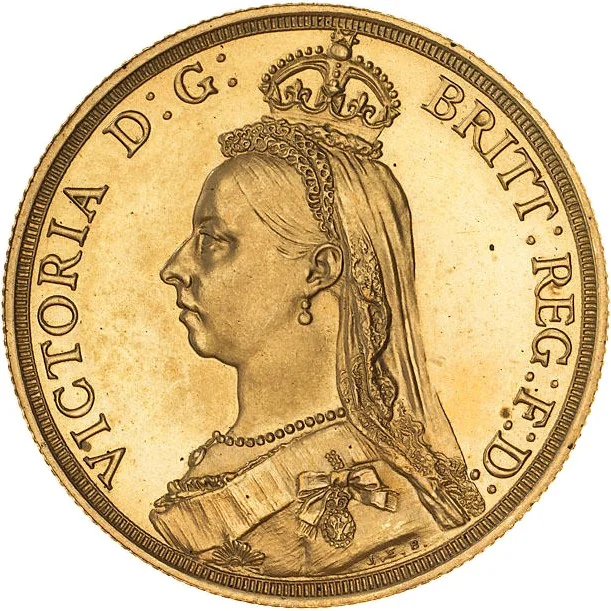
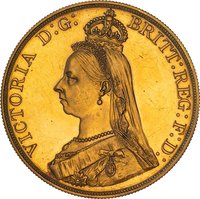
Jubilee bust of Queen Victoria in imperial crown, facing left, with a draped bust adorned by the Star of the Garter and the badge of the Order of the Crown of India.
Inscription:
VICTORIA D:G: BRITT: REG: F:D:
J.E.B.
J.E.B.
Script: Latin
Engraver: Joseph Edgar Boehm
Reverse
Description:
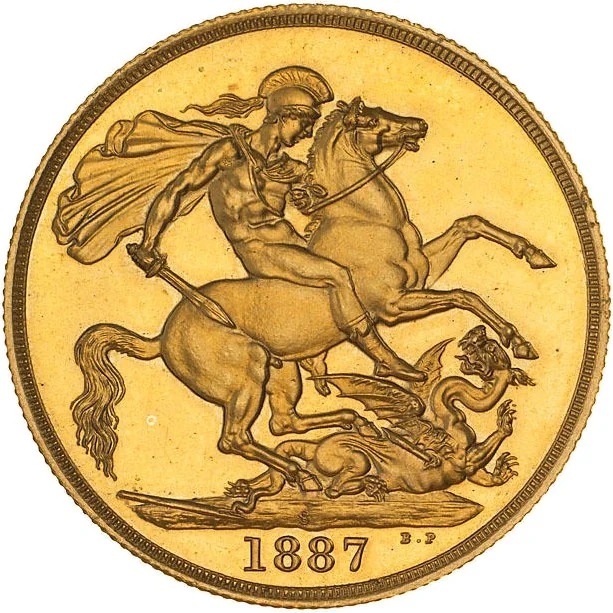
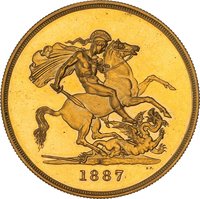
St. George on horseback, rearing right over a fallen dragon, holding a short sword as a broken lance pierces the beast.
Inscription:
S
B.P.
1887
B.P.
1887
Script: Latin
Engraver: Benedetto Pistrucci
Edge
Milled
Categories
| Mythology> Fantastic animal |
| Animal> Horse |
Mints
| Name | Mark |
|---|---|
| Royal Mint | S |
Mintings
| Year | Mint Mark | Mintage | Quality | Collection |
|---|---|---|---|---|
| 1887 | S | 11 | Proof |
Historical background
By 1887, the currency situation across the British Empire was a complex patchwork of systems, largely unified under the principle of the gold standard but varied in local practice. The core was the British gold sovereign, which served as the ultimate standard of value. However, the actual coins circulating in colonies from the West Indies to West Africa and Asia were overwhelmingly silver, primarily the Mexican and Spanish dollars and their local derivatives. This created a persistent problem: the value of this silver coinage fluctuated on the global market against gold, causing monetary instability, budget uncertainties for colonial governments, and complications for imperial trade.
In response, the imperial government had been pushing for the introduction of distinct, local silver token currencies that were sterling-denominated and fixed in value to gold at a set rate. The successful model, established by the Colonial Bank Act of 1849 and expanded, was the creation of "sterling exchange standards." Under this system, colonies like Hong Kong (1863) and Ceylon (1870) issued their own subsidiary silver coins, which were legal tender locally but not in Britain. Their value was maintained by making them convertible at face value into sterling drafts on London, effectively tethering them to the gold sovereign. This ensured stable exchange rates within the Empire.
Nevertheless, by 1887, this transition was incomplete. Many colonies, especially in the West African settlements and the Straits Settlements, still relied heavily on the old Spanish dollar and ad-hoc foreign coinages. The year 1887 itself was a point of active reform, as the Royal Commission on Gold and Silver was taking global testimony, with its findings (published in 1888) set to influence future policy. The drive was toward greater imperial monetary uniformity, leading directly to the landmark Coinage Act of 1891, which would standardise the issuance of British colonial silver coinage and fully cement the sterling exchange standard as the financial backbone of the colonial system.
In response, the imperial government had been pushing for the introduction of distinct, local silver token currencies that were sterling-denominated and fixed in value to gold at a set rate. The successful model, established by the Colonial Bank Act of 1849 and expanded, was the creation of "sterling exchange standards." Under this system, colonies like Hong Kong (1863) and Ceylon (1870) issued their own subsidiary silver coins, which were legal tender locally but not in Britain. Their value was maintained by making them convertible at face value into sterling drafts on London, effectively tethering them to the gold sovereign. This ensured stable exchange rates within the Empire.
Nevertheless, by 1887, this transition was incomplete. Many colonies, especially in the West African settlements and the Straits Settlements, still relied heavily on the old Spanish dollar and ad-hoc foreign coinages. The year 1887 itself was a point of active reform, as the Royal Commission on Gold and Silver was taking global testimony, with its findings (published in 1888) set to influence future policy. The drive was toward greater imperial monetary uniformity, leading directly to the landmark Coinage Act of 1891, which would standardise the issuance of British colonial silver coinage and fully cement the sterling exchange standard as the financial backbone of the colonial system.
✨ Legendary