

100 lire – Vatican City
Add to wishlist
Circulating commemorative coins
Commemoration: Pope Trips for spreading the Gospels
Vatican City
Context
Year: 1985
Issuer: Vatican City
Ruler: John Paul II
Currency:
(1929—2001)
Demonetization: 1 March 2002
Total mintage: 726,000
Material
References
KM: #
Numista: #9161
Value
Exchange value: 100 VAL
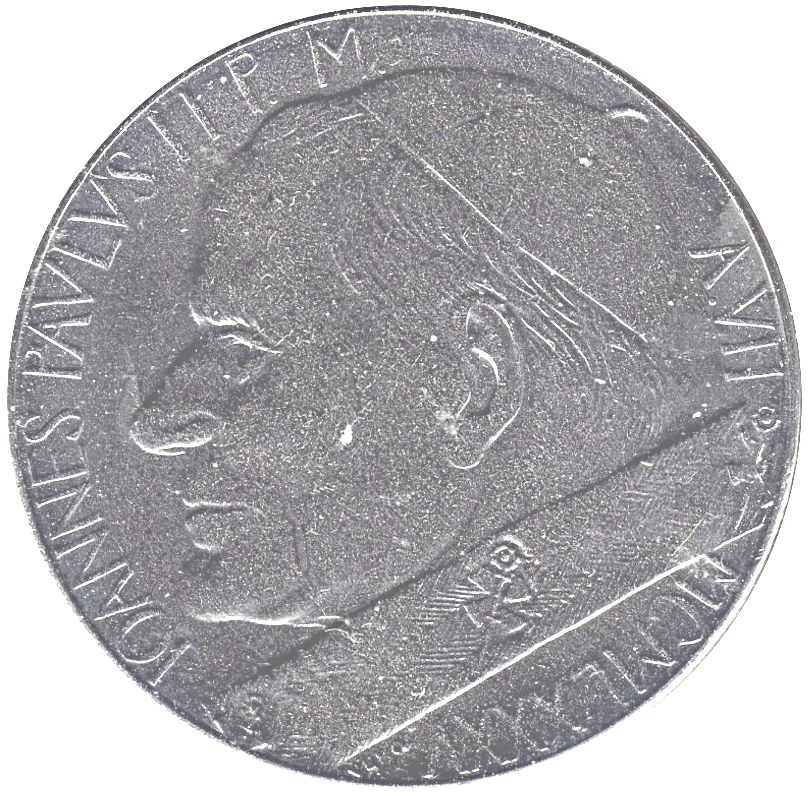
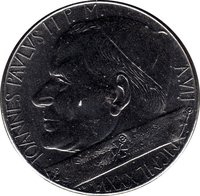
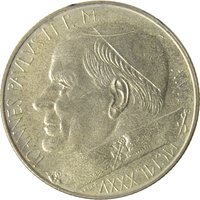
Obverse
Description:
Left turn
Inscription:
IOANNES PAVLVS II P.M. A.VII MCMLXXXV
Translation:
JOHN PAUL II SUPREME PONTIFF YEAR 7 1985
Script: Latin
Language: Latin
Engraver: Guido Veroi
Reverse
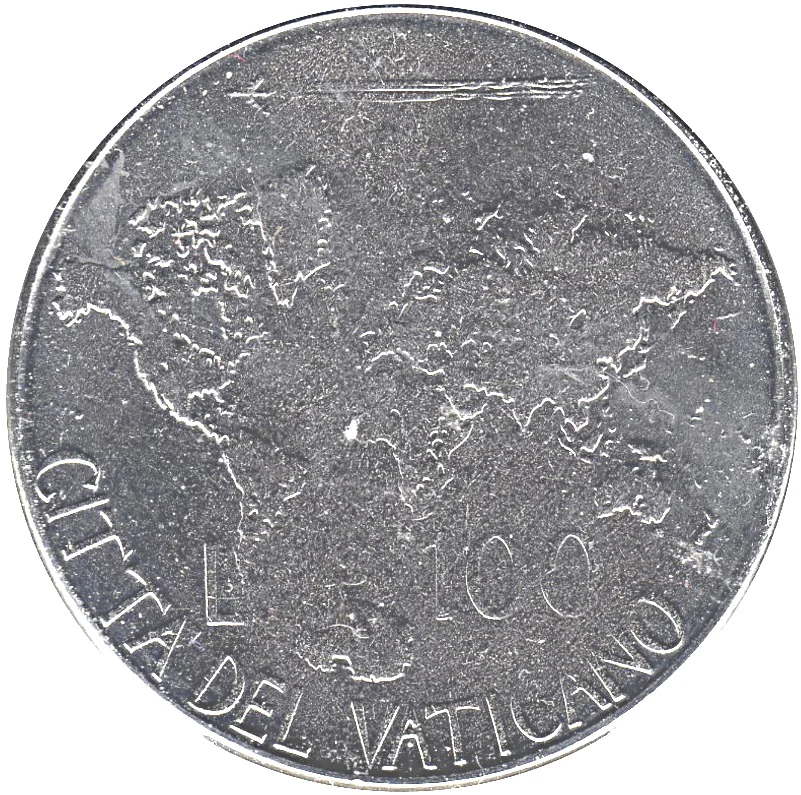
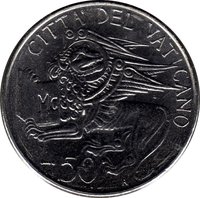
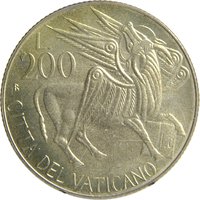
Description:
Airplane over a globe.
Inscription:
CITTA' DEL VATICANO
R L. 100
R L. 100
Translation:
Vatican City State
L. 100
L. 100
Script: Latin
Language: Italian
Engraver: Guido Veroi
Edge
Reeded
Categories
| Person> Religious figure |
| Map |
| Religion> Religious objects |
Mints
| Name | Mark |
|---|---|
| Rome | R |
Mintings
| Year | Mint Mark | Mintage | Quality | Collection |
|---|---|---|---|---|
| 1985 | R | 726,000 |
Historical background
In 1985, Vatican City's currency situation was defined by its unique status as an independent state without its own circulating banknotes or coins for general public use. While it possessed the sovereign right to issue its own currency, practical and economic realities made this unfeasible. Instead, the Vatican operated under a series of formal monetary agreements with Italy, rooted in the 1929 Lateran Treaty. The most important of these was the 1930 Concordat, which established the Italian lira as the official legal tender of the Holy See, granting it the same value and circulation as within Italy itself. This meant the Vatican's financial system was entirely pegged to and dependent on the Italian monetary system.
However, the Vatican did exercise its symbolic sovereign privilege by minting limited quantities of its own coins. These Vatican lire, first issued in 1929, were produced in small, collectible volumes at the Italian Mint and had legal tender status only within the walls of Vatican City. They were identical in metal, size, and face value to Italian coins but featured distinctive designs with the image of the Pope (in 1985, John Paul II) and papal insignia. Their primary purpose was not for daily commerce but for commemorative purposes, as gifts for official visitors, and as sought-after numismatic items for collectors worldwide, providing a modest source of revenue.
The year 1985 fell within a period of relative monetary stability for the Vatican under this Italian framework, but broader economic challenges loomed. The Italian lira itself was part of the European Monetary System's Exchange Rate Mechanism, facing pressures from inflation and devaluation. Furthermore, the Vatican's budget was under strain, having run deficits for years, which would lead to significant financial reforms later in the decade. Thus, while the day-to-day currency situation was straightforward—using Italian lire—it was underpinned by a complex diplomatic agreement and existed within the context of ongoing fiscal concerns for the smallest sovereign state in the world.
However, the Vatican did exercise its symbolic sovereign privilege by minting limited quantities of its own coins. These Vatican lire, first issued in 1929, were produced in small, collectible volumes at the Italian Mint and had legal tender status only within the walls of Vatican City. They were identical in metal, size, and face value to Italian coins but featured distinctive designs with the image of the Pope (in 1985, John Paul II) and papal insignia. Their primary purpose was not for daily commerce but for commemorative purposes, as gifts for official visitors, and as sought-after numismatic items for collectors worldwide, providing a modest source of revenue.
The year 1985 fell within a period of relative monetary stability for the Vatican under this Italian framework, but broader economic challenges loomed. The Italian lira itself was part of the European Monetary System's Exchange Rate Mechanism, facing pressures from inflation and devaluation. Furthermore, the Vatican's budget was under strain, having run deficits for years, which would lead to significant financial reforms later in the decade. Thus, while the day-to-day currency situation was straightforward—using Italian lire—it was underpinned by a complex diplomatic agreement and existed within the context of ongoing fiscal concerns for the smallest sovereign state in the world.
🌱 Common