

50 Lire – Vatican City
Circulating commemorative coins
Commemoration: Peace and Cardinal Virtues
Vatican City
Context
Years: 1979–1980
Issuer: Vatican City 
Ruler: John Paul II
Currency:
(1929—2001)
Demonetization: 1 March 2002
Total mintage: 147,000
Material
References
KM: #Click to copy to clipboard145
Numista: #11508
Value
Exchange value: 50 VAL
Obverse
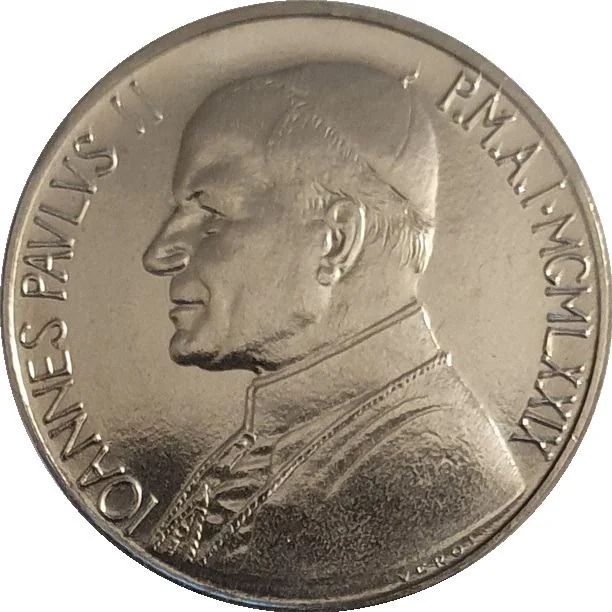
Description:
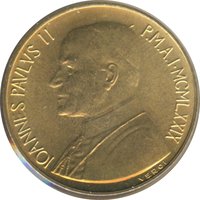
Left turn
Inscription:
IOANNES PAVLVS II
P.M.A.I·MCMLXXIX
P.M.A.I·MCMLXXIX
Translation:
Supreme Pontiff of the World John Paul II 1979
Script: Latin
Language: Latin
Engraver: Guido Veroi
Reverse
Description:
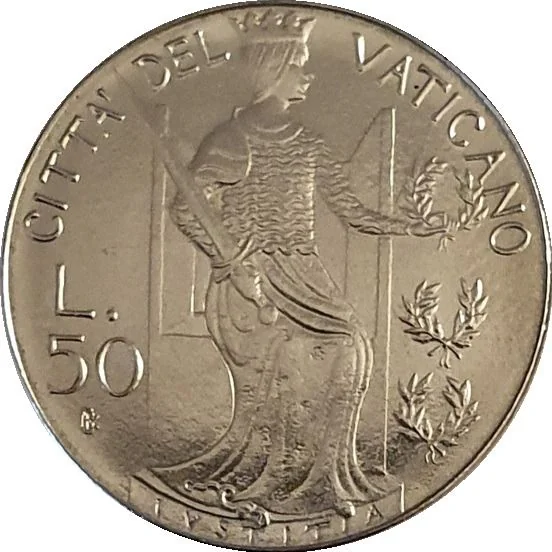
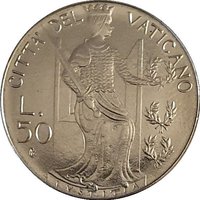
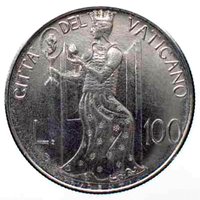
Seated Justice, crowned, holds a sword in her right hand and a laurel wreath in her left, with two more wreaths beneath it.
Inscription:
CITTA' DEL VATICANO
L. 50
IVSTITIA
L. 50
IVSTITIA
Translation:
Vatican City
50 Lire
Justice
50 Lire
Justice
Script: Latin
Language: Italian
Engraver: Guido Veroi
Edge
Reeded
Categories
| Symbol> Allegory |
| Person> Religious figure |
| Religion> Religious objects |
| Symbol> Wreath |
| Object> Cold weapons |
Mints
| Name | Mark |
|---|---|
| Rome | IPZS |
Historical background
In 1979, Vatican City's currency situation was defined by its unique status as an enclave within Italy and its reliance on international agreements. Although it issued its own coinage—the Vatican lira, which was equal in value and interchangeable with the Italian lira—it did not print banknotes. Instead, Italian lira banknotes served as the primary paper currency for daily transactions. This arrangement was formalized under the terms of the 1929 Lateran Treaty, which established Vatican City as a sovereign state and granted it the right to mint coins, but its monetary system was intrinsically tied to Italy's.
The year 1979 was particularly significant as it marked the beginning of Pope John Paul II's pontificate, and the Vatican mint issued new coinage bearing his image. These coins, while legal tender in Italy and San Marino due to bilateral agreements, were primarily intended for collectors and tourists rather than general circulation. Their numismatic value almost always exceeded their face value, meaning they were rarely used in everyday commerce within the tiny city-state. Practically, the economy operated on a dual system of Italian banknotes and low-circulation Vatican coins.
Furthermore, the Vatican's monetary autonomy was constrained by its economic reality. With no central bank or independent monetary policy, its financial system was an extension of Italy's. The Italian lira faced periods of high inflation and instability during the 1970s, indirectly affecting the Vatican's purchasing power and the real value of its lira-denominated assets. Thus, while possessing the symbolic trappings of a sovereign currency, Vatican City in 1979 was deeply integrated into the Italian monetary area, with its currency situation reflecting its geopolitical and economic dependence on its host nation.
The year 1979 was particularly significant as it marked the beginning of Pope John Paul II's pontificate, and the Vatican mint issued new coinage bearing his image. These coins, while legal tender in Italy and San Marino due to bilateral agreements, were primarily intended for collectors and tourists rather than general circulation. Their numismatic value almost always exceeded their face value, meaning they were rarely used in everyday commerce within the tiny city-state. Practically, the economy operated on a dual system of Italian banknotes and low-circulation Vatican coins.
Furthermore, the Vatican's monetary autonomy was constrained by its economic reality. With no central bank or independent monetary policy, its financial system was an extension of Italy's. The Italian lira faced periods of high inflation and instability during the 1970s, indirectly affecting the Vatican's purchasing power and the real value of its lira-denominated assets. Thus, while possessing the symbolic trappings of a sovereign currency, Vatican City in 1979 was deeply integrated into the Italian monetary area, with its currency situation reflecting its geopolitical and economic dependence on its host nation.
🌱 Common