


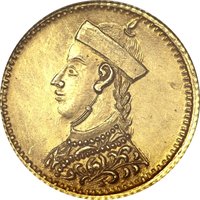
Obverse
Description:
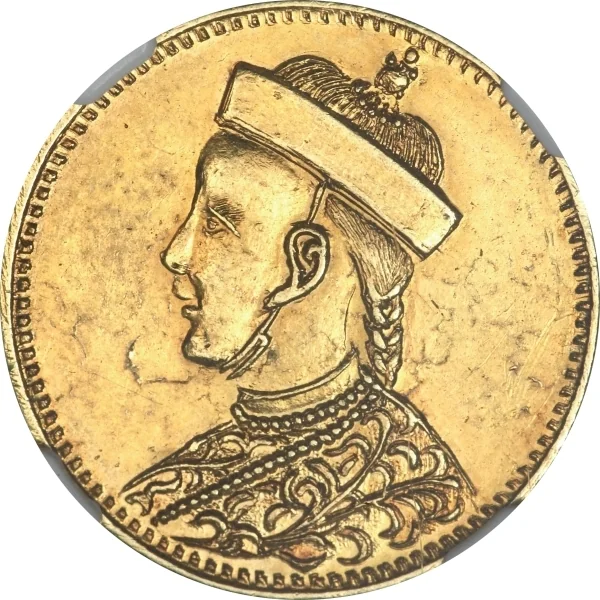
Guangxu bust in cap and floral robe, facing left.
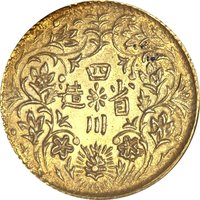
Reverse
Description:
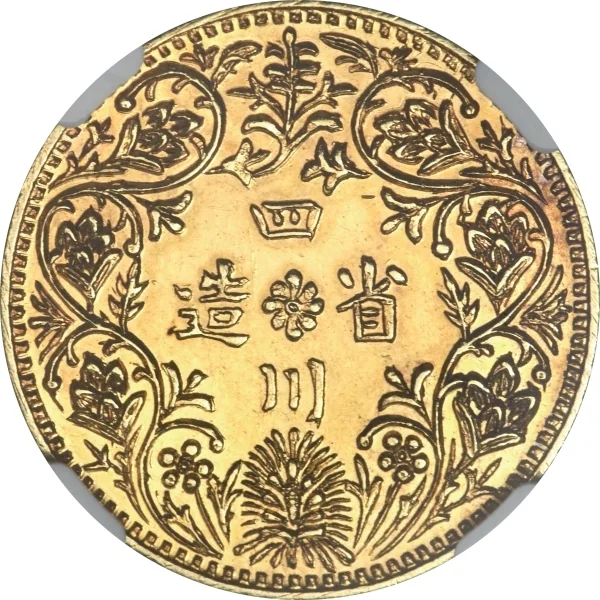
Four Chinese characters read vertically around a central flower, enclosed by a floral wreath.
Inscription:
四
造 省
川
造 省
川
Translation:
Made by the Ministry of Revenue of Sichuan.
Scripts: Chinese (traditional, regular script)
Language: Chinese
Edge
Reeded.
Mintings
| Year | Mint Mark | Mintage | Quality | Collection |
|---|---|---|---|---|
| 1905 | — | — |
Historical background
In 1905, Tibet's currency situation was complex and transitional, reflecting its political status as a region under loose Qing suzerainty but with strong local autonomy. The primary circulating medium was the Tibetan silver tangka (or srang), a coin minted in Lhasa and other centers like Derge. These coins were traditionally hand-struck, often irregular in shape and fineness, and their value was tied to their intrinsic silver content. Alongside these, Chinese silver sycees (ingots) and yuan from the coastal mints, as well as Indian rupees, circulated in border areas for trade. The lack of a standardized, modern coinage system created difficulties in both internal commerce and cross-border trade.
This monetary landscape was directly tied to the geopolitical tensions of the period. British India's growing economic influence, particularly following the Younghusband Expedition of 1903-04, increased the inflow of Indian rupees, challenging the Qing's symbolic authority. In response, the Qing Amban in Lhasa, supported by the 13th Dalai Lama's government, initiated a key reform: the minting of new machine-struck silver coins. These 1903-05 issues, bearing both Tibetan and Chinese legends, were an attempt to standardize the currency, assert Qing sovereignty, and counter foreign monetary influence by providing a more reliable and uniform medium of exchange.
However, the reform's impact in 1905 remained limited. The old hand-struck tangka continued to circulate widely, especially in remote areas, creating a dual-system. The new coins themselves faced challenges, including public suspicion and potential debasement concerns. Ultimately, the currency situation mirrored Tibet's precarious position—caught between a weakening Qing dynasty unable to enforce full centralization and increasing British imperial interest, with its own government striving to maintain economic control amidst these competing powers.
This monetary landscape was directly tied to the geopolitical tensions of the period. British India's growing economic influence, particularly following the Younghusband Expedition of 1903-04, increased the inflow of Indian rupees, challenging the Qing's symbolic authority. In response, the Qing Amban in Lhasa, supported by the 13th Dalai Lama's government, initiated a key reform: the minting of new machine-struck silver coins. These 1903-05 issues, bearing both Tibetan and Chinese legends, were an attempt to standardize the currency, assert Qing sovereignty, and counter foreign monetary influence by providing a more reliable and uniform medium of exchange.
However, the reform's impact in 1905 remained limited. The old hand-struck tangka continued to circulate widely, especially in remote areas, creating a dual-system. The new coins themselves faced challenges, including public suspicion and potential debasement concerns. Ultimately, the currency situation mirrored Tibet's precarious position—caught between a weakening Qing dynasty unable to enforce full centralization and increasing British imperial interest, with its own government striving to maintain economic control amidst these competing powers.
✨ Legendary