

500 Patacas – Macau
Non-circulating coins
Commemoration: 25th Grand Prix
China
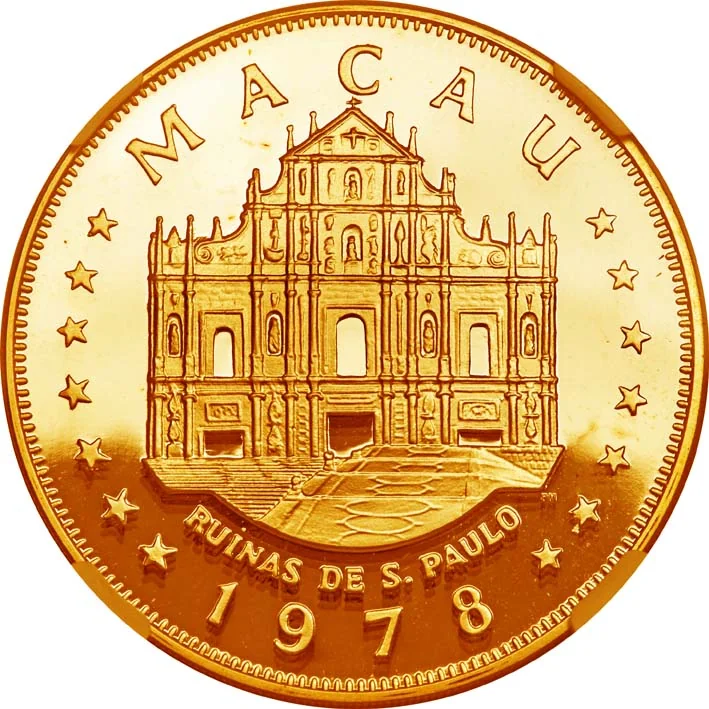
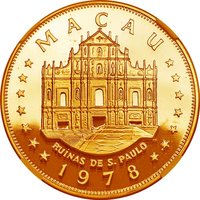
Obverse
Inscription:
MACAU
RUINAS DE S. PAULO
1978
RUINAS DE S. PAULO
1978
Translation:
MACAU
RUINS OF ST. PAUL'S
1978
RUINS OF ST. PAUL'S
1978
Script: Latin
Languages: Portuguese, English
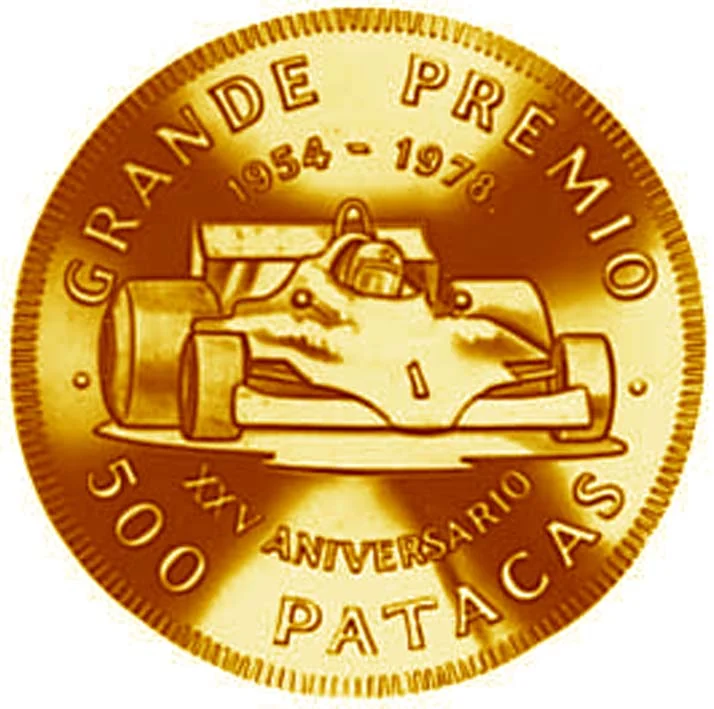
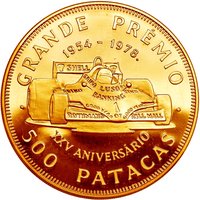
Reverse
Inscription:
GRANDE PRÉMIO
1953-1978
XXV ANIVERSÁRIO
1953-1978
XXV ANIVERSÁRIO
Translation:
Grand Prize
1953-1978
25th Anniversary
1953-1978
25th Anniversary
Script: Latin
Language: Portuguese
Edge
Mintings
| Year | Mint Mark | Mintage | Quality | Collection |
|---|---|---|---|---|
| 1978 | — | 5,500 | Proof |
Historical background
In 1978, Macau's currency situation was defined by its unique colonial status and economic ties. As a Portuguese-administered territory, the official currency was the Macanese pataca (MOP), which had been pegged to the Portuguese escudo since 1906. However, the escudo itself was a weak and unstable currency, leading to significant practical challenges. The pataca's peg did not reflect Macau's real economic dependencies, as the territory's economy was overwhelmingly intertwined with neighbouring Hong Kong and, by extension, the broader Chinese market.
Consequently, the Hong Kong dollar (HKD) was the de facto dominant currency in daily commerce and especially in the burgeoning tourism and nascent casino industry. This created a dual-currency system where the Hong Kong dollar was often preferred for its stability and wider international acceptance, while the pataca remained the unit for government transactions and smaller local retail. The Portuguese administration struggled with this monetary duality, as it undermined the authority and utility of the official currency and complicated fiscal policy.
Furthermore, 1978 marked a period of economic and political transition that would soon reshape the currency landscape. China had begun its Reform and Opening-Up policy, and discussions about Macau's future sovereignty were nascent. Within two years, in 1980, the Macau government would decisively re-peg the pataca to the Hong Kong dollar at a fixed rate of 1.03 patacas to 1 Hong Kong dollar, a move that recognised economic reality and provided the stability needed for the gaming and tourism boom that would follow. Therefore, the 1978 currency situation was one of instability and duality, on the cusp of a pivotal reform.
Consequently, the Hong Kong dollar (HKD) was the de facto dominant currency in daily commerce and especially in the burgeoning tourism and nascent casino industry. This created a dual-currency system where the Hong Kong dollar was often preferred for its stability and wider international acceptance, while the pataca remained the unit for government transactions and smaller local retail. The Portuguese administration struggled with this monetary duality, as it undermined the authority and utility of the official currency and complicated fiscal policy.
Furthermore, 1978 marked a period of economic and political transition that would soon reshape the currency landscape. China had begun its Reform and Opening-Up policy, and discussions about Macau's future sovereignty were nascent. Within two years, in 1980, the Macau government would decisively re-peg the pataca to the Hong Kong dollar at a fixed rate of 1.03 patacas to 1 Hong Kong dollar, a move that recognised economic reality and provided the stability needed for the gaming and tourism boom that would follow. Therefore, the 1978 currency situation was one of instability and duality, on the cusp of a pivotal reform.
✨ Legendary