

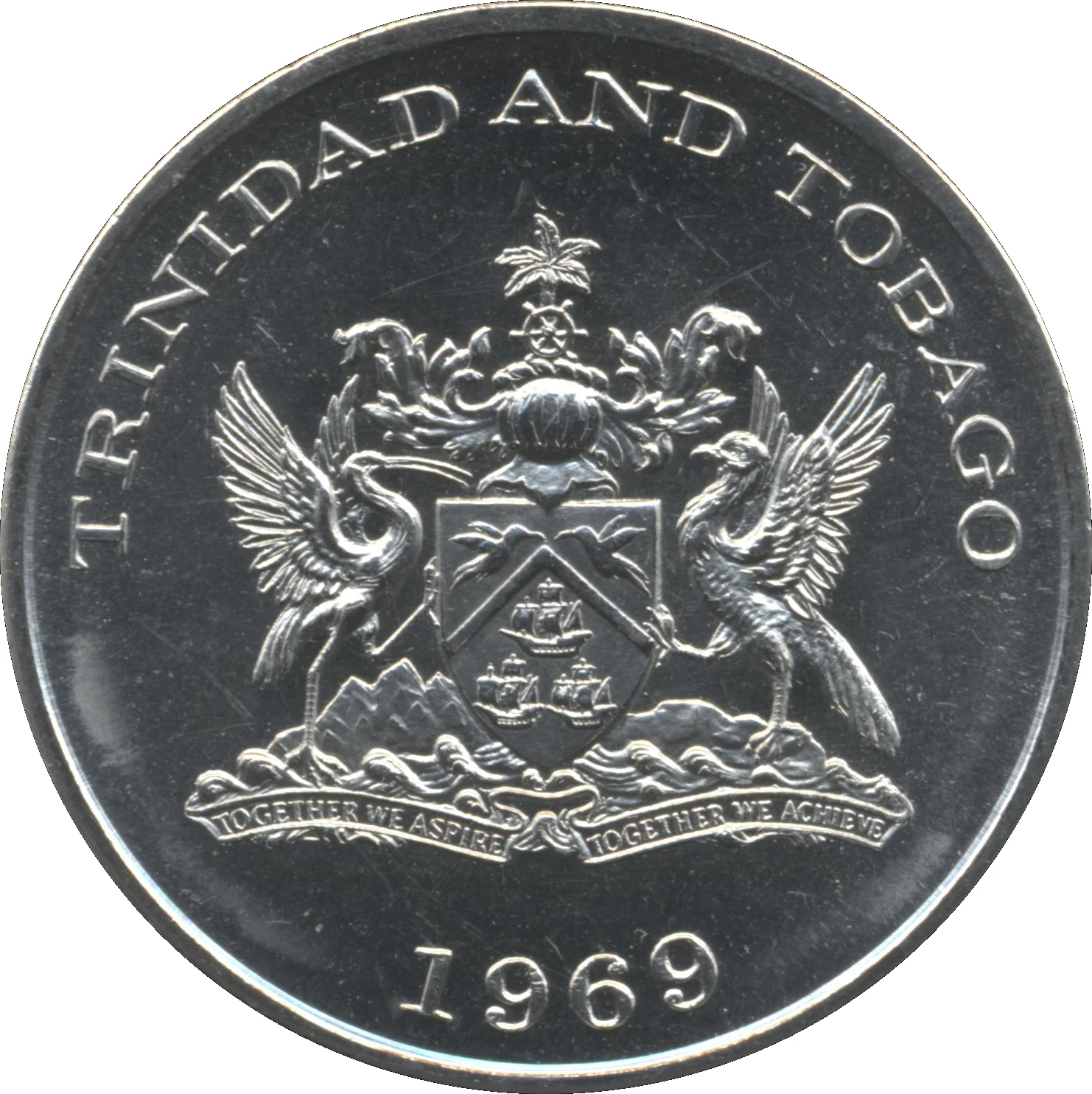
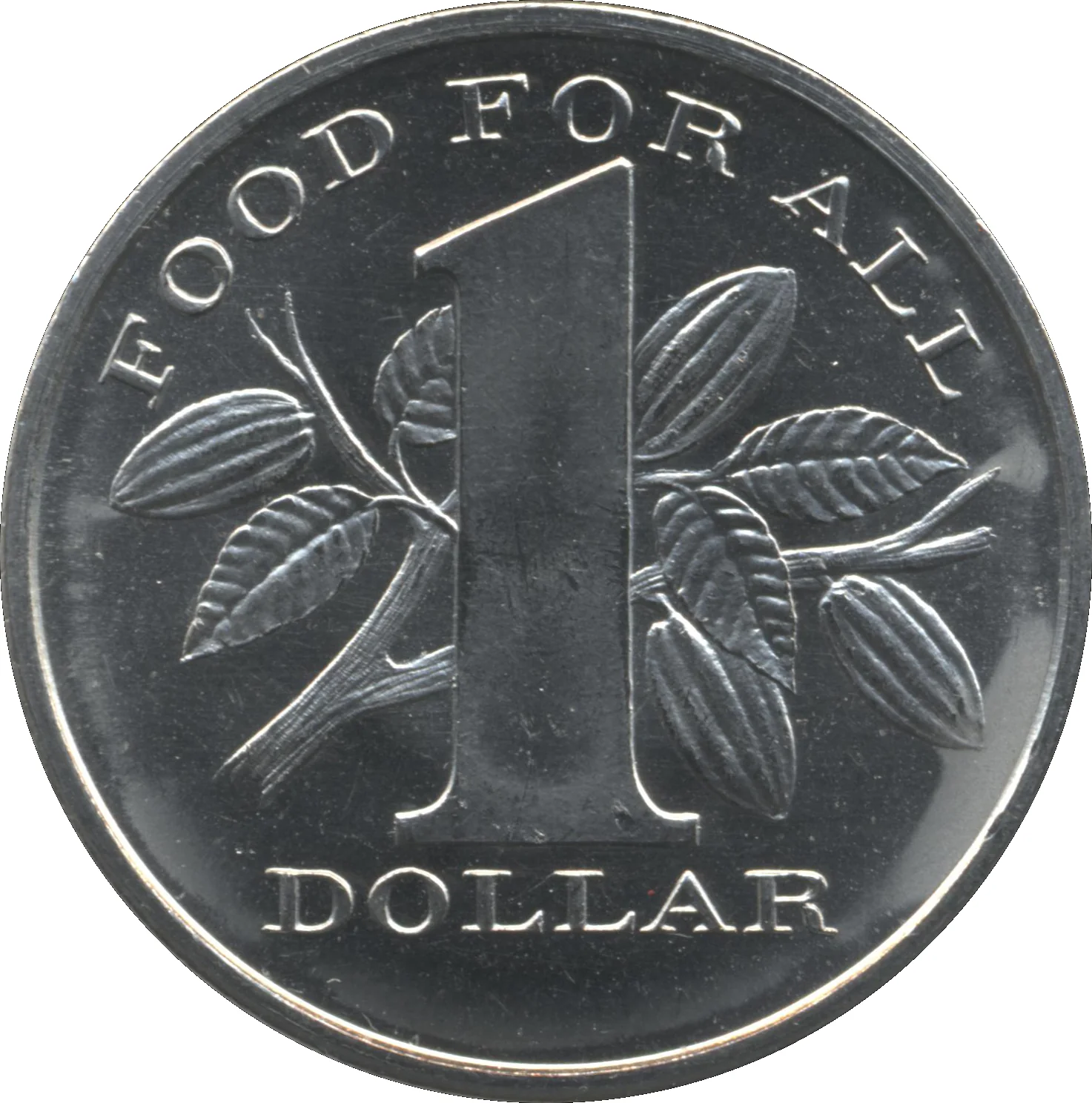
1 Dollar – Trinidad and Tobago
Circulating commemorative coins
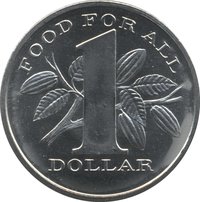
Commemoration: F.A.O. - Food for All
Trinidad and Tobago
Context
Year: 1969
Issuer: Trinidad and Tobago 
Ruler: Elizabeth II
Currency:
(since 1964)
Demonetized: Yes
Total mintage: 250,000
Material
References
KM: #Click to copy to clipboard6
Numista: #11503
Value
Exchange value: 1 TTD
Obverse
Reverse
Edge
Reeded
Categories
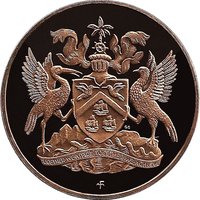
| Symbols> Coat of Arms |
| Organization> FAO |
Mints
| Name | Mark |
|---|---|
| Sherritt Mint | — |
Mintings
| Year | Mint Mark | Mintage | Quality | Collection |
|---|---|---|---|---|
| 1969 | — | 250,000 |
Historical background
In 1969, Trinidad and Tobago's currency situation was defined by its recent transition to a decimalized system and its continued operation within the sterling area. Just two years prior, in 1967, the country had introduced the Trinidad and Tobago dollar (TT$) to replace the British West Indies dollar, pegging it at a fixed rate of TT$4.80 to one pound sterling. This move was a significant step in asserting monetary sovereignty following independence in 1962, though it maintained a strong colonial-era financial link to the United Kingdom.
The economy underpinning the currency was robust, fueled by a booming oil sector and a growing industrial base centered on Point Lisas. This hydrocarbon wealth provided strong foreign exchange reserves, which bolstered confidence in the new dollar and ensured the stability of its peg. Consequently, 1969 was not a year of currency crisis but rather one of consolidation, with the Central Bank of Trinidad and Tobago (established in 1964) managing the fixed exchange rate regime effectively amidst a period of relative economic prosperity.
However, this stability existed within a context of global monetary uncertainty. International pressures on the sterling area were mounting, and the British pound itself would be devalued in 1967, a move to which Trinidad and Tobago had to adjust by maintaining its peg. By 1969, questions about the long-term viability of a sterling peg were beginning to emerge among policymakers, setting the stage for future shifts. The decade would end with the country beginning to consider a realignment of its currency peg toward the US dollar, a reflection of changing trade patterns and the weakening position of sterling on the world stage.
The economy underpinning the currency was robust, fueled by a booming oil sector and a growing industrial base centered on Point Lisas. This hydrocarbon wealth provided strong foreign exchange reserves, which bolstered confidence in the new dollar and ensured the stability of its peg. Consequently, 1969 was not a year of currency crisis but rather one of consolidation, with the Central Bank of Trinidad and Tobago (established in 1964) managing the fixed exchange rate regime effectively amidst a period of relative economic prosperity.
However, this stability existed within a context of global monetary uncertainty. International pressures on the sterling area were mounting, and the British pound itself would be devalued in 1967, a move to which Trinidad and Tobago had to adjust by maintaining its peg. By 1969, questions about the long-term viability of a sterling peg were beginning to emerge among policymakers, setting the stage for future shifts. The decade would end with the country beginning to consider a realignment of its currency peg toward the US dollar, a reflection of changing trade patterns and the weakening position of sterling on the world stage.
🌱 Fairly Common