

1 drachma – Greece
Add to wishlist
Greece
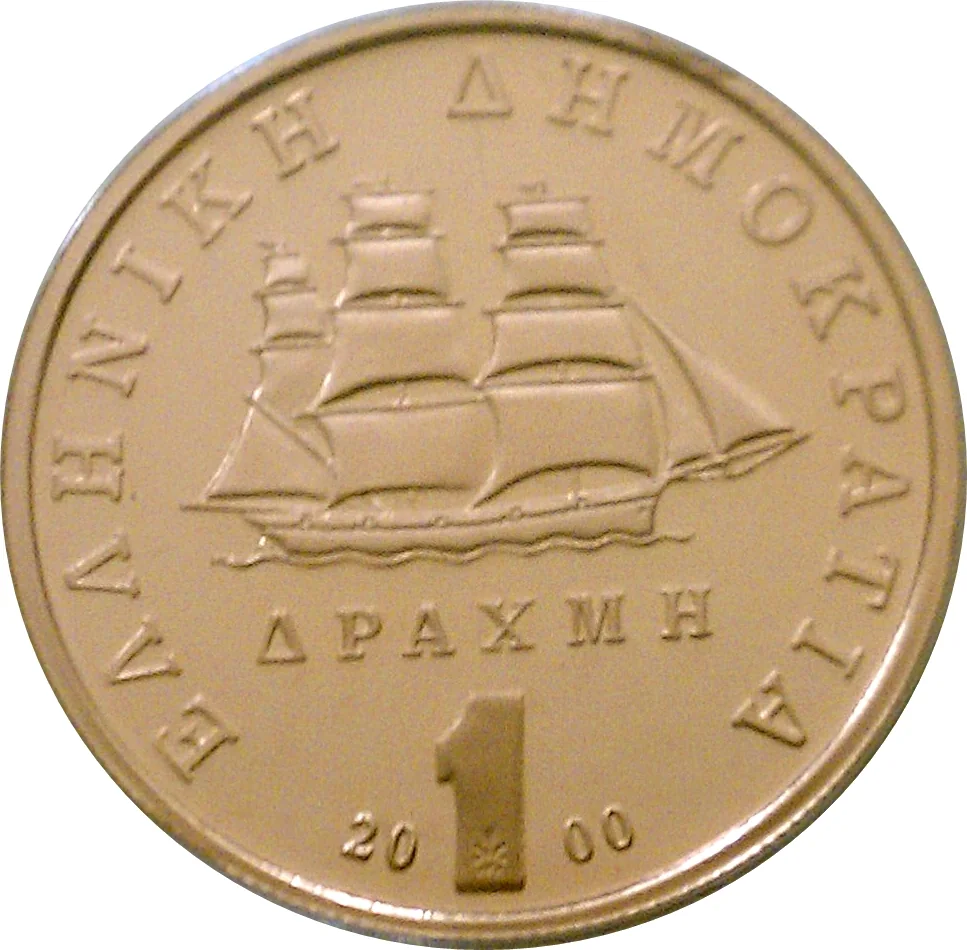
Obverse
Description:
1821 corvette.
Inscription:
ΕΛΛΗΝΙΚΗ ΔΗΜΟΚΡΑΤΙΑ
1 ΔΡΑΧΜΗ 2000
1 ΔΡΑΧΜΗ 2000
Translation:
HELLENIC REPUBLIC
1 DRACHMA 2000
1 DRACHMA 2000
Script: Greek
Language: Greek
Engraver: N. Perantinos
Reverse
Description:
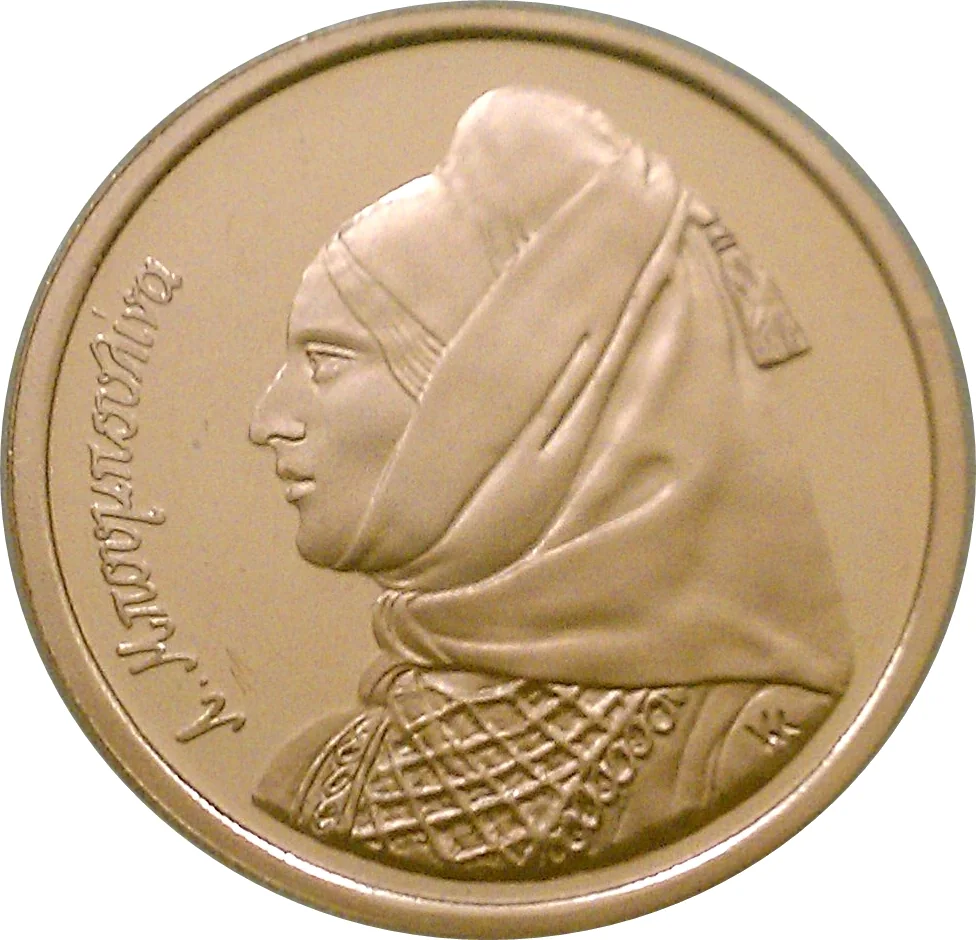
Portrait of Laskarina Bouboulina (1771–1825), a heroine of the Greek War of Independence.
Inscription:
Λ. Μπουμπουλίνα
Translation:
L. Bouboulina
Script: Greek
Language: Greek
Engraver: N. Perantinos
Edge
Milled
Categories
| Transportation> Watercraft |
Mints
| Name | Mark |
|---|---|
| National Mint of the Bank of Greece | — |
Mintings
| Year | Mint Mark | Mintage | Quality | Collection |
|---|---|---|---|---|
| 2000 | — | 10,000 | Proof |
Historical background
By the year 2000, Greece was in a period of significant economic transition and optimism, having just qualified to adopt the euro. After years of austerity measures and structural reforms aimed at meeting the strict Maastricht Treaty convergence criteria—particularly for budget deficit, debt-to-GDP ratio, inflation, and interest rates—the country was formally accepted into the Eurozone in June 2000. The drachma, Greece's historic currency, was set to be permanently replaced by the euro on January 1, 2001, for electronic transactions, with euro banknotes and coins to follow in 2002. This achievement was a source of national pride and was widely expected to lower borrowing costs, stimulate investment, and solidify Greece's place in the European core.
However, this positive backdrop was shadowed by underlying fiscal vulnerabilities that would later prove catastrophic. The official statistics used to qualify for the euro were later revealed to have been significantly manipulated with the help of complex financial derivatives, obscuring the true scale of Greece's public debt and deficit. While the country enjoyed the immediate benefits of euro membership, including dramatically lower interest rates as risk premiums vanished, it lost control over key economic levers. Most critically, Greece could no longer devalue its currency to regain competitiveness, nor could it set its own monetary policy, tools that had historically been used to address economic imbalances.
Consequently, the currency situation in 2000 was a paradox of triumph and impending trouble. On the surface, it represented the culmination of a successful European integration project, granting Greece stability and access to cheap capital. Yet beneath, it locked the country into a monetary union without having first addressed deep-seated issues of chronic fiscal mismanagement, a large public sector, and widespread tax evasion. The convergence was more nominal than real, setting the stage for a debt-fueled boom in the 2000s and the severe crisis that would erupt a decade later when global financial markets scrutinized the true state of its finances.
However, this positive backdrop was shadowed by underlying fiscal vulnerabilities that would later prove catastrophic. The official statistics used to qualify for the euro were later revealed to have been significantly manipulated with the help of complex financial derivatives, obscuring the true scale of Greece's public debt and deficit. While the country enjoyed the immediate benefits of euro membership, including dramatically lower interest rates as risk premiums vanished, it lost control over key economic levers. Most critically, Greece could no longer devalue its currency to regain competitiveness, nor could it set its own monetary policy, tools that had historically been used to address economic imbalances.
Consequently, the currency situation in 2000 was a paradox of triumph and impending trouble. On the surface, it represented the culmination of a successful European integration project, granting Greece stability and access to cheap capital. Yet beneath, it locked the country into a monetary union without having first addressed deep-seated issues of chronic fiscal mismanagement, a large public sector, and widespread tax evasion. The convergence was more nominal than real, setting the stage for a debt-fueled boom in the 2000s and the severe crisis that would erupt a decade later when global financial markets scrutinized the true state of its finances.
💎 Extremely Rare