

2000 pesos uruguayos (National Library) – Uruguay
Add to wishlist
Non-circulating coins
Commemoration: 200th Anniversary of National Library
Uruguay
Obverse
Description:
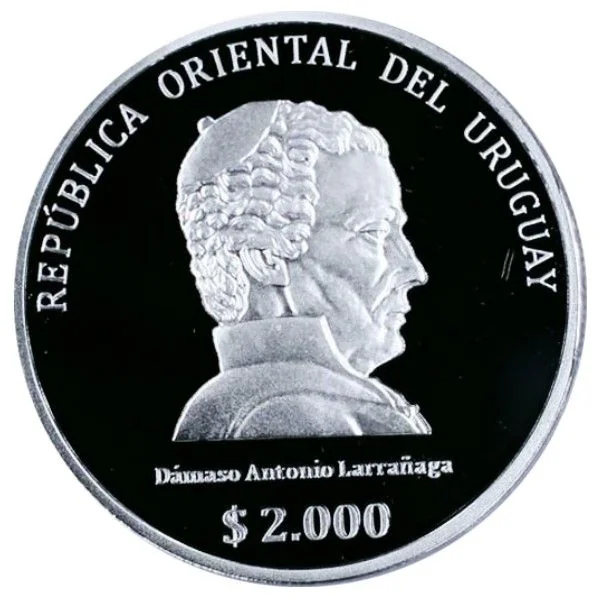
Bust of Dámaso Antonio Larrañaga, with his name below. The country name arches above, and the face value is in the exergue.
Inscription:
REPÚBLICA ORIENTAL DEL URUGUAY
Dámaso Antonio Larrañaga
$ 2.000
Dámaso Antonio Larrañaga
$ 2.000
Translation:
Eastern Republic of Uruguay
Dámaso Antonio Larrañaga
$ 2,000
Dámaso Antonio Larrañaga
$ 2,000
Script: Latin
Language: Spanish
Reverse
Description:
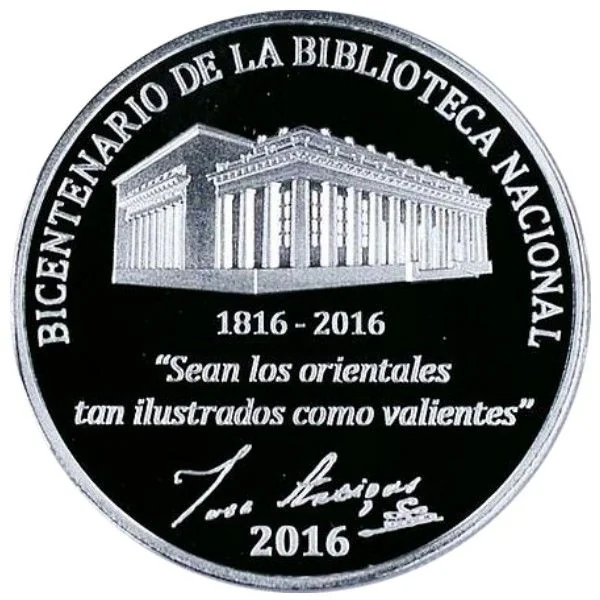
National Library Building; event name above, years in centre, Artigas phrase and signature below, issue year on exergue.
Inscription:
BICENTENARIO DE LA BIBLIOTECA NACIONAL
1816 - 2016
"Sean los orientales
tan ilustrados como valientes"
José Artigas
2016
1816 - 2016
"Sean los orientales
tan ilustrados como valientes"
José Artigas
2016
Translation:
Bicentennial of the National Library
1816 - 2016
"Let the Orientals be
as enlightened as they are brave"
José Artigas
2016
1816 - 2016
"Let the Orientals be
as enlightened as they are brave"
José Artigas
2016
Script: Latin
Language: Spanish
Edge
Reeded
Categories
| Building |
| Person> Politician |
Mints
| Name | Mark |
|---|---|
| Mint of Poland | — |
Mintings
| Year | Mint Mark | Mintage | Quality | Collection |
|---|---|---|---|---|
| 2016 | — | 5,000 | Proof |
Historical background
In 2016, Uruguay's currency situation was characterized by a period of significant monetary policy transition and exchange rate volatility. The Uruguayan peso (UYU) had experienced a sharp and sustained depreciation against the US dollar since 2012, a trend that continued into 2016. This depreciation was driven by a combination of external factors, including a strong US dollar globally and economic slowdowns in key regional trading partners like Argentina and Brazil, which reduced export demand and capital inflows. Domestically, persistent fiscal deficits and relatively high inflation contributed to the peso's weakness.
The Central Bank of Uruguay (BCU) faced a complex policy dilemma. In response to high inflation, which remained above the target range (reaching around 9% for the year), the BCU had been tightening monetary policy. However, it also intervened in the foreign exchange market to smooth excessive volatility and build international reserves, which had declined. A key development was the shift towards a fully flexible exchange rate regime, formally abandoning the managed float band system that had been in place since 2004. This move, aimed at increasing monetary policy autonomy, meant the peso's value was increasingly set by market forces, though the BCU retained the right to intervene in cases of disorderly market conditions.
Overall, the economy in 2016 was adjusting to these "floatation shocks." The weaker peso provided a boost to the competitiveness of Uruguay's vital export sectors, such as beef, soy, and dairy, but it also increased the cost of imports and the burden of dollar-denominated debt for many households and businesses. Consequently, the currency situation was a central economic challenge, balancing the benefits of a more independent inflation-targeting policy against the pressures of depreciation on prices and financial stability.
The Central Bank of Uruguay (BCU) faced a complex policy dilemma. In response to high inflation, which remained above the target range (reaching around 9% for the year), the BCU had been tightening monetary policy. However, it also intervened in the foreign exchange market to smooth excessive volatility and build international reserves, which had declined. A key development was the shift towards a fully flexible exchange rate regime, formally abandoning the managed float band system that had been in place since 2004. This move, aimed at increasing monetary policy autonomy, meant the peso's value was increasingly set by market forces, though the BCU retained the right to intervene in cases of disorderly market conditions.
Overall, the economy in 2016 was adjusting to these "floatation shocks." The weaker peso provided a boost to the competitiveness of Uruguay's vital export sectors, such as beef, soy, and dairy, but it also increased the cost of imports and the burden of dollar-denominated debt for many households and businesses. Consequently, the currency situation was a central economic challenge, balancing the benefits of a more independent inflation-targeting policy against the pressures of depreciation on prices and financial stability.

💎 Extremely Rare