

300 Dollars – Canada
Non-circulating coins
Commemoration: Golden Jubilee of Elizabeth II
Canada
Context

Material
References
Numista: #90658
Value
Exchange value: 300 CAD = $219.39
Bullion value: $5838.61
Inflation-adjusted value: 485.57 CAD
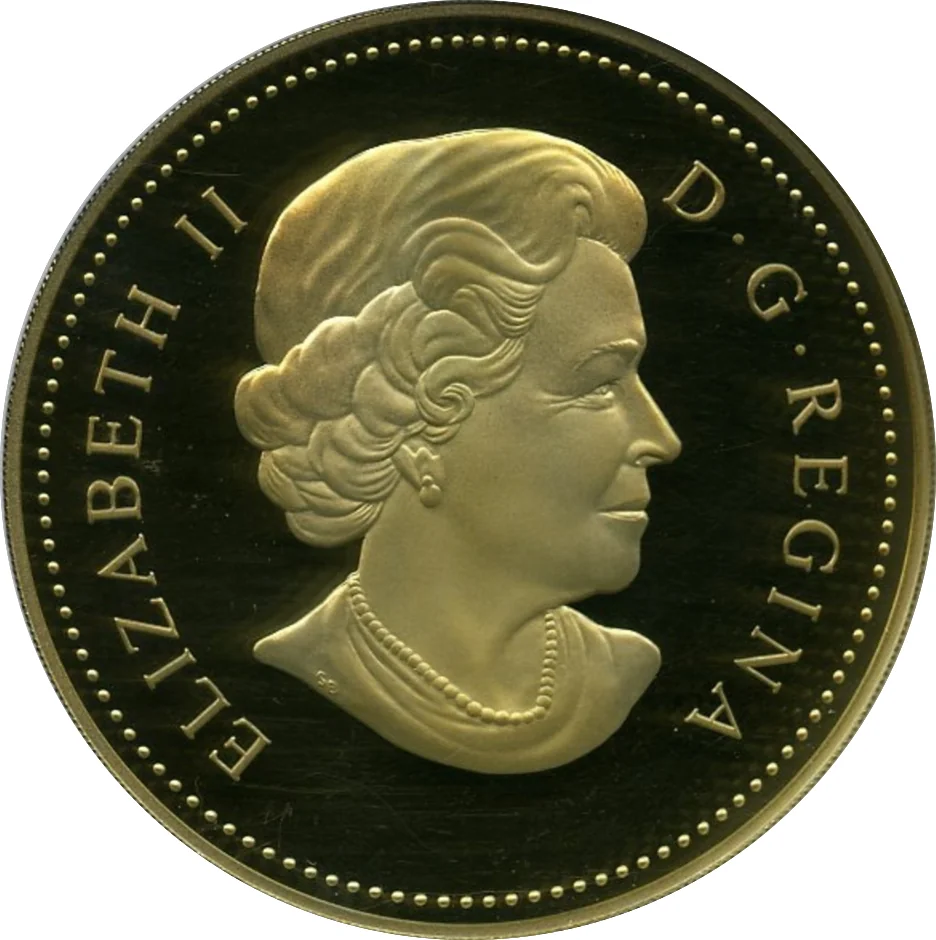
Obverse
Description:
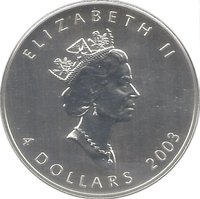
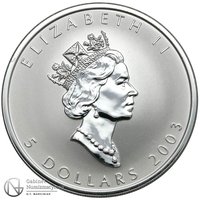
Queen Elizabeth II at 77, facing right, wearing a necklace and earrings.
Inscription:
ELIZABETH II D•G•REGINA
Translation:
Elizabeth II by the Grace of God, Queen
Script: Latin
Language: Latin
Engraver: Susan Taylor
Designer: Susanna Blunt
Reverse
Description:
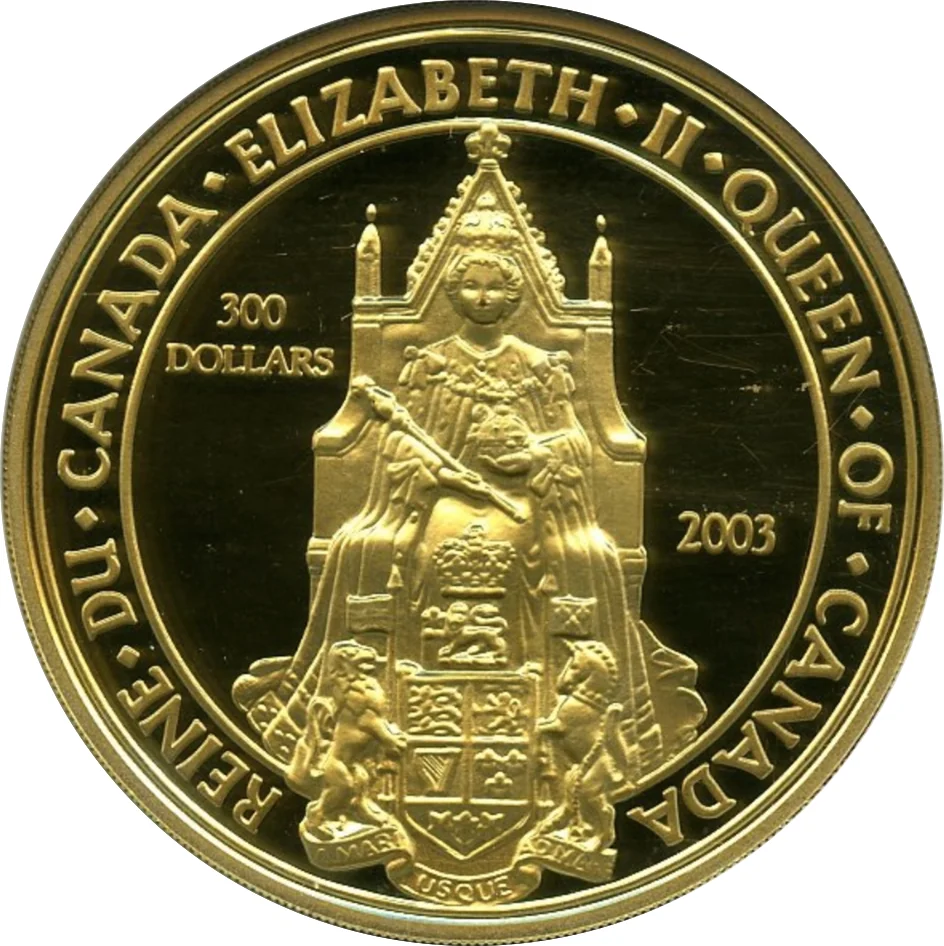
Queen Elizabeth II on the throne at her coronation, before the Canadian coat of arms, on the Great Seal of Canada.
Inscription:
REINE • DU • CANADA • ELIZABETH • II • QUEEN • OF • CANADA
300 DOLLARS
2003
300 DOLLARS
2003
Translation:
QUEEN OF CANADA ELIZABETH II QUEEN OF CANADA
300 DOLLARS
2003
300 DOLLARS
2003
Script: Latin
Edge
Serrated
Mints
| Name | Mark |
|---|---|
| Royal Canadian Mint of Ottawa | — |
Mintings
| Year | Mint Mark | Mintage | Quality | Collection |
|---|---|---|---|---|
| 2003 | — | 998 | Proof |
Historical background
In 2003, the Canadian dollar, often called the "loonie" after the aquatic bird on its one-dollar coin, was in the midst of a dramatic and sustained appreciation against the US dollar, marking a decisive end to a long period of weakness. For most of the 1990s and into the early 2000s, the loonie had traded significantly below parity, even hitting an all-time low of US$0.6179 in 2002. However, a powerful convergence of factors in 2003 reversed this trend, with the currency beginning a sharp climb that would see it gain over 20% in value against the greenback within the year, closing 2003 near US$0.77.
This surge was driven by a combination of strong commodity prices and relative economic fundamentals. As a major exporter of raw materials, Canada benefited enormously from soaring global prices for key exports like oil, natural gas, and metals, fueled by burgeoning demand from China and other emerging economies. Simultaneously, Canada's economic and fiscal position appeared stronger than that of the United States; the federal government was posting substantial budget surpluses, and the Bank of Canada had raised interest rates earlier and more aggressively than the US Federal Reserve, making Canadian assets more attractive to international investors and driving capital inflows.
The rapid rise of the loonie presented a significant policy challenge and a "double-edged sword" for the economy. While it reduced the cost of imports and eased inflationary pressures, providing the Bank of Canada room to keep interest rates lower, it severely hurt the critical manufacturing and export sectors, particularly in Central Canada. Industries like automotive and forestry faced intense pressure as their goods became more expensive for foreign buyers, leading to job losses and plant closures. Consequently, policymakers and businesses grappled with the complex adjustments required by a suddenly much stronger currency.
This surge was driven by a combination of strong commodity prices and relative economic fundamentals. As a major exporter of raw materials, Canada benefited enormously from soaring global prices for key exports like oil, natural gas, and metals, fueled by burgeoning demand from China and other emerging economies. Simultaneously, Canada's economic and fiscal position appeared stronger than that of the United States; the federal government was posting substantial budget surpluses, and the Bank of Canada had raised interest rates earlier and more aggressively than the US Federal Reserve, making Canadian assets more attractive to international investors and driving capital inflows.
The rapid rise of the loonie presented a significant policy challenge and a "double-edged sword" for the economy. While it reduced the cost of imports and eased inflationary pressures, providing the Bank of Canada room to keep interest rates lower, it severely hurt the critical manufacturing and export sectors, particularly in Central Canada. Industries like automotive and forestry faced intense pressure as their goods became more expensive for foreign buyers, leading to job losses and plant closures. Consequently, policymakers and businesses grappled with the complex adjustments required by a suddenly much stronger currency.


✨ Legendary