

½ Penny – ERR AustraliaandIndia - British
Context
Year: 1916
Issuer: ERR AustraliaandIndia - British
Ruler: George V
Currency:
(1788—1966)
Total mintage: 250
Material
References
KM: #Click to copy to clipboard30
Numista: #90246
Obverse
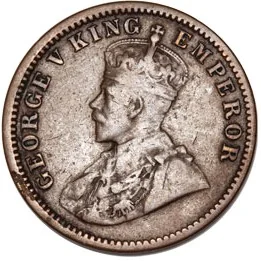
Description:
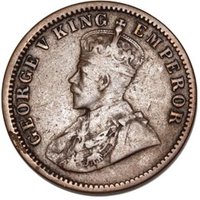
King George V facing left, English legend, toothed rim.
Inscription:
GEORGE V KING EMPEROR
Translation:
GEORGE V KING EMPEROR
Script: Latin
Language: English
Engraver: Edgar Bertram MacKennal
Reverse
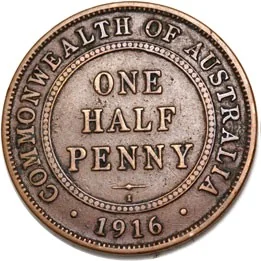
Description:
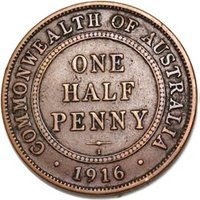
Denomination and mintmark within three beaded circles. Outer lettering, date below within dots.
Inscription:
COMMONWEALTH OF AUSTRALIA
ONE HALF PENNY
I
· 1916 ·
ONE HALF PENNY
I
· 1916 ·
Script: Latin
Engraver: William Henry James Blakemore
Edge
Plain
Mints
| Name | Mark |
|---|---|
| Kolkata / Calcutta / Murshidabad | — |
Mintings
| Year | Mint Mark | Mintage | Quality | Collection |
|---|---|---|---|---|
| 1916 | I | 250 |
Historical background
In 1916, both Australia and India, as integral parts of the British Empire, had their currency systems fundamentally anchored to the British Pound Sterling, but their practical monetary experiences during World War I were diverging. The core principle was the gold standard, where local currencies were legally defined as a fixed weight of gold and thus interchangeable with Sterling at a fixed rate. Australia operated on a "gold standard with a hole," where its pound (£A) was officially sterling but physical gold coin had largely been replaced by British silver and bronze and, more importantly, by banknotes. India's system was more complex, being a "gold exchange standard." The Indian Rupee's value was fixed not to a direct gold coin but to Sterling (at 1s 4d), with the Gold Standard Reserve held in London ensuring convertibility.
The war profoundly strained these systems. Both dominions saw the practical suspension of the gold standard, as Britain called upon their financial resources and gold reserves to fund the war effort. In Australia, this led to a sharp increase in the issuance of banknotes by the Commonwealth Treasury and trading banks, effectively creating a fiduciary paper currency. While the official peg to Sterling remained, inflationary pressures began to build. In India, the massive wartime expenditure by the British Government—financing its own armies and purchasing Indian goods—led to a huge influx of Sterling into the Indian monetary system. This increased the rupee's money supply without a corresponding increase in goods, stoking significant inflation and causing the rupee's market exchange rate to actually appreciate against sterling temporarily, contrary to official policy.
Consequently, by 1916, the shared imperial framework was masking distinct local pressures. Australia was grappling with the practical realities of a managed, inflationary currency divorced from gold, while maintaining a steadfast Sterling link for trade and debt purposes. India, meanwhile, was experiencing severe economic dislocation from its forced role as a financial reservoir for the Empire, with its currency system under immense internal strain from inflation and external strain from complex exchange management. For both, the war had set in motion monetary changes that would challenge the pre-war orthodoxy and reshape their financial relationships with Britain in the post-war era.
The war profoundly strained these systems. Both dominions saw the practical suspension of the gold standard, as Britain called upon their financial resources and gold reserves to fund the war effort. In Australia, this led to a sharp increase in the issuance of banknotes by the Commonwealth Treasury and trading banks, effectively creating a fiduciary paper currency. While the official peg to Sterling remained, inflationary pressures began to build. In India, the massive wartime expenditure by the British Government—financing its own armies and purchasing Indian goods—led to a huge influx of Sterling into the Indian monetary system. This increased the rupee's money supply without a corresponding increase in goods, stoking significant inflation and causing the rupee's market exchange rate to actually appreciate against sterling temporarily, contrary to official policy.
Consequently, by 1916, the shared imperial framework was masking distinct local pressures. Australia was grappling with the practical realities of a managed, inflationary currency divorced from gold, while maintaining a steadfast Sterling link for trade and debt purposes. India, meanwhile, was experiencing severe economic dislocation from its forced role as a financial reservoir for the Empire, with its currency system under immense internal strain from inflation and external strain from complex exchange management. For both, the war had set in motion monetary changes that would challenge the pre-war orthodoxy and reshape their financial relationships with Britain in the post-war era.
💎 Extremely Rare