

5 pesos – Cuba
Add to wishlist
Circulating commemorative coins
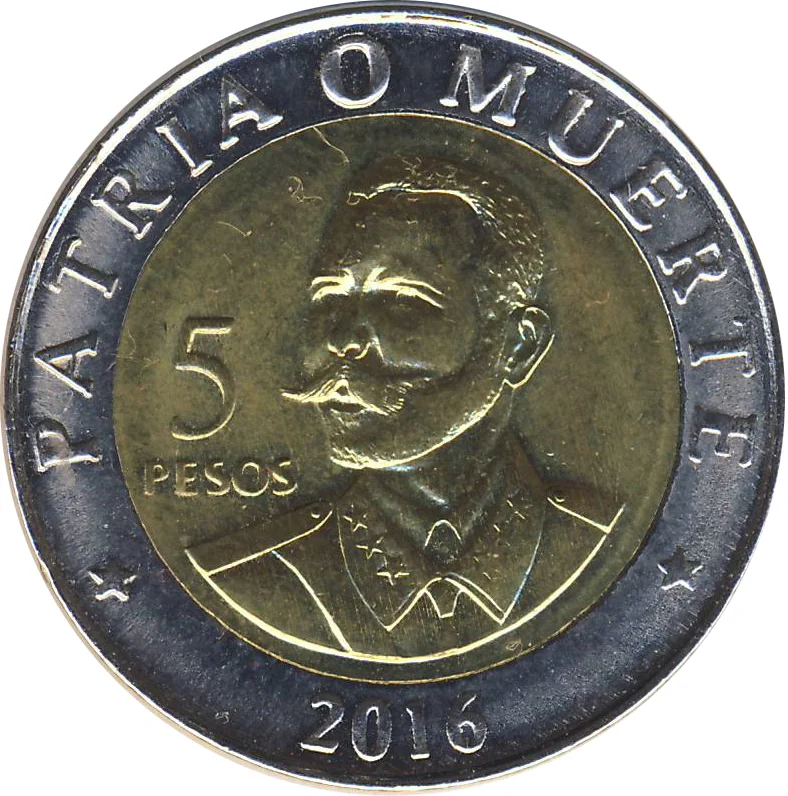
Commemoration: Antonio Maceo
Cuba
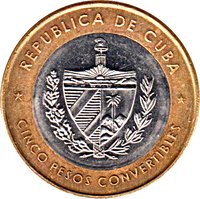
Obverse
Description:
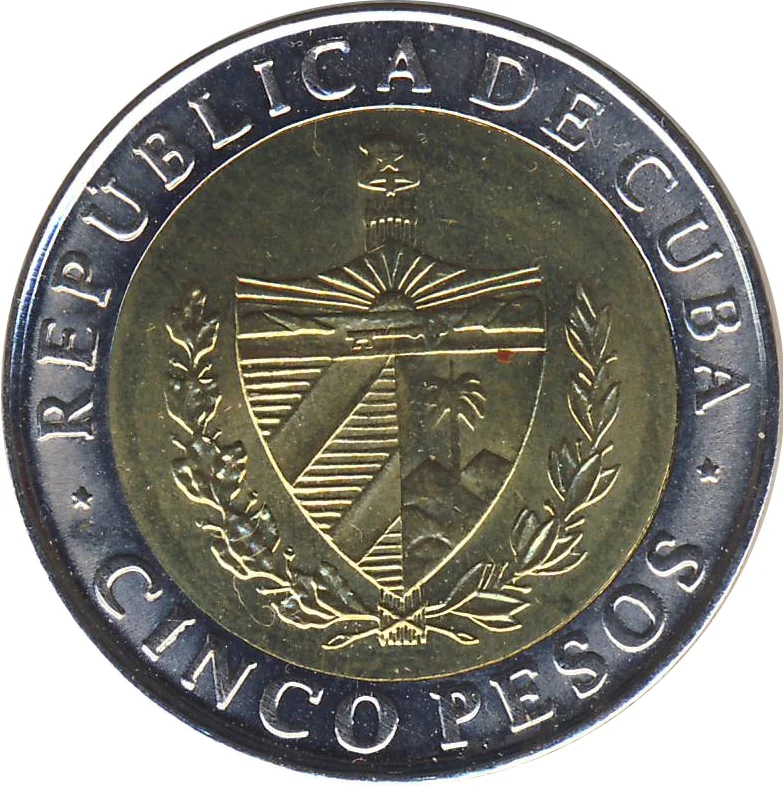
Cuban coat of arms centered, country name and value encircling it.
Inscription:
REPUBLICA DE CUBA
• CINCO PESOS •
• CINCO PESOS •
Translation:
REPUBLIC OF CUBA
• FIVE PESOS •
• FIVE PESOS •
Script: Latin
Language: Spanish
Engraver: Charles Edward Barber
Reverse
Edge
Reeded
Categories
| Person> Military leader |
| Symbols> Coat of Arms |
Mints
| Name | Mark |
|---|---|
| Empresa Cubana de Acuñaciones | — |
Mintings
| Year | Mint Mark | Mintage | Quality | Collection |
|---|---|---|---|---|
| 2016 | — | — | ||
| 2017 | — | — | ||
| 2018 | — | — | ||
| 2021 | — | — |
Historical background
In 2016, Cuba was grappling with a complex and economically damaging dual-currency system that had been in place since 1994. The system consisted of the Cuban Peso (CUP), used by most Cubans for their salaries and local goods, and the Convertible Peso (CUC), which was pegged 1:1 to the US dollar and used for tourism, imported goods, and luxury items. This created a stark economic apartheid, as Cubans earning in CUPs (with an official exchange rate of 24 CUP to 1 CUC) found essential imported goods and many services priced in the much stronger CUC, effectively making them unaffordable. The system distorted the entire economy, incentivized a brain drain to tourism jobs, and complicated accounting for both state and emerging private enterprises.
The situation was under increasing pressure due to Cuba’s ongoing economic challenges and the nascent process of normalization with the United States initiated in 2014. While the government, under President Raúl Castro, had long acknowledged that currency unification was essential for modernizing the economy, the move was fraught with risk. Eliminating the CUC threatened to trigger inflation, devalue savings, and destabilize state-owned enterprises that relied on artificial exchange rates. Throughout 2016, authorities continued a cautious, incremental approach, focusing on preparing the macroeconomic conditions and expanding the sectors allowed to use CUP, while the public awaited a definitive timeline for the full unification.
Thus, the currency situation in 6 was one of tense anticipation. The dysfunctional dual system was widely recognized as unsustainable, acting as a major brake on productivity and creating profound social inequalities. However, the government proceeded slowly, prioritizing stability over speed, as it managed the delicate balance of implementing essential reform without triggering social unrest. The year passed without the long-promised unification, leaving the population to continue coping with the daily frustrations and inequities of the two-currency reality.
The situation was under increasing pressure due to Cuba’s ongoing economic challenges and the nascent process of normalization with the United States initiated in 2014. While the government, under President Raúl Castro, had long acknowledged that currency unification was essential for modernizing the economy, the move was fraught with risk. Eliminating the CUC threatened to trigger inflation, devalue savings, and destabilize state-owned enterprises that relied on artificial exchange rates. Throughout 2016, authorities continued a cautious, incremental approach, focusing on preparing the macroeconomic conditions and expanding the sectors allowed to use CUP, while the public awaited a definitive timeline for the full unification.
Thus, the currency situation in 6 was one of tense anticipation. The dysfunctional dual system was widely recognized as unsustainable, acting as a major brake on productivity and creating profound social inequalities. However, the government proceeded slowly, prioritizing stability over speed, as it managed the delicate balance of implementing essential reform without triggering social unrest. The year passed without the long-promised unification, leaving the population to continue coping with the daily frustrations and inequities of the two-currency reality.
🌱 Common