

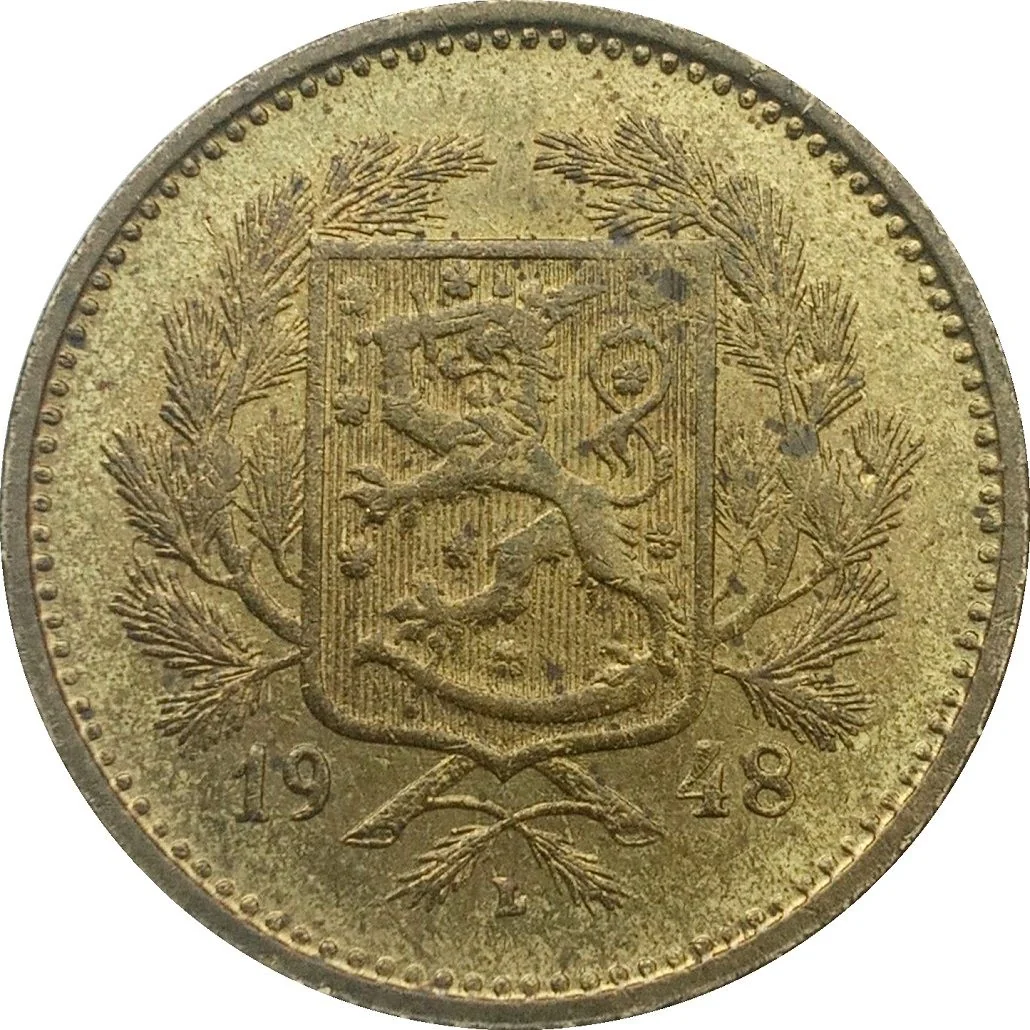
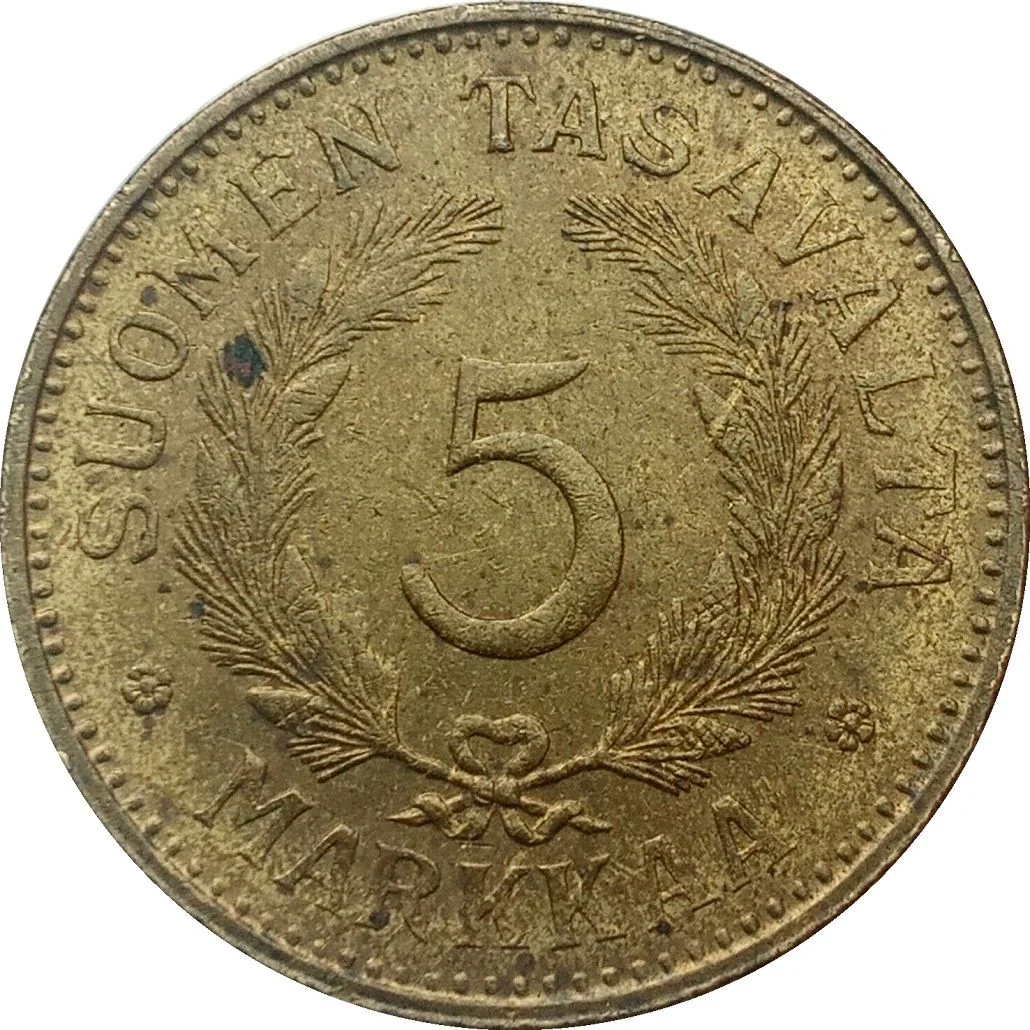
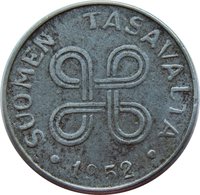
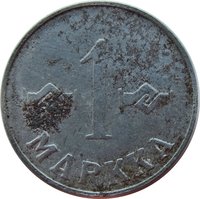
Obverse
Reverse
Inscription:
SUOMEN TASAVALTA
5
* MARKKAA *
5
* MARKKAA *
Translation:
REPUBLIC OF FINLAND
5
* MARKKA *
5
* MARKKA *
Script: Latin
Language: Finnish
Engraver: Isak Gustaf Sundell
Edge
Reeded
Categories
| Animal> Feline |
| Plants> Flower |
| Symbols> Coat of Arms |
| Symbol> Wreath |
| Object> Cold weapons |
Mints
| Name | Mark |
|---|---|
| Mint of Finland | — |
Mintings
| Year | Mint Mark | Mintage | Quality | Collection |
|---|---|---|---|---|
| 1946 | — | 5,538,000 | ||
| 1947 | — | 6,550,000 | ||
| 1948 | — | 8,210,000 | ||
| 1949 | — | — | ||
| 1950 | — | 4,762,000 | ||
| 1951 | — | 7,798,000 | ||
| 1952 | — | 1,210,000 |
Historical background
In 1946, Finland’s currency situation was a direct consequence of the immense economic strain of World War II. The country had fought two major conflicts against the Soviet Union (the Winter War and Continuation War) and a third against Germany (the Lapland War), leaving its economy depleted, burdened by heavy war reparations to the USSR, and suffering from widespread shortages and inflation. The Bank of Finland had financed the war effort largely by printing money, leading to a significant oversupply of banknotes in circulation, a loss of public confidence in the currency's value, and a thriving black market.
To address this crisis, the Finnish government undertook a radical monetary reform in 1946. The old markka was effectively declared invalid and replaced with a new currency, simply called the markka, at a rate of 1 new markka for 100 old markka. This redenomination, or "lopping off of zeros," was a practical measure to simplify transactions and restore some semblance of order to the monetary system. More critically, it was accompanied by a strict conversion process where only a limited amount of old cash could be exchanged freely, with larger holdings being frozen or transferred into bank accounts for scrutiny, aiming to mop up excess liquidity and curb inflationary pressures.
The reform was politically and socially difficult, perceived by many as a forced confiscation of savings, but it was deemed a necessary step for stabilization. It did not instantly solve Finland's profound economic challenges, which required years of austerity, careful planning, and the fostering of new export industries to meet reparation payments. However, the 1946 currency reform successfully reset the monetary baseline, ending the hyperinflationary spiral and creating a more stable framework for the subsequent period of reconstruction and managed growth under the influence of the Bank of Finland and government controls.
To address this crisis, the Finnish government undertook a radical monetary reform in 1946. The old markka was effectively declared invalid and replaced with a new currency, simply called the markka, at a rate of 1 new markka for 100 old markka. This redenomination, or "lopping off of zeros," was a practical measure to simplify transactions and restore some semblance of order to the monetary system. More critically, it was accompanied by a strict conversion process where only a limited amount of old cash could be exchanged freely, with larger holdings being frozen or transferred into bank accounts for scrutiny, aiming to mop up excess liquidity and curb inflationary pressures.
The reform was politically and socially difficult, perceived by many as a forced confiscation of savings, but it was deemed a necessary step for stabilization. It did not instantly solve Finland's profound economic challenges, which required years of austerity, careful planning, and the fostering of new export industries to meet reparation payments. However, the 1946 currency reform successfully reset the monetary baseline, ending the hyperinflationary spiral and creating a more stable framework for the subsequent period of reconstruction and managed growth under the influence of the Bank of Finland and government controls.
🌱 Very Common