

1 rupee – Sri Lanka
Add to wishlist
Sri Lanka
Context
Material
Diameter: 25 mm
Weight: 7.1 g
Thickness: 1.8 mm
Shape: Round
Composition: Copper-nickel
Magnetic: No
Technique: Milled
Alignment: Medal alignment
flip
References
KM: #
Numista: #895
Value
Exchange value: 1 LKR
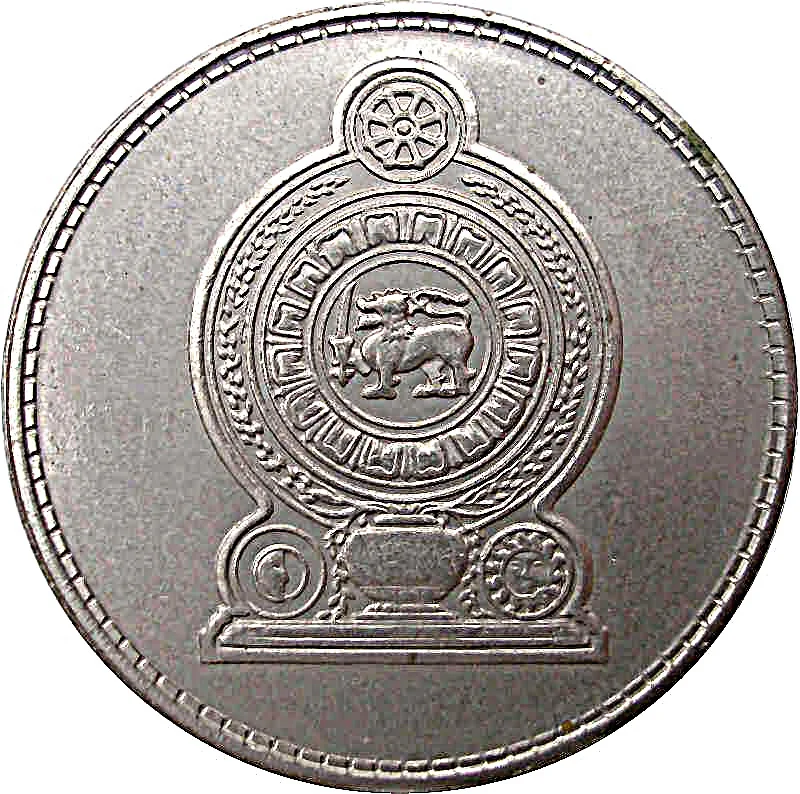
Obverse
Description:
National flag of Sri Lanka
Reverse
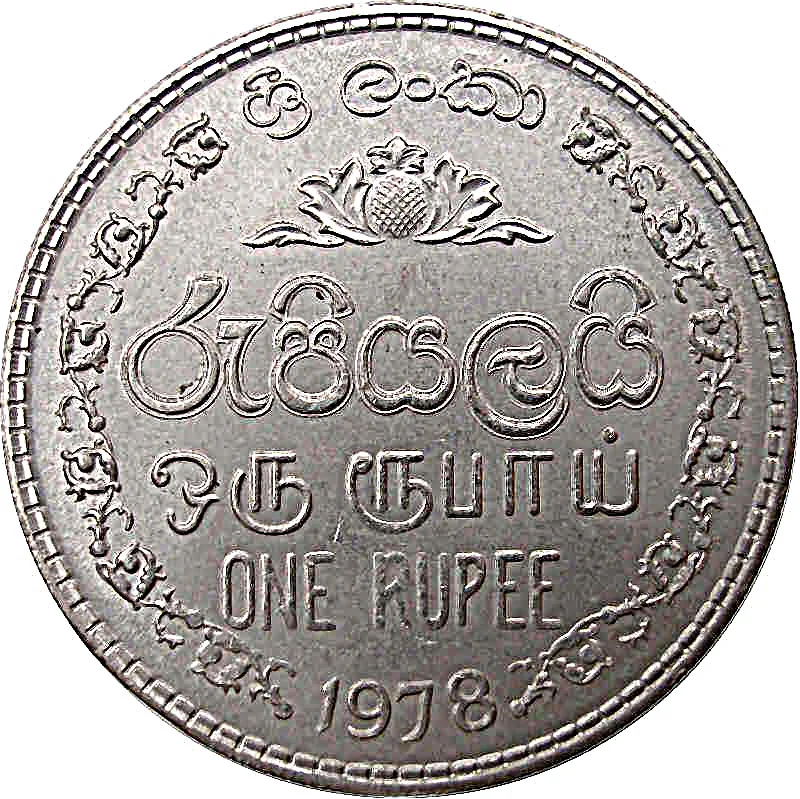
Description:
A central trilingual value, encircled by a floral ornament, with the Sinhala country name above and the date below.
Inscription:
ශ්රී ලංකා
රුපියලයි
ஒரு ரூபாய்
ONE RUPEE
1978
රුපියලයි
ஒரு ரூபாய்
ONE RUPEE
1978
Translation:
Sri Lanka
It is a Rupee
One Rupee
ONE RUPEE
1978
It is a Rupee
One Rupee
ONE RUPEE
1978
Edge
Reeded or security edge
Mints
| Name | Mark |
|---|---|
| Royal Mint | — |
Mintings
| Year | Mint Mark | Mintage | Quality | Collection |
|---|---|---|---|---|
| 1972 | — | 7,000,000 | ||
| 1975 | — | 31,500,000 | ||
| 1978 | — | 37,018,000 | ||
| 1978 | — | 20,000 | Proof | |
| 1982 | — | 75,000,000 | ||
| 1994 | — | 50,000,000 |
Historical background
In 1972, Sri Lanka's currency situation was fundamentally shaped by the economic policies of the newly established Republic, which had just replaced the Dominion of Ceylon. The government, led by Prime Minister Sirimavo Bandaranaike, pursued a socialist-oriented, inward-looking economic model characterized by extensive state controls, import substitution, and fixed exchange rates. The Sri Lankan rupee was pegged to a basket of currencies, though effectively tied to the British pound sterling, at a rate of approximately Rs. 15.60 to £1. This overvalued official exchange rate, maintained through strict foreign exchange regulations, created a significant disparity with the black market, where the rupee traded at a much weaker value due to scarcity.
The currency regime was under severe pressure from chronic balance of payments deficits. The country's export base was narrow, relying heavily on tea, rubber, and coconut, whose prices were volatile on the global market. Meanwhile, the cost of essential imports like food and fuel was rising. To conserve scarce foreign reserves, the government enforced stringent import controls and exchange restrictions, leading to shortages of goods and stifling economic growth. This controlled system aimed to manage the external account but resulted in inefficiencies, suppressed export competitiveness, and encouraged illicit currency flows.
Overall, the currency situation in 1972 reflected a struggling, tightly managed economy facing structural weaknesses. The fixed and overvalued exchange rate, combined with a complex system of permits and quotas for foreign exchange, was unsustainable in the long term. It set the stage for the economic difficulties that would intensify throughout the 1970s, eventually leading to a major liberalization shift in 1977, when the rupee was devalued and a more flexible exchange rate mechanism was adopted.
The currency regime was under severe pressure from chronic balance of payments deficits. The country's export base was narrow, relying heavily on tea, rubber, and coconut, whose prices were volatile on the global market. Meanwhile, the cost of essential imports like food and fuel was rising. To conserve scarce foreign reserves, the government enforced stringent import controls and exchange restrictions, leading to shortages of goods and stifling economic growth. This controlled system aimed to manage the external account but resulted in inefficiencies, suppressed export competitiveness, and encouraged illicit currency flows.
Overall, the currency situation in 1972 reflected a struggling, tightly managed economy facing structural weaknesses. The fixed and overvalued exchange rate, combined with a complex system of permits and quotas for foreign exchange, was unsustainable in the long term. It set the stage for the economic difficulties that would intensify throughout the 1970s, eventually leading to a major liberalization shift in 1977, when the rupee was devalued and a more flexible exchange rate mechanism was adopted.
🌱 Very Common