

200 Milliemes – Sudan
Sudan

Obverse
Description:
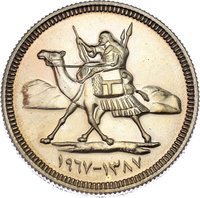
Man in traditional costume faces left inside an oval, flanked by palm trees (two on his right, one on his left).
Inscription:
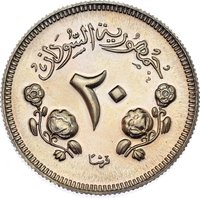
جمهورية السودان
٢٠٠ مليم
٢٠٠ مليم
Translation:
Republic of the Sudan
200 Millim
200 Millim
Language: Arabic
Reverse
Description:
Man in traditional costume faces left inside an oval, flanked by palm trees (two on his right, one on his left).
Inscription:
REPUBLIC SUDAN
200 MILLIEMES
200 MILLIEMES
Edge
Mintings
| Year | Mint Mark | Mintage | Quality | Collection |
|---|---|---|---|---|
| 1956 | — | — |
Historical background
At Sudan’s independence on 1 January 1956, the nation inherited a complex currency situation directly tied to its colonial past. The official currency was the Sudanese pound, which was not an independent note but a issue of the Sudan Currency Board, headquartered in London. This board held sterling reserves to fully back the currency, pegging the Sudanese pound at par with the British pound sterling. In practice, the currency was a colonial sterling-area currency, managed externally to ensure stability and facilitate trade with Britain, but offering Khartoum little control over monetary policy.
This system presented immediate challenges for the new sovereign state. While the currency board arrangement provided low inflation and credibility, it severely constrained the government’s ability to finance development projects or manage economic shocks by printing money or adjusting interest rates. Furthermore, the economy was highly dependent on cotton exports, and foreign exchange earnings were largely controlled through the board’s sterling link. This lack of monetary autonomy was at odds with the ambitions of a nation seeking to chart its own economic course and fund essential infrastructure and services.
Consequently, one of the first major economic policy debates in post-independence Sudan centered on establishing a national central bank to replace the currency board. This move was seen as a critical step toward true economic sovereignty, allowing for a managed currency that could respond to domestic needs. The outcome was the establishment of the Bank of Sudan in 1959, which began issuing a sovereign Sudanese pound in 1960, marking the end of the automatic sterling peg and the beginning of an independent, though challenging, monetary era.
This system presented immediate challenges for the new sovereign state. While the currency board arrangement provided low inflation and credibility, it severely constrained the government’s ability to finance development projects or manage economic shocks by printing money or adjusting interest rates. Furthermore, the economy was highly dependent on cotton exports, and foreign exchange earnings were largely controlled through the board’s sterling link. This lack of monetary autonomy was at odds with the ambitions of a nation seeking to chart its own economic course and fund essential infrastructure and services.
Consequently, one of the first major economic policy debates in post-independence Sudan centered on establishing a national central bank to replace the currency board. This move was seen as a critical step toward true economic sovereignty, allowing for a managed currency that could respond to domestic needs. The outcome was the establishment of the Bank of Sudan in 1959, which began issuing a sovereign Sudanese pound in 1960, marking the end of the automatic sterling peg and the beginning of an independent, though challenging, monetary era.
✨ Legendary