

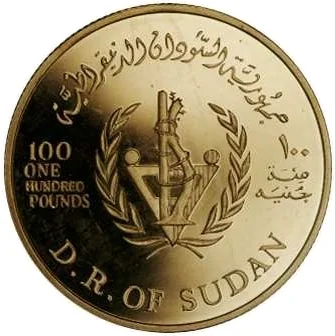
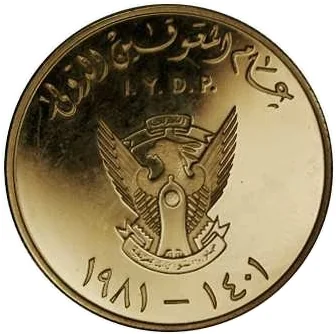
100 pounds – Sudan
Add to wishlist
Non-circulating coins
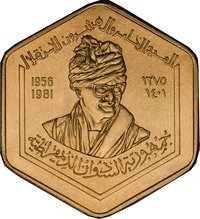
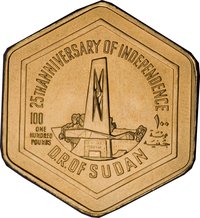
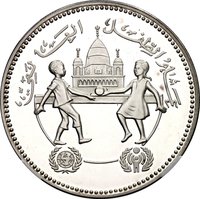
Commemoration: International Year of Disabled Persons
Sudan
Context
Year: 1981
Islamic (Hijri) Year:: 1401
Issuer: Sudan
Period:
(1969—1985)
Currency:
(1956—1992)
Demonetization: 8 June 1992
Total mintage: 4,000
Material
References
KM: #
Numista: #89179
Value
Exchange value: 100 SDP
Bullion value: $2247.08
Edge
Mintings
| Year | Mint Mark | Mintage | Quality | Collection |
|---|---|---|---|---|
| 1981 | — | 2,000 | ||
| 1981 | — | 2,000 | Proof |
Historical background
In 1981, Sudan's currency situation was characterized by mounting instability and the early stages of a profound economic crisis. The country was still using the Sudanese pound (SDG), which was officially pegged to the U.S. dollar, but this parity was becoming increasingly unsustainable. Under President Gaafar Nimeiry's regime, economic mismanagement, coupled with a massive external debt burden and falling agricultural productivity, led to severe balance of payments problems. The government's response—financing deficits through money creation—fueled inflation and put intense pressure on the official exchange rate.
This pressure gave rise to a thriving black market for foreign currency, where the Sudanese pound traded at a significant discount compared to the official rate. The disparity between the two rates created major distortions, discouraging official exports and leading to widespread corruption and smuggling. The situation was exacerbated by the government's ambitious but costly development projects and its heavy reliance on imports, which drained foreign reserves. Consequently, confidence in the national currency was eroding both domestically and internationally.
The currency woes of 1981 were a clear precursor to more drastic measures. The economic strains of this period contributed directly to the disastrous devaluation and currency reform enacted in 1982, when Nimeiry's government attempted to stem the crisis by introducing a new currency, the "Sudanese dinar," at a rate of 1 dinar = 10 pounds. This abrupt move, which failed to address underlying fiscal indiscipline, further disrupted the economy, wiped out savings, and fueled social unrest, setting the stage for the deepening crises of the mid-1980s.
This pressure gave rise to a thriving black market for foreign currency, where the Sudanese pound traded at a significant discount compared to the official rate. The disparity between the two rates created major distortions, discouraging official exports and leading to widespread corruption and smuggling. The situation was exacerbated by the government's ambitious but costly development projects and its heavy reliance on imports, which drained foreign reserves. Consequently, confidence in the national currency was eroding both domestically and internationally.
The currency woes of 1981 were a clear precursor to more drastic measures. The economic strains of this period contributed directly to the disastrous devaluation and currency reform enacted in 1982, when Nimeiry's government attempted to stem the crisis by introducing a new currency, the "Sudanese dinar," at a rate of 1 dinar = 10 pounds. This abrupt move, which failed to address underlying fiscal indiscipline, further disrupted the economy, wiped out savings, and fueled social unrest, setting the stage for the deepening crises of the mid-1980s.
✨ Legendary