

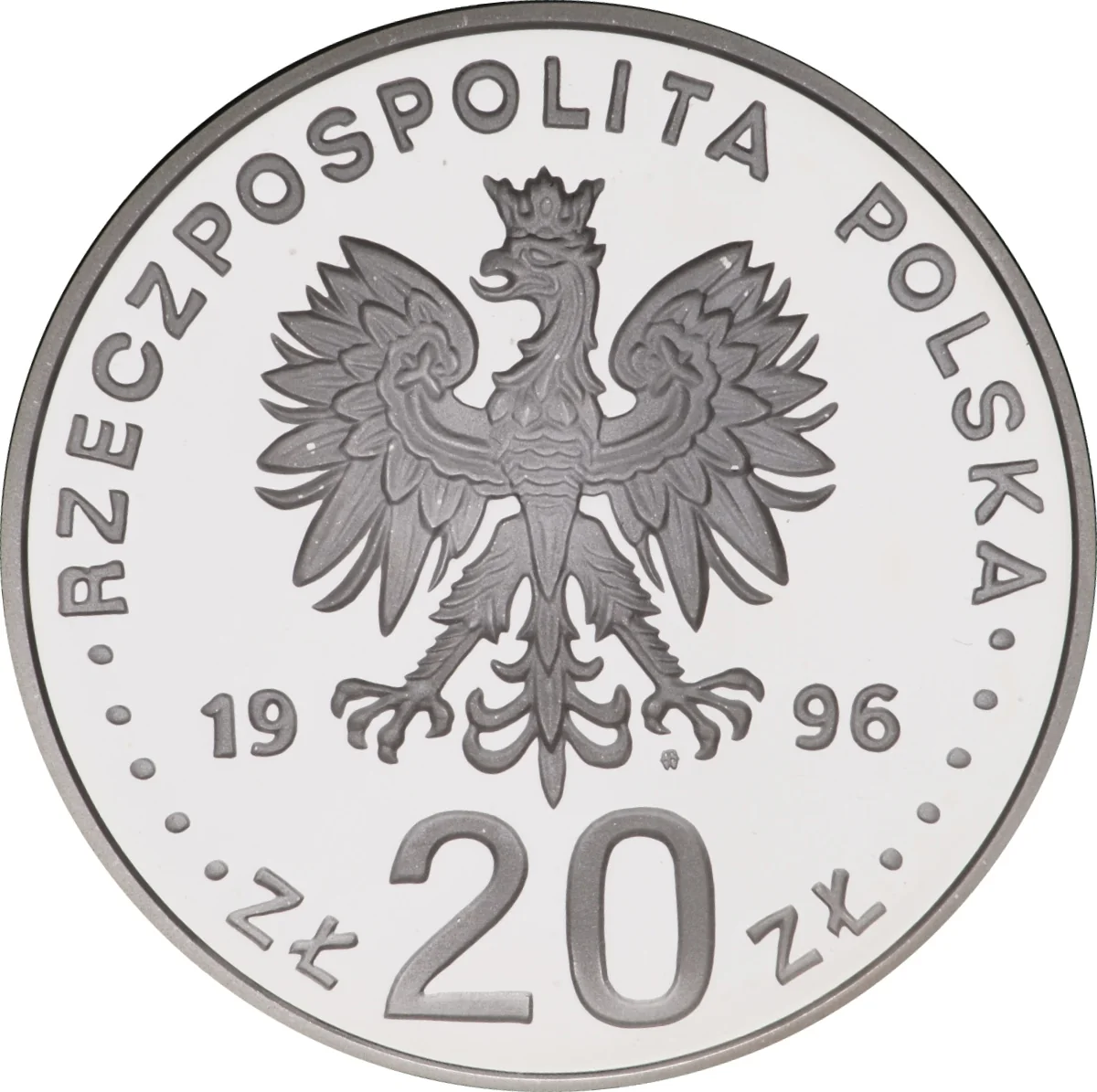
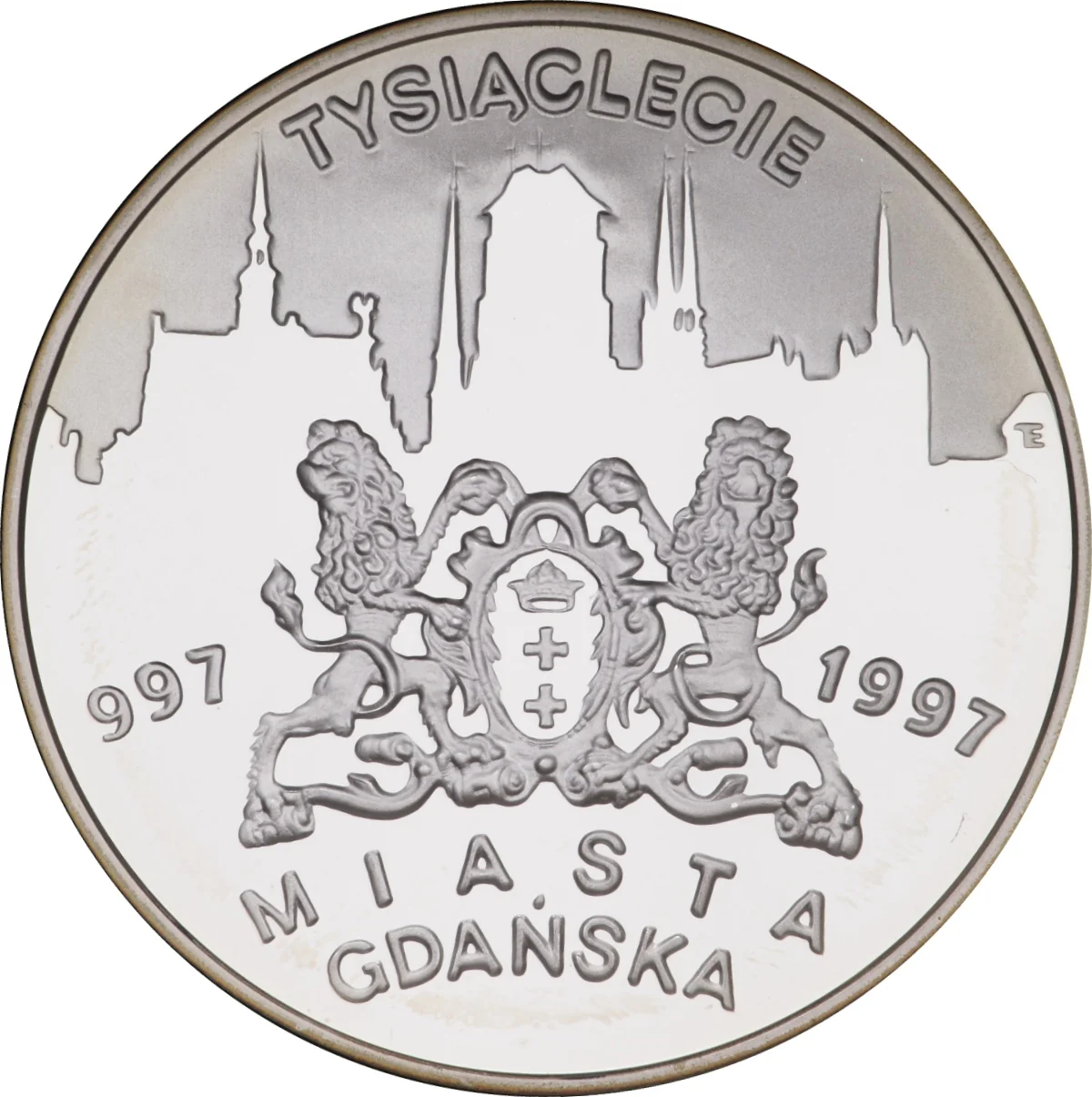
20 Zlotys (Gdańsk) – Poland
Non-circulating coins
Commemoration: The 1000th anniversary of Gdańsk (997 - 1997)
Poland
Context

Material
Diameter: 38.61 mm
Weight: 31.1 g
Silver weight: 28.77 g
Shape: Round
Composition: 92.5% Silver
Standard: Silver ounce
Magnetic: No
Technique: Milled
Alignment: Medal alignment
flip
References
Y: #Click to copy to clipboard319
Numista: #89008
Value
Exchange value: 20 PLN = $5.60
Bullion value: $83.58
Inflation-adjusted value: 80.04 PLN
Obverse
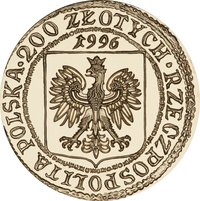
Inscription:
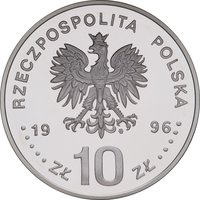
RZECZPOSPOLITA POLSKA
1996
mw
ZŁ 20 ZŁ
1996
mw
ZŁ 20 ZŁ
Translation:
REPUBLIC OF POLAND
1996
mw
20 ZŁ ZŁ
1996
mw
20 ZŁ ZŁ
Script: Latin
Language: Polish
Designer: Ewa Tyc-Karpińska
Reverse
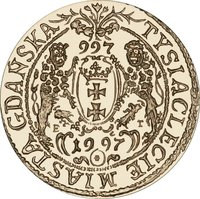
Inscription:
TYSIĄCLECIE
997 1997
MIASTA
GDAŃSKA
997 1997
MIASTA
GDAŃSKA
Translation:
MILLENNIUM
997 1997
OF THE CITY
OF GDAŃSK
997 1997
OF THE CITY
OF GDAŃSK
Script: Latin
Language: Polish
Designer: Ewa Tyc-Karpińska
Edge
Smooth with inscription
Legend:
MONUMENTUM MILLENII CIVITATIS GEDANENSIS
Mints
| Name | Mark |
|---|---|
| Mint of Poland | (MW) |
Mintings
| Year | Mint Mark | Mintage | Quality | Collection |
|---|---|---|---|---|
| 1996 | MW | 20,000 | Proof |
Historical background
In 1996, Poland was in a period of robust economic transition and stabilization following the "shock therapy" reforms of the early 1990s. The national currency, the złoty (PLN), was no longer subject to the hyperinflation and extreme volatility of the previous decade. A crucial milestone had been reached in 1995 when the government carried out a redenomination, introducing a "new złoty" (PLN) that replaced 10,000 "old złotys" (PLZ). By 1996, this technical change was fully bedded in, simplifying transactions and symbolizing the country's successful taming of inflation, which had fallen to an annual rate of approximately 19%—still high by Western standards but a dramatic improvement from earlier peaks.
The exchange rate regime was a managed float, operating under a "crawling peg" system. The National Bank of Poland (NBP) deliberately devalued the złoty against a basket of currencies (primarily the US Dollar and Deutsche Mark) at a pre-announced, gradually slowing rate. This policy, initiated in 1991, aimed to provide stability for trade and investment by preventing sudden shocks, while allowing for a controlled adjustment to account for Poland's higher inflation relative to its trading partners. In 1996, the monthly crawl was set at 1.2%, reflecting continued confidence in the currency's trajectory.
This period was one of consolidation and preparation for deeper integration with the global economy. Poland's strong economic growth, attracting significant foreign direct investment, created upward pressure on the złoty, which occasionally conflicted with the central bank's devaluation schedule. The currency stability achieved by 1996 was a key foundation for the next major steps: the lifting of all remaining capital controls later in the year and the subsequent shift to a fully floating exchange rate in 2000, which would pave the way for eventual European Union accession and the future adoption of the euro.
The exchange rate regime was a managed float, operating under a "crawling peg" system. The National Bank of Poland (NBP) deliberately devalued the złoty against a basket of currencies (primarily the US Dollar and Deutsche Mark) at a pre-announced, gradually slowing rate. This policy, initiated in 1991, aimed to provide stability for trade and investment by preventing sudden shocks, while allowing for a controlled adjustment to account for Poland's higher inflation relative to its trading partners. In 1996, the monthly crawl was set at 1.2%, reflecting continued confidence in the currency's trajectory.
This period was one of consolidation and preparation for deeper integration with the global economy. Poland's strong economic growth, attracting significant foreign direct investment, created upward pressure on the złoty, which occasionally conflicted with the central bank's devaluation schedule. The currency stability achieved by 1996 was a key foundation for the next major steps: the lifting of all remaining capital controls later in the year and the subsequent shift to a fully floating exchange rate in 2000, which would pave the way for eventual European Union accession and the future adoption of the euro.
💎 Extremely Rare