

1 rupee – Nepal
Add to wishlist
Nepal
Context
Material
Diameter: 27.5 mm
Weight: 6.75 g
Thickness: 1.75 mm
Shape: Round
Composition: Stainless steel
Technique: Milled
Alignment: Medal alignment
flip
References
KM: #
Numista: #8862
Value
Exchange value: 1 NPR
Obverse
Description:
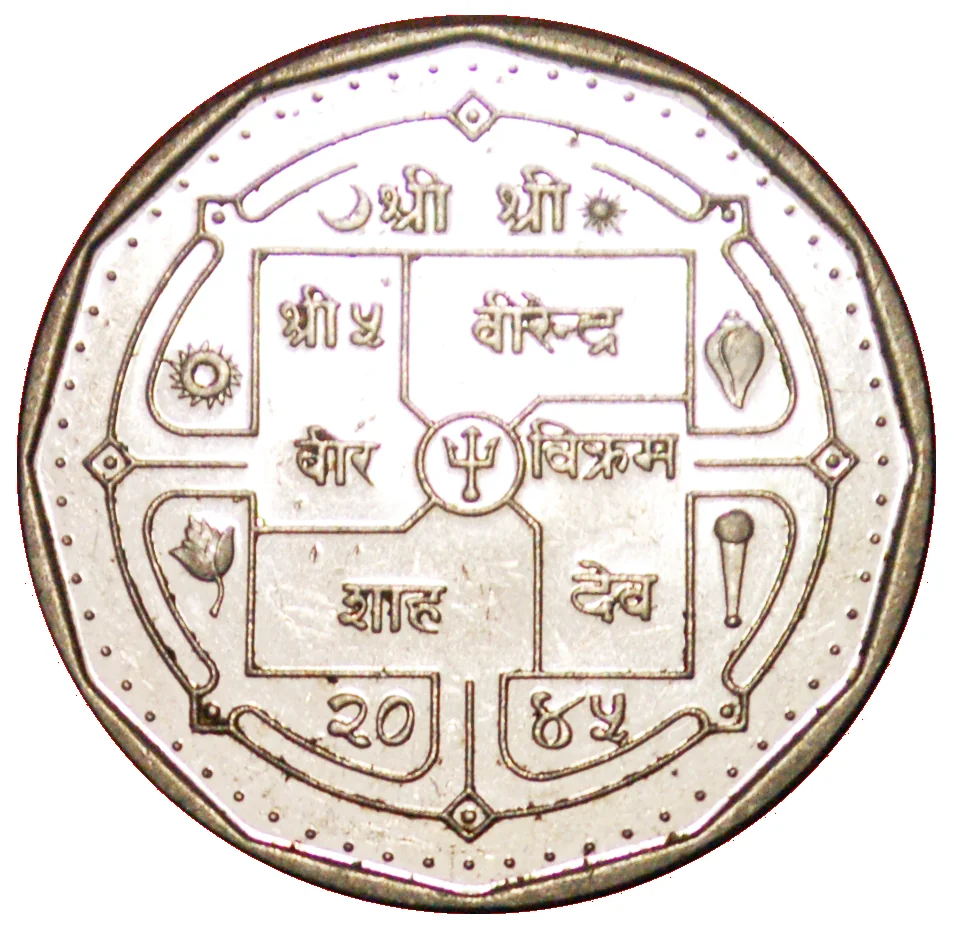
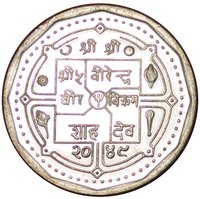
Central: Trident with legend. Square corners: Chakra, Shank, Gadha, Padma. Top: Crescent, two Sri symbols, Sun. Bottom: Year.
Inscription:
श्री श्री
श्री ५ वीरेन्द्र
वीर विक्रम
शाह देव
२०४५
श्री ५ वीरेन्द्र
वीर विक्रम
शाह देव
२०४५
Translation:
Shri Shri
Shri 5 Virendra
Vir Vikram
Shah Dev
2045
Shri 5 Virendra
Vir Vikram
Shah Dev
2045
Language: Nepali
Reverse
Description:
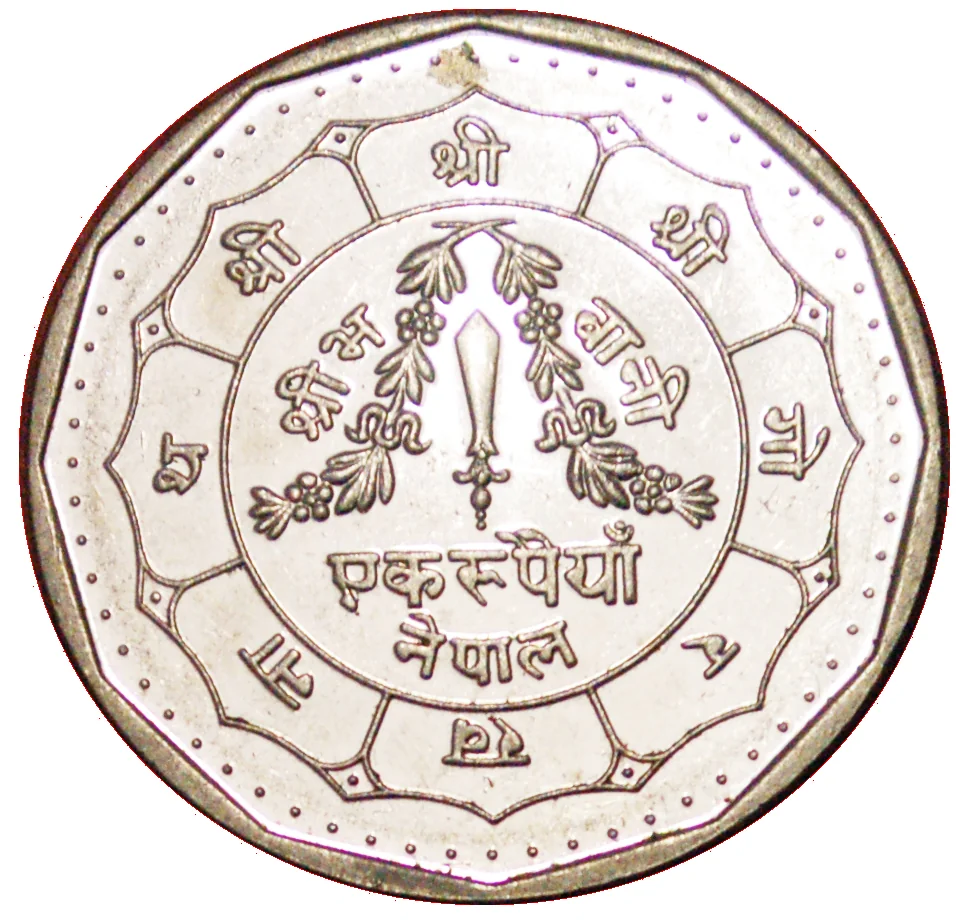
Dagger flanked by garlands. Devanagari legends: "Shree Shree Shree Gorkhanath" outside circle; "Shree Bhavani" above; "Ek Rupaiya" line; "Nepal" bottom semicircle.
Inscription:
श्री श्री श्री गो र ख ना थ
श्री भवानी
एक रुपैयाँ
नेपाल
श्री भवानी
एक रुपैयाँ
नेपाल
Translation:
Shri Shri Shri Gorakhnath
Shri Bhavani
One Rupee
Nepal
Shri Bhavani
One Rupee
Nepal
Edge
Plain
Mintings
| Year | Mint Mark | Mintage | Quality | Collection |
|---|---|---|---|---|
| 1988 | — | — | Prooflike | |
| 1991 | — | — | Prooflike | |
| 1992 | — | — | Prooflike |
Historical background
In 1988, Nepal's currency situation was dominated by its complex and strained economic relationship with India, its largest trading partner. Since 1960, the Nepalese rupee (NRs) had been pegged to the Indian rupee (INR) at a fixed rate of 1:1.25 (1 INR = 1.25 NRs), facilitating open-border trade. However, this arrangement made Nepal's economy highly vulnerable to India's monetary policy and trade decisions. A significant point of tension was the widespread use of Indian currency notes within Nepal's territory, which, while practical for cross-border commerce, limited Nepal's own monetary sovereignty and control over its money supply.
The situation reached a critical juncture in 1988 when a major trade and transit dispute erupted between the two countries. India, citing security concerns, unilaterally closed multiple border crossing points and imposed what was effectively an economic blockade. This severe disruption choked off essential supplies, including fuel and medicine, and triggered a sharp depreciation of the Nepalese rupee in the unofficial market. With trade crippled, confidence in the Nepalese currency plummeted, and the fixed peg came under immense practical strain, exposing the fragility of Nepal's dependent monetary framework.
Consequently, 1988 became a watershed year that forced a fundamental rethink of Nepal's monetary policy. The crisis starkly revealed the dangers of excessive dependence on a single foreign currency and a rigid exchange rate peg. The economic hardship and currency instability of this period provided the direct impetus for Nepal to pursue greater monetary independence, which would culminate in the landmark Nepal Rastra Bank Act of 2002 and the Foreign Exchange Regulation Act of 2003. These later reforms aimed to establish a more flexible and managed floating exchange rate system, reducing the overwhelming influence of the Indian rupee and strengthening the central bank's control over the national currency.
The situation reached a critical juncture in 1988 when a major trade and transit dispute erupted between the two countries. India, citing security concerns, unilaterally closed multiple border crossing points and imposed what was effectively an economic blockade. This severe disruption choked off essential supplies, including fuel and medicine, and triggered a sharp depreciation of the Nepalese rupee in the unofficial market. With trade crippled, confidence in the Nepalese currency plummeted, and the fixed peg came under immense practical strain, exposing the fragility of Nepal's dependent monetary framework.
Consequently, 1988 became a watershed year that forced a fundamental rethink of Nepal's monetary policy. The crisis starkly revealed the dangers of excessive dependence on a single foreign currency and a rigid exchange rate peg. The economic hardship and currency instability of this period provided the direct impetus for Nepal to pursue greater monetary independence, which would culminate in the landmark Nepal Rastra Bank Act of 2002 and the Foreign Exchange Regulation Act of 2003. These later reforms aimed to establish a more flexible and managed floating exchange rate system, reducing the overwhelming influence of the Indian rupee and strengthening the central bank's control over the national currency.
🌱 Common