

10 Israeli Pounds – Israel
Non-circulating coins
Commemoration: Victory Commemorative - Six-Day War
Israel
Context
Year: 1967
Hebrew Year: 5727
Issuer: Israel 
Issuing organization: Israel Government Coins and medals Corp.
Period:
(since 1948)
Currency:
(1949—1960)
Demonetized: Yes
Total mintage: 50,380
Material
References
KM: #Click to copy to clipboard49a
Numista: #87698
Value
Exchange value: 10 ILP
Bullion value: $69.58
Inflation-adjusted value: 913023.11 ILP
Obverse
Description:
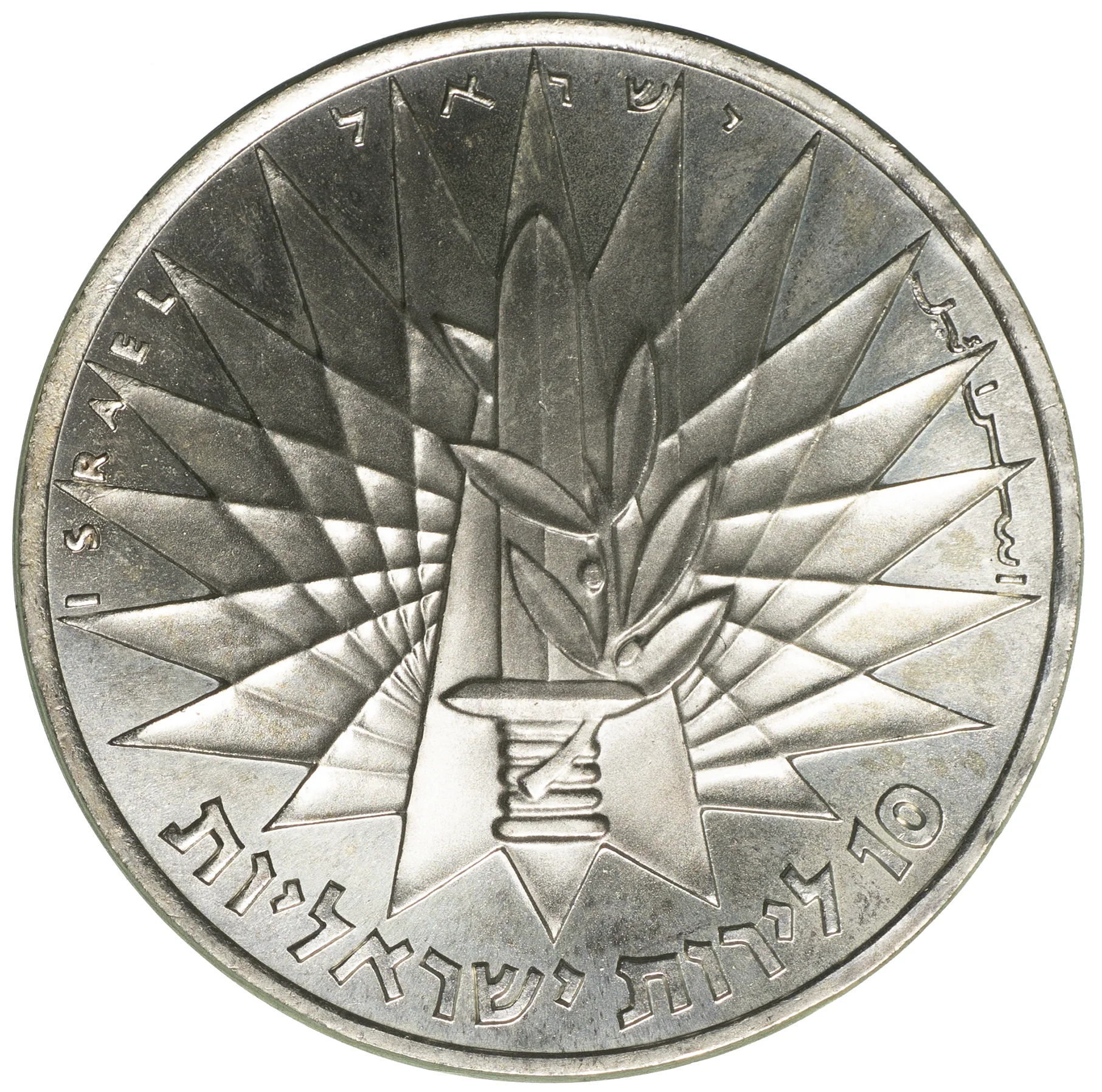
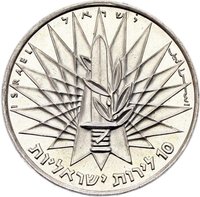
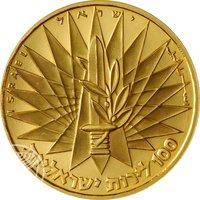
Central IDF emblem on a stylized star. Above, "Israel" in Arabic, Hebrew, and English. Below, the face value in Hebrew: "10 Israeli Lirot" on silver coins, "100 Israeli Lirot" on the gold coin.
Inscription:
ISRAEL اسرائيل ישראל
10 לירות ישראליות
10 לירות ישראליות
Translation:
Ten Israeli Lira
Engraver: Zvi Narkiss
Reverse
Description:
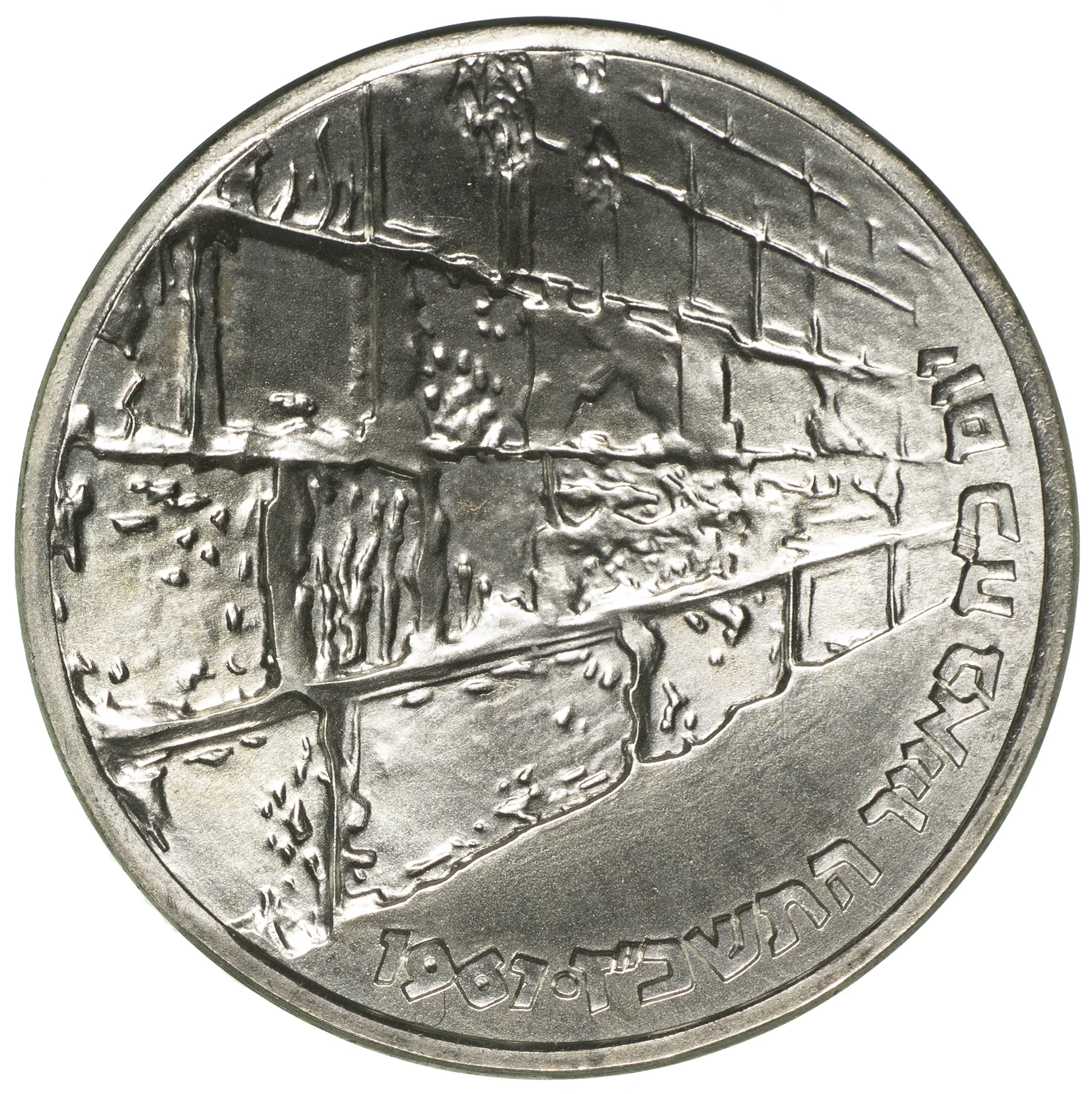
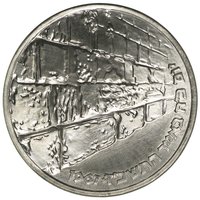
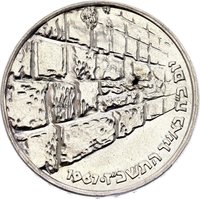
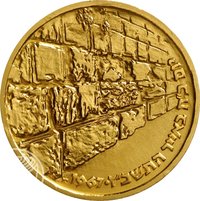
The Western Wall. Along the lower right border, its restoration date: "28th day of lyar 5727" in Hebrew and "1967" in English.
Inscription:
יום כ"ח באייר התשכ"ז • 1967 מ
Translation:
Twenty-eighth of Iyar, 5727 • 1967
Script: Hebrew
Language: Hebrew
Engravers: Zeev Lipman, Gerd Rothschild
Edge
Legend:
••• 5.6-10.6 1967 ••• כ"ו אייר - ב׳ סיון תשכ"ז
Translation:
Twenty-sixth of Iyar - Second of Sivan 5727
Language: Hebrew
Mints
| Name | Mark |
|---|---|
| Kretschmer Mint | — |
Mintings
| Year | Mint Mark | Mintage | Quality | Collection |
|---|---|---|---|---|
| 1967 | — | 50,380 | Proof |
Historical background
In the years leading up to the 1967 Six-Day War, Israel's currency, the Israeli lira (also known as the Israeli pound), was under significant strain. The young state's economy was characterized by rapid development and heavy defense spending, which was financed largely through high levels of government borrowing, foreign loans, and substantial financial aid from abroad, particularly from world Jewry and reparations from West Germany. This led to persistent budget deficits and mounting inflationary pressures. The government maintained a complex system of multiple exchange rates and strict currency controls to manage the balance of payments, conserve foreign reserves, and prevent capital flight, as confidence in the local currency was often shaky.
The immediate pre-war period saw these pressures intensify. In February 1967, facing a looming economic crisis, the government implemented a dramatic austerity and devaluation package known as the "1966-67 Recession Policy." This included a major devaluation of the official exchange rate from IL 3 to IL 3.5 per US dollar, alongside tax increases and cuts to subsidies. However, the intended economic stabilization was abruptly overshadowed by the severe political and military tensions that escalated in May 1967, culminating in the Six-Day War in June. The national focus shifted entirely to survival, freezing further economic reforms.
In the war's immediate aftermath, Israel's currency situation entered a new phase. The stunning military victory provided a massive boost to national morale and international standing, which temporarily bolstered economic confidence. However, the economic fundamentals remained challenging. The costs of the war and the subsequent occupation and administration of new territories placed a heavy long-term burden on the state budget. While a post-war economic boom occurred, the underlying structural issues of deficit spending and inflation persisted, setting the stage for the chronic inflationary problems that would plague the Israeli lira throughout the 1970s before it was eventually replaced by the shekel in 1980.
The immediate pre-war period saw these pressures intensify. In February 1967, facing a looming economic crisis, the government implemented a dramatic austerity and devaluation package known as the "1966-67 Recession Policy." This included a major devaluation of the official exchange rate from IL 3 to IL 3.5 per US dollar, alongside tax increases and cuts to subsidies. However, the intended economic stabilization was abruptly overshadowed by the severe political and military tensions that escalated in May 1967, culminating in the Six-Day War in June. The national focus shifted entirely to survival, freezing further economic reforms.
In the war's immediate aftermath, Israel's currency situation entered a new phase. The stunning military victory provided a massive boost to national morale and international standing, which temporarily bolstered economic confidence. However, the economic fundamentals remained challenging. The costs of the war and the subsequent occupation and administration of new territories placed a heavy long-term burden on the state budget. While a post-war economic boom occurred, the underlying structural issues of deficit spending and inflation persisted, setting the stage for the chronic inflationary problems that would plague the Israeli lira throughout the 1970s before it was eventually replaced by the shekel in 1980.
🌟 Limited