

20 centimes – Tunisia
Add to wishlist
Tunisia
Context
Year: 1942
Islamic (Hijri) Year:: 1361
Issuer: Tunisia
Currency:
(1891—1957)
Demonetized: Yes
Total mintage: 5,000,000
Material
Diameter: 24 mm
Weight: 3.5 g
Shape: Round with a round hole
Composition: Zinc
Magnetic: No
Technique: Milled
Alignment: Coin alignment
flip
References
KM: #
Numista: #8768
Value
Exchange value: 0.20 TNF
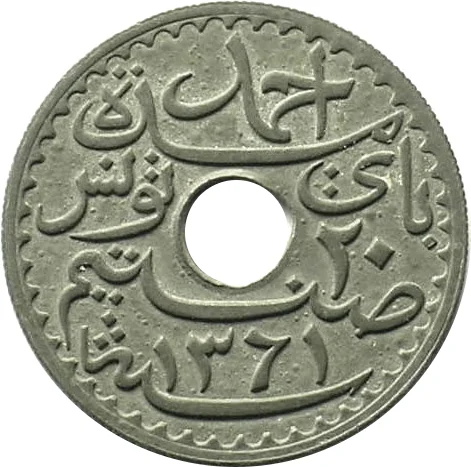
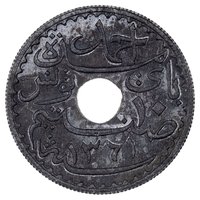
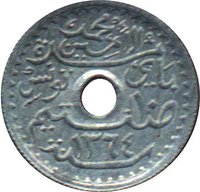
Obverse
Description:
Inscription with central hole: value, date.
Inscription:
احمد
مدة
باي تونس
٢٠
صنتيم
١٣٦١
سنه
مدة
باي تونس
٢٠
صنتيم
١٣٦١
سنه
Translation:
Ahmad
Pasha
Bey of Tunis
20
Centimes
1361
Year
Pasha
Bey of Tunis
20
Centimes
1361
Year
Script: Arabic
Language: Arabic
Engraver: Lucien Georges Bazor
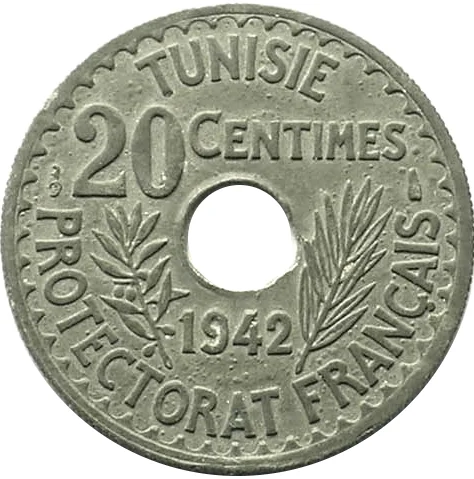
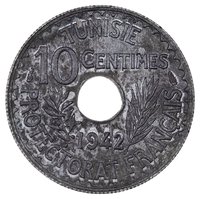
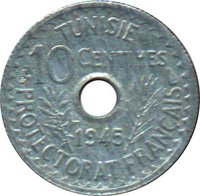
Reverse
Description:
Value above centre hole, date and sprigs.
Inscription:
TUNISIE
20 CENTIMES
1942
PROTECTORAT FRANÇAIS
20 CENTIMES
1942
PROTECTORAT FRANÇAIS
Translation:
TUNISIA
20 CENTIMES
1942
FRENCH PROTECTORATE
20 CENTIMES
1942
FRENCH PROTECTORATE
Script: Latin
Language: French
Engraver: Lucien Georges Bazor
Edge
Reeded
Mints
| Name | Mark |
|---|---|
| Monnaie de Paris | — |
Mintings
| Year | Mint Mark | Mintage | Quality | Collection |
|---|---|---|---|---|
| 1942 | — | 5,000,000 |
Historical background
In 1942, Tunisia's currency situation was defined by its status as a French protectorate and the direct impact of the North African Campaign of World War II. The official currency was the Tunisian franc, which was pegged at par with the French franc and issued by the Banque de l'Algérie et de la Tunisie. This arrangement tied Tunisia's monetary policy directly to that of France, even after the fall of France in 1940, creating a complex and unstable financial environment as competing French authorities vied for control.
The Allied landings in Morocco and Algeria in Operation Torch (November 1942) and the subsequent Axis occupation of Tunisia created a zone of intense military conflict, fracturing the monetary system. Both Allied and Axis forces introduced their own military currencies to pay troops and procure supplies, leading to a chaotic circulation of British Military Authority francs, US-printed "Allied Military Currency," and Italian lire and German Reichskreditkassenscheine (military scrip). This proliferation of currencies caused severe inflation, undermined public confidence, and created a black market where exchange rates fluctuated wildly based on the shifting front lines.
Consequently, by the end of 1942, Tunisia operated under a dysfunctional multi-currency regime. The pre-war Tunisian franc remained in use but was increasingly distrusted, while various military scripts competed for acceptance amid widespread scarcity of goods. This monetary chaos reflected the broader collapse of civil administration and the severe economic strain on the local population, who faced not only the dangers of battle but also a rapidly devaluing and confusing monetary landscape that would require significant stabilization after the Allied victory in May 1943.
The Allied landings in Morocco and Algeria in Operation Torch (November 1942) and the subsequent Axis occupation of Tunisia created a zone of intense military conflict, fracturing the monetary system. Both Allied and Axis forces introduced their own military currencies to pay troops and procure supplies, leading to a chaotic circulation of British Military Authority francs, US-printed "Allied Military Currency," and Italian lire and German Reichskreditkassenscheine (military scrip). This proliferation of currencies caused severe inflation, undermined public confidence, and created a black market where exchange rates fluctuated wildly based on the shifting front lines.
Consequently, by the end of 1942, Tunisia operated under a dysfunctional multi-currency regime. The pre-war Tunisian franc remained in use but was increasingly distrusted, while various military scripts competed for acceptance amid widespread scarcity of goods. This monetary chaos reflected the broader collapse of civil administration and the severe economic strain on the local population, who faced not only the dangers of battle but also a rapidly devaluing and confusing monetary landscape that would require significant stabilization after the Allied victory in May 1943.
🌱 Fairly Common