

10 Bahts – Thailand
Circulating commemorative coins
Commemoration: 2007 World University Games, Bangkok
Thailand
Context
Year: 2007
Thai Year: 2550
Issuer: Thailand 
Ruler: Bhumibol Adulyadej
Currency:
(since 1897)
Total mintage: 3,000,000
Material
References
Y: #Click to copy to clipboard435
Numista: #8761
Value
Exchange value: 10 THB = $0.32
Obverse
Description:
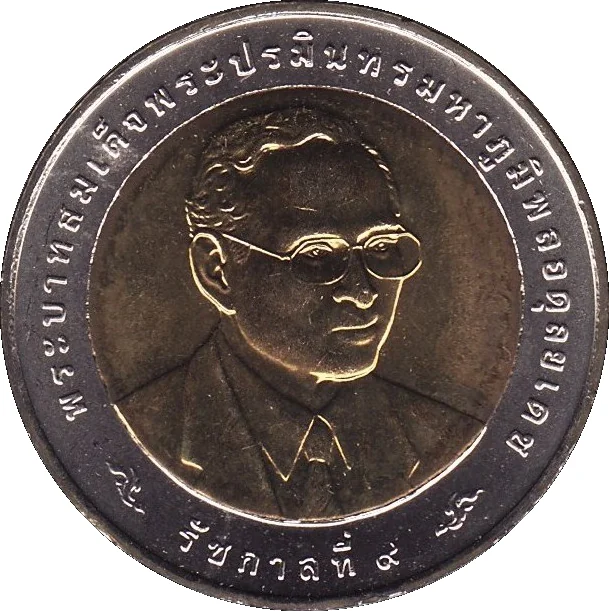
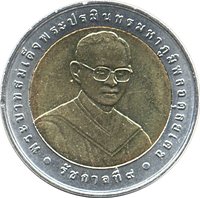
Bust of King Bhumibol.
Reverse
Description:
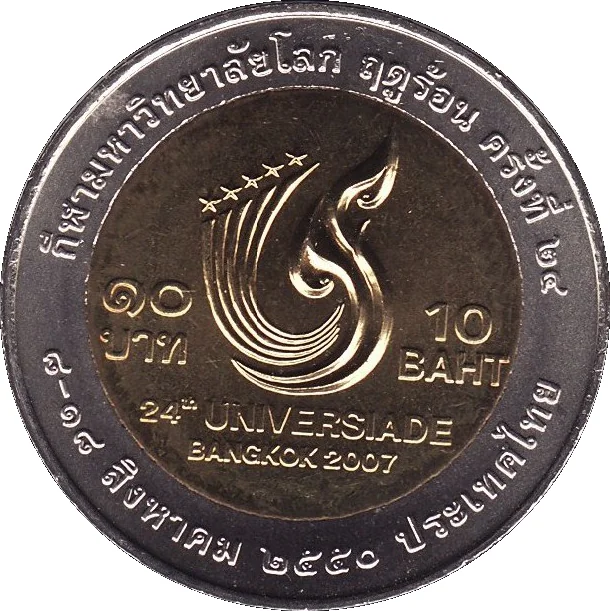
2007 Bangkok Summer Universiade logo.
Edge
Segmented reeding
Mintings
| Year | Mint Mark | Mintage | Quality | Collection |
|---|---|---|---|---|
| 2007 | — | 3,000,000 |
Historical background
In 2007, Thailand's currency, the baht (THB), was navigating a complex post-crisis landscape dominated by strong capital inflows and significant government intervention. The year was politically charged, occurring after the 2006 military coup that ousted Prime Minister Thaksin Shinawatra, which created an environment of uncertainty. Economically, the country was experiencing robust growth and a large current account surplus, which attracted substantial foreign investment into the stock and bond markets. This demand for Thai assets put persistent upward pressure on the baht, causing it to appreciate considerably against the US dollar, raising concerns among the nation's crucial export sector about losing competitiveness.
The Bank of Thailand (BOT) responded with aggressive measures to curb the baht's strength. These included stringent capital controls, most notably the controversial December 2006 unremunerated reserve requirement (URR), which required 30% of incoming short-term capital to be held interest-free at the central bank. Although modified in early 2007 after causing a stock market crash, these controls symbolized the authorities' determination to manage the exchange rate. Throughout the year, the BOT also engaged in heavy direct intervention in the foreign exchange market, buying dollars to build reserves and slow the appreciation, leading to a significant increase in foreign reserves, which approached $100 billion by year's end.
Ultimately, 2007 was a year of tension between market forces and administrative control. While the economy benefited from strong fundamentals, the policy focus was squarely on sterilization and managing "hot money" inflows to prevent rapid currency appreciation. This defensive stance, set against a backdrop of political transition, aimed to protect export-led growth but also drew criticism for creating market distortions and not addressing longer-term structural economic needs. The baht ended the year at around 34 to the US dollar, significantly stronger than its post-1997 crisis lows, reflecting the ongoing challenges of globalization and domestic political instability.
The Bank of Thailand (BOT) responded with aggressive measures to curb the baht's strength. These included stringent capital controls, most notably the controversial December 2006 unremunerated reserve requirement (URR), which required 30% of incoming short-term capital to be held interest-free at the central bank. Although modified in early 2007 after causing a stock market crash, these controls symbolized the authorities' determination to manage the exchange rate. Throughout the year, the BOT also engaged in heavy direct intervention in the foreign exchange market, buying dollars to build reserves and slow the appreciation, leading to a significant increase in foreign reserves, which approached $100 billion by year's end.
Ultimately, 2007 was a year of tension between market forces and administrative control. While the economy benefited from strong fundamentals, the policy focus was squarely on sterilization and managing "hot money" inflows to prevent rapid currency appreciation. This defensive stance, set against a backdrop of political transition, aimed to protect export-led growth but also drew criticism for creating market distortions and not addressing longer-term structural economic needs. The baht ended the year at around 34 to the US dollar, significantly stronger than its post-1997 crisis lows, reflecting the ongoing challenges of globalization and domestic political instability.
🌱 Common