

200 Zlotys (Warsaw University of Life Sciences – SGGW) – Poland
Non-circulating coins
Commemoration: Bicentenary of the Warsaw University of Life Sciences – SGGW
Poland
Context

Material
Diameter: 27 mm
Weight: 15.5 g
Gold weight: 13.95 g
Shape: Round
Composition: 90% Gold
Standard: Silver half ounce
Magnetic: No
Technique: Milled
Alignment: Medal alignment

flip
References
Y: #Click to copy to clipboard967
Numista: #87167
Value
Exchange value: 200 PLN = $55.96
Bullion value: $2325.93
Inflation-adjusted value: 311.21 PLN
Obverse
Description:
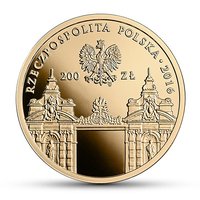
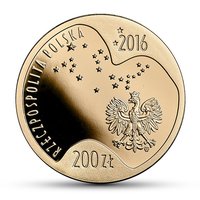
Grain spikes forming the Ursynów Palace appear above Poland's emblem.
Inscription:
2016
200 ZŁ
mw
RZECZPOSPOLITA POLSKA
200 ZŁ
mw
RZECZPOSPOLITA POLSKA
Translation:
2016
200 ZŁOTYCH
RZECZPOSPOLITA POLSKA
200 ZŁOTYCH
RZECZPOSPOLITA POLSKA
Script: Latin
Language: Polish
Designer: Sebastian Mikołajczak
Reverse
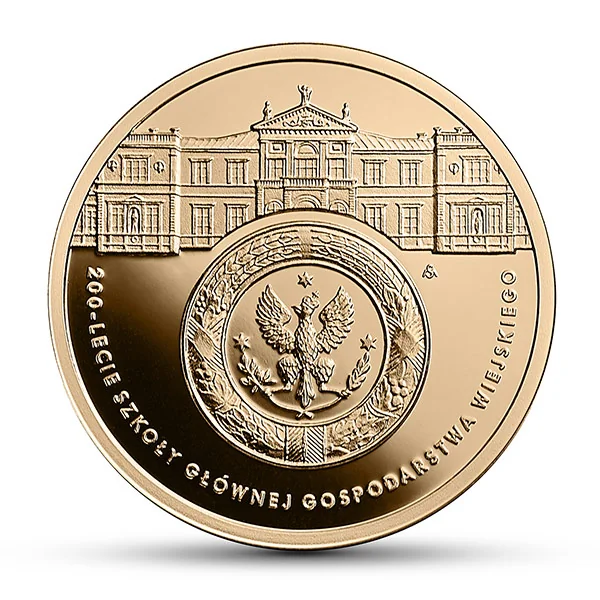
Description:
The reverse shows SGGW's historic emblem, featuring the Ursynów Palace above an eagle with an olive branch and palm, and three stars representing the original Agriculture, Forestry, and Horticulture departments.
Inscription:
200 - LECIE SZKOŁY GŁÓWNEJ GOSPODARSTWA WIEJSKIEGO
SM
SM
Translation:
200th Anniversary of the Main School of Rural Husbandry
Script: Latin
Language: Polish
Designer: Sebastian Mikołajczak
Edge
Plain
Categories
| Education |
Mints
| Name | Mark |
|---|---|
| Mint of Poland | (MW) |
Mintings
| Year | Mint Mark | Mintage | Quality | Collection |
|---|---|---|---|---|
| 2016 | MW | 2,000 | Proof |
Historical background
In 2016, Poland's currency, the złoty (PLN), navigated a year of significant political uncertainty and external market pressures. The primary driver was the domestic political shift following the 2015 election of the Law and Justice (PiS) party, whose policies—including increased social spending, banking sector reforms, and conflicts with the European Union over rule-of-law issues—raised concerns among international investors. This led to bouts of volatility and downward pressure on the złoty, as markets weighed the risks of potential credit rating downgrades and reduced EU cohesion funds.
Externally, the currency was heavily influenced by global factors, particularly the policies of major central banks. The ultra-low interest rate environment in the Eurozone and the delayed pace of interest rate hikes by the U.S. Federal Reserve provided some support, as the relatively higher Polish interest rates made złoty-denominated assets attractive for carry trades. However, this also made the currency sensitive to shifts in global risk sentiment and the strength of the euro. Furthermore, the aftermath of the UK's Brexit referendum in June 2016 injected additional volatility into European currencies, including the złoty.
Despite these headwinds, the Polish economy demonstrated fundamental resilience, with strong GDP growth (over 3% annually) and stable macroeconomic indicators. This underlying strength, coupled with the proactive stance of the National Bank of Poland (NBP) under Governor Adam Glapiński—which maintained a steady interest rate throughout the year—helped prevent a sharp depreciation. Consequently, the złoty ended 2016 relatively stable against the euro, having weathered the political turbulence without a full-blown crisis, though it remained weaker than levels seen earlier in the decade.
Externally, the currency was heavily influenced by global factors, particularly the policies of major central banks. The ultra-low interest rate environment in the Eurozone and the delayed pace of interest rate hikes by the U.S. Federal Reserve provided some support, as the relatively higher Polish interest rates made złoty-denominated assets attractive for carry trades. However, this also made the currency sensitive to shifts in global risk sentiment and the strength of the euro. Furthermore, the aftermath of the UK's Brexit referendum in June 2016 injected additional volatility into European currencies, including the złoty.
Despite these headwinds, the Polish economy demonstrated fundamental resilience, with strong GDP growth (over 3% annually) and stable macroeconomic indicators. This underlying strength, coupled with the proactive stance of the National Bank of Poland (NBP) under Governor Adam Glapiński—which maintained a steady interest rate throughout the year—helped prevent a sharp depreciation. Consequently, the złoty ended 2016 relatively stable against the euro, having weathered the political turbulence without a full-blown crisis, though it remained weaker than levels seen earlier in the decade.
✨ Legendary