

Obverse
Description:
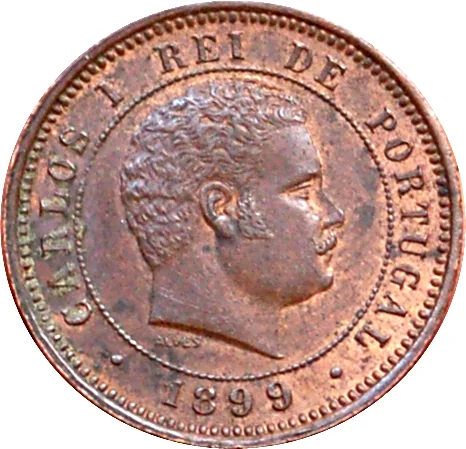
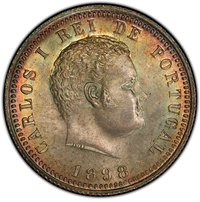
Portrait of Carlos I facing right, encircled.
Inscription:
CARLOS I REI DE PORTUGAL
· 1899 ·
· 1899 ·
Translation:
Charles I King of Portugal
· 1899 ·
· 1899 ·
Script: Latin
Language: Portuguese
Engraver: Valancio Alves
Reverse
Edge
Plain
Mintings
| Year | Mint Mark | Mintage | Quality | Collection |
|---|---|---|---|---|
| 1890 | — | 430,000 | ||
| 1891 | — | — | ||
| 1892 | — | — | ||
| 1893 | — | 3,280,000 | ||
| 1897 | — | 1,120,000 | ||
| 1898 | — | 700,000 | ||
| 1899 | — | 1,220,000 | ||
| 1900 | — | 1,110,000 | ||
| 1901 | — | 1,070,000 | ||
| 1904 | — | 720,000 | ||
| 1905 | — | 1,340,000 | ||
| 1906 | — | 5,670,000 |
Historical background
In 1890, Portugal faced a severe currency crisis rooted in decades of fiscal mismanagement and external pressures. The country operated on a bimetallic system, but chronic budget deficits, heavy borrowing, and the costs of maintaining its vast colonial empire, particularly in Africa, had depleted the treasury's gold reserves. This fragile situation was pushed to the brink by the British Ultimatum of January 1890, which forced Portugal to abandon its claims to a territorial corridor linking Angola and Mozambique. This national humiliation triggered political turmoil and a catastrophic loss of confidence, both domestically and internationally, in Portugal's financial stability.
The immediate consequence was a dramatic run on gold, as investors and the public rushed to convert paper money into specie. The Banco de Portugal, the kingdom's issuer of banknotes, struggled to maintain convertibility as its reserves dwindled. By May 1891, the bank was forced to suspend the gold convertibility of its notes, effectively placing Portugal on an inconvertible paper money standard. This led to a sharp depreciation of the Portuguese real, rampant inflation, and a deep economic recession, exacerbating social unrest and further destabilizing the monarchy.
The 1890 currency crisis was a pivotal event with profound consequences. It exposed the weakness of the Portuguese state and economy, discrediting the ruling constitutional monarchy and contributing to the republican sentiments that would culminate in the 1910 revolution. Financially, it marked the end of the metallic standard for decades, leading to a period of fiscal austerity, increased foreign debt dependency, and a long struggle to restore monetary stability and international credibility well into the 20th century.
The immediate consequence was a dramatic run on gold, as investors and the public rushed to convert paper money into specie. The Banco de Portugal, the kingdom's issuer of banknotes, struggled to maintain convertibility as its reserves dwindled. By May 1891, the bank was forced to suspend the gold convertibility of its notes, effectively placing Portugal on an inconvertible paper money standard. This led to a sharp depreciation of the Portuguese real, rampant inflation, and a deep economic recession, exacerbating social unrest and further destabilizing the monarchy.
The 1890 currency crisis was a pivotal event with profound consequences. It exposed the weakness of the Portuguese state and economy, discrediting the ruling constitutional monarchy and contributing to the republican sentiments that would culminate in the 1910 revolution. Financially, it marked the end of the metallic standard for decades, leading to a period of fiscal austerity, increased foreign debt dependency, and a long struggle to restore monetary stability and international credibility well into the 20th century.
🌱 Very Common