

1 Tögrög (Mongolian Revolution) – Mongolia
Non-circulating coins
Commemoration: 50th Anniversary of the Mongolian Revolution
Mongolia
Context
Material

References
KM: #Click to copy to clipboard34c
Numista: #114625
Value
Exchange value: 1 MNT
Bullion value: $5044.33
Obverse
Description:
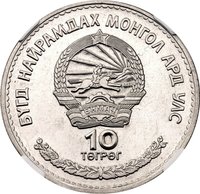
People's Republic of Mongolia emblem (1960–1992).
Inscription:
БУГД НАЙРАМДАХ МОНГОЛ АРД УЛС
НЭГ
ТӨГРӨГ
НЭГ
ТӨГРӨГ
Translation:
PEOPLE'S REPUBLIC OF MONGOLIA
ONE
TÖGRÖG
ONE
TÖGRÖG
Language: Mongolian
Reverse
Description:
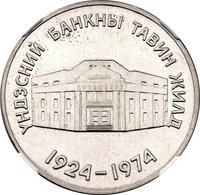
Equestrian statue of Damdinii Sükhbaatar, a founding member of the Mongolian People's Party, in Ulaanbaatar. The pedestal bears the abbreviation for the Mongolian People's Republic.
Inscription:
БНМАУ
50
ЖИЛ
50
ЖИЛ
Translation:
Mongolian People's Republic
50
Years
50
Years
Language: Mongolian
Edge
Categories
| Event> Revolution |
Mintings
| Year | Mint Mark | Mintage | Quality | Collection |
|---|---|---|---|---|
| 1971 | — | — |
Historical background
In 1971, Mongolia's currency situation was fundamentally defined by its position within the Soviet-led Council for Mutual Economic Assistance (COMECON). The national currency, the tögrög (MNT), was a non-convertible administrative unit with its value and circulation tightly controlled by the state and the Mongol Bank. Its exchange rate, particularly the critical peg to the Soviet ruble, was set artificially by central planners rather than market forces. Internally, the tögrög functioned as an accounting tool for the state-directed economy, with separate rates often applied to foreign trade transactions with socialist versus non-socialist countries.
This system was directly impacted by the international monetary upheavals of 1971, specifically the collapse of the Bretton Woods system and U.S. President Nixon's suspension of the dollar's convertibility to gold. As the Soviet ruble was formally pegged to the U.S. dollar until 1972, this global shock created indirect pressure and necessitated adjustments within the entire COMECON bloc. For Mongolia, a small, trade-dependent command economy, this meant its primary reference currency (the ruble) was suddenly linked to a fluctuating dollar, introducing new complexities in planning and pricing for its substantial trade with both the USSR and the wider world.
Consequently, Mongolia's monetary authorities in 1971 were operating in a context of heightened external uncertainty, yet their responses remained constrained within the rigid frameworks of socialist economic management. The immediate focus would have been on recalibrating the technical exchange rates with partner countries to maintain the stability of planned bilateral trade flows, especially with the USSR, which accounted for the overwhelming majority of Mongolia's foreign commerce. The situation underscored the country's deep economic dependency and insulation from global capital markets, with the tögrög's fate inextricably tied to political and economic decisions made in Moscow.
This system was directly impacted by the international monetary upheavals of 1971, specifically the collapse of the Bretton Woods system and U.S. President Nixon's suspension of the dollar's convertibility to gold. As the Soviet ruble was formally pegged to the U.S. dollar until 1972, this global shock created indirect pressure and necessitated adjustments within the entire COMECON bloc. For Mongolia, a small, trade-dependent command economy, this meant its primary reference currency (the ruble) was suddenly linked to a fluctuating dollar, introducing new complexities in planning and pricing for its substantial trade with both the USSR and the wider world.
Consequently, Mongolia's monetary authorities in 1971 were operating in a context of heightened external uncertainty, yet their responses remained constrained within the rigid frameworks of socialist economic management. The immediate focus would have been on recalibrating the technical exchange rates with partner countries to maintain the stability of planned bilateral trade flows, especially with the USSR, which accounted for the overwhelming majority of Mongolia's foreign commerce. The situation underscored the country's deep economic dependency and insulation from global capital markets, with the tögrög's fate inextricably tied to political and economic decisions made in Moscow.

✨ Legendary