

50 francs – France
Add to wishlist
Non-circulating coins
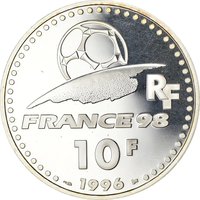
Commemoration: 1998 World Cup, France
France
Obverse
Description:
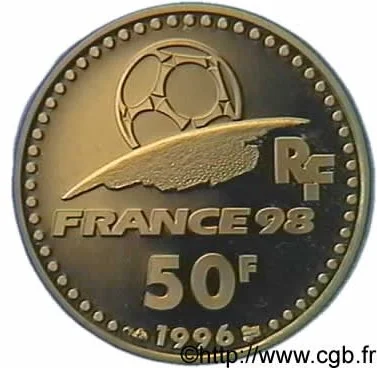
A torn goal net releases a dove. Soccer field background. Round and square dots symbolize the teams.
Inscription:
RF
FRANCE 98
50F.
1996
FRANCE 98
50F.
1996
Script: Latin
Reverse
Description:
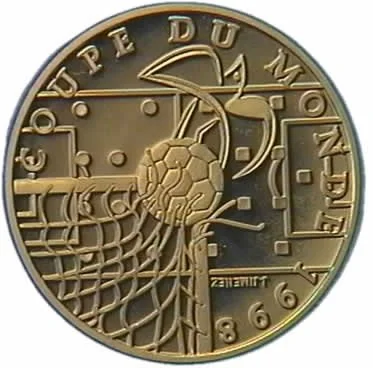
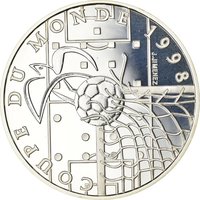
Soccer ball as rising sun.
Inscription:
COUPE DU MONDE 1998
J.JIMENEZ
J.JIMENEZ
Translation:
World Cup 1998
J.Jimenez
J.Jimenez
Script: Latin
Language: French
Engraver: Joaquin Jimenez
Edge
Tranche A
Legend:
LIBERTÉ ÉGALITÉ FRATERNITÉ
Translation:
Liberty Equality Fraternity
Language: French
Mints
| Name | Mark |
|---|---|
| Monnaie de Paris | — |
Mintings
| Year | Mint Mark | Mintage | Quality | Collection |
|---|---|---|---|---|
| 1996 | — | 10,000 | Proof |
Historical background
In 1996, France was in the final, confident phase of its long-standing commitment to European monetary integration, operating within the strict framework of the European Monetary System (EMS). The French franc was a core and stable member of the Exchange Rate Mechanism (ERM), its value pegged tightly to the Deutsche Mark within narrow fluctuation bands. This stability was hard-won, following the severe crises of 1992-1993 that had forced a widening of the bands, and was a testament to the French policy of the franc fort (strong franc). This policy prioritized low inflation and exchange rate stability over domestic monetary flexibility, aligning closely with German Bundesbank policies to build credibility for the coming single currency.
The primary national focus was not on managing an independent currency but on meticulously fulfilling the Maastricht Treaty convergence criteria to qualify for the European Economic and Monetary Union (EMU). France was actively preparing to cede its monetary sovereignty to the future European Central Bank. Key efforts involved stringent austerity measures to reduce the budget deficit to the required 3% of GDP threshold and to control public debt, sparking significant domestic political debate and social unrest over cuts to public spending and welfare.
Thus, the currency situation was one of transition and anticipation. The franc itself was effectively in a holding pattern, its fate already decided. The real economic drama centered on the government's struggle to meet the Maastricht targets on time, against a backdrop of high unemployment, while the financial markets and institutions were increasingly planning for a post-franc future. The year 1996 was less about the franc's standalone performance and more about France's final preparations to irrevocably lock its exchange rate and adopt the euro, which was then scheduled for introduction in virtual form on January 1, 1999.
The primary national focus was not on managing an independent currency but on meticulously fulfilling the Maastricht Treaty convergence criteria to qualify for the European Economic and Monetary Union (EMU). France was actively preparing to cede its monetary sovereignty to the future European Central Bank. Key efforts involved stringent austerity measures to reduce the budget deficit to the required 3% of GDP threshold and to control public debt, sparking significant domestic political debate and social unrest over cuts to public spending and welfare.
Thus, the currency situation was one of transition and anticipation. The franc itself was effectively in a holding pattern, its fate already decided. The real economic drama centered on the government's struggle to meet the Maastricht targets on time, against a backdrop of high unemployment, while the financial markets and institutions were increasingly planning for a post-franc future. The year 1996 was less about the franc's standalone performance and more about France's final preparations to irrevocably lock its exchange rate and adopt the euro, which was then scheduled for introduction in virtual form on January 1, 1999.
✨ Legendary