

2 Pounds (DNA discovery) – United Kingdom
Circulating commemorative coins
Commemoration: 50th anniversary of the discovery of DNA
United Kingdom
Context
Year: 2003
Issuer: United Kingdom 
Ruler: Elizabeth II
Currency:
(since 1971)
Total mintage: 4,446,822
Material
References
KM: #Click to copy to clipboard1037
Numista: #8661
Value
Exchange value: 2 GBP = $2.71
Inflation-adjusted value: 4.16 GBP
Obverse
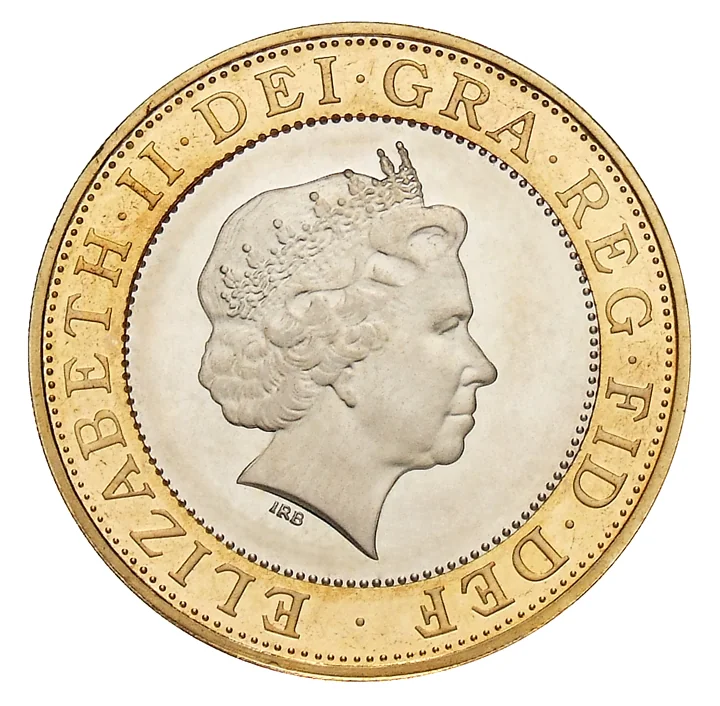
Description:
Queen Elizabeth IV facing right, wearing the Girls of Great Britain and Ireland tiara.
Inscription:
ELIZABETH·II·DEI·GRA·REG·FID·DEF ·
IRB
IRB
Translation:
Elizabeth II by the Grace of God Queen Defender of the Faith
Script: Latin
Language: Latin
Engraver: Ian Rank-Broadley
Reverse
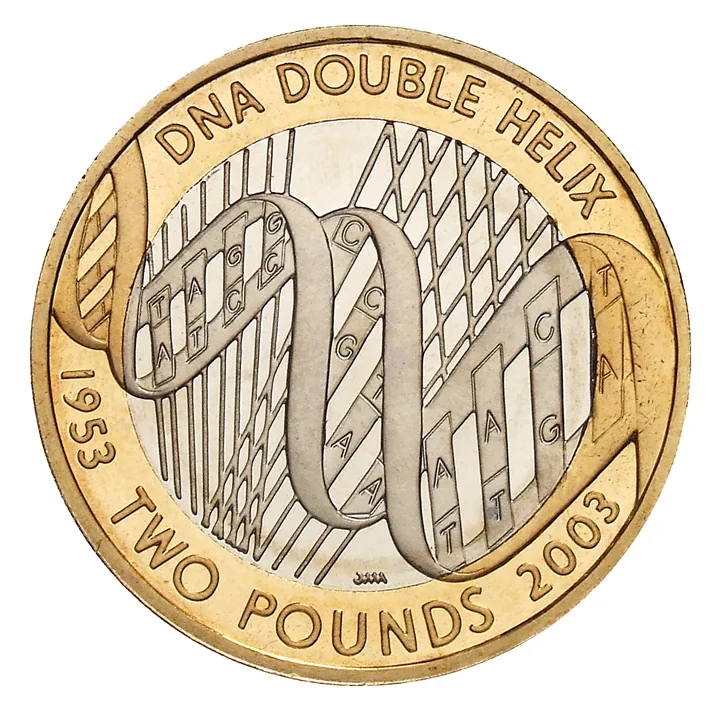
Description:
DNA double helix with legend above, name and dates below.
Inscription:
DNA DOUBLE HELIX
JWM
1953 TWO POUNDS 2003
JWM
1953 TWO POUNDS 2003
Script: Latin
Engraver: John Mills
Edge
Milled with incuse legend and decorative side view of a double helix
Legend:
DEOXYRIBONUCLEIC ACID
Categories
| Science |
Mints
| Name | Mark |
|---|---|
| Royal Mint | — |
Mintings
| Year | Mint Mark | Mintage | Quality | Collection |
|---|---|---|---|---|
| 2003 | — | 4,299,000 | ||
| 2003 | — | 104,309 | BU | |
| 2003 | — | 43,513 | Proof |
Historical background
In 2003, the United Kingdom's currency situation was defined by its continued membership of the European Union but its deliberate exclusion from the Eurozone. The Labour government, led by Prime Minister Tony Blair and Chancellor Gordon Brown, had established five economic tests in 1997 to determine whether joining the euro would be beneficial for the UK. In June 2003, Chancellor Brown delivered his long-awaited assessment, concluding that only one of the five tests—on financial services—had been met. The critical tests on sustainable convergence and flexibility were judged unfulfilled, effectively ruling out membership for the foreseeable future. This decision cemented the pound sterling's status as the nation's independent currency.
The economic context was one of relative stability and growth for the pound. The UK economy was experiencing a period of sustained expansion, and the Bank of England, which had gained operational independence in 1997, maintained a focus on an inflation-targeting monetary policy. Sterling traded strongly against both the US dollar and the newly physical euro, reflecting investor confidence in the UK's separate monetary path. This strength, however, presented challenges for export-oriented manufacturing sectors, which argued that an overvalued pound hurt their international competitiveness.
Public and political sentiment played a crucial role in the backdrop. There was significant and persistent public scepticism towards adopting the euro, fueled by concerns over a loss of national sovereignty and identity. The Conservative Party was firmly opposed to membership, and a substantial faction within Blair's own Labour Party shared these reservations. Thus, the 2003 decision was as much a political calculation as an economic one, acknowledging that even if the economic tests were eventually passed, a referendum on joining would be unlikely to succeed. The outcome was a settled period of monetary independence, with the pound sterling remaining a core symbol of UK economic sovereignty.
The economic context was one of relative stability and growth for the pound. The UK economy was experiencing a period of sustained expansion, and the Bank of England, which had gained operational independence in 1997, maintained a focus on an inflation-targeting monetary policy. Sterling traded strongly against both the US dollar and the newly physical euro, reflecting investor confidence in the UK's separate monetary path. This strength, however, presented challenges for export-oriented manufacturing sectors, which argued that an overvalued pound hurt their international competitiveness.
Public and political sentiment played a crucial role in the backdrop. There was significant and persistent public scepticism towards adopting the euro, fueled by concerns over a loss of national sovereignty and identity. The Conservative Party was firmly opposed to membership, and a substantial faction within Blair's own Labour Party shared these reservations. Thus, the 2003 decision was as much a political calculation as an economic one, acknowledging that even if the economic tests were eventually passed, a referendum on joining would be unlikely to succeed. The outcome was a settled period of monetary independence, with the pound sterling remaining a core symbol of UK economic sovereignty.
🌱 Very Common