

100 lei (Iancu de Hunedoara becoming Voivode of Transylvania) – Romania
Add to wishlist
Non-circulating coins
Commemoration: The anniversary of 575 years since Iancu de Hunedoara became Voivode of Transylvania
Romania
Context
Year: 2016
Issuer: Romania
Issuing organization: National Bank of Romania
Period:
(since 1989)
Currency:
(since 2005)
Total mintage: 250
Material
References
KM: #
Numista: #85972
Value
Exchange value: 100 RON
Bullion value: $889.89
Inflation-adjusted value: 154.26 RON
Obverse
Description:
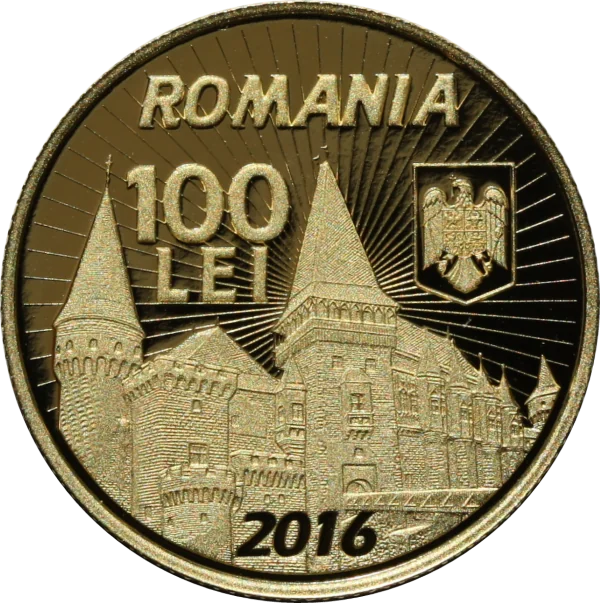
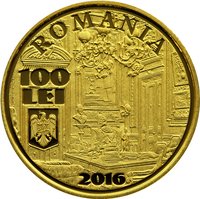
Corvin Castle, "ROMANIA", 100 LEI, Romania's coat of arms, and 2016.
Inscription:
ROMANIA
100 LEI
2016
100 LEI
2016
Script: Latin
Reverse
Description:
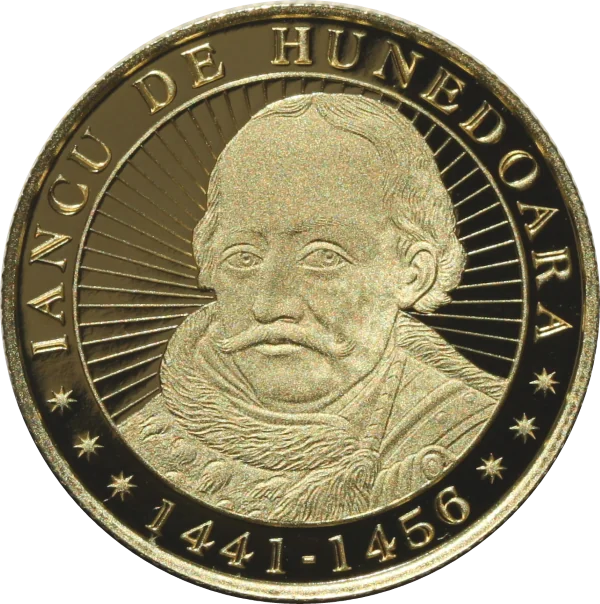
Portrait of Iancu de Hunedoara, with his name arched above and his voivode years "1441-1456".
Inscription:
IANCU DE HUNEDOARA
1441-1456
1441-1456
Script: Latin
Edge
Milled
Mintings
| Year | Mint Mark | Mintage | Quality | Collection |
|---|---|---|---|---|
| 2016 | — | 250 | Proof |
Historical background
In 2016, Romania's currency situation was characterized by a period of relative stability for the Romanian Leu (RON) against the Euro, but within a context of significant political volatility and fiscal policy concerns. The National Bank of Romania (BNR) maintained a managed float regime, with the exchange rate largely hovering around 4.5 RON per EUR for much of the year. This stability was supported by the BNR's interventions and a robust economic growth rate, which was among the highest in the European Union, driven by strong domestic consumption.
However, this stable facade was undercut by persistent political risks. A major driver of currency speculation and pressure was the incoming left-wing government's populist agenda, which took office in early 2016. Its flagship policy—a series of substantial wage and pension increases—sparked intense debate and market anxiety. Investors and analysts feared these fiscal measures would overheat the economy, widen the budget and current account deficits, and fuel inflation, thereby putting long-term downward pressure on the Leu.
Consequently, the BNR faced a delicate balancing act. While it cautiously cut key interest rates in early 2016 to stimulate lending, it had to remain vigilant against inflationary pressures and potential capital outflows. The year ended with the Leu slightly depreciated, closing near 4.6 RON per EUR, reflecting the mounting concerns over fiscal discipline. Thus, 2016 set the stage for subsequent challenges, where robust growth coexisted with vulnerabilities stemming from expansionary fiscal policies, keeping the currency sensitive to both domestic political decisions and external market sentiment.
However, this stable facade was undercut by persistent political risks. A major driver of currency speculation and pressure was the incoming left-wing government's populist agenda, which took office in early 2016. Its flagship policy—a series of substantial wage and pension increases—sparked intense debate and market anxiety. Investors and analysts feared these fiscal measures would overheat the economy, widen the budget and current account deficits, and fuel inflation, thereby putting long-term downward pressure on the Leu.
Consequently, the BNR faced a delicate balancing act. While it cautiously cut key interest rates in early 2016 to stimulate lending, it had to remain vigilant against inflationary pressures and potential capital outflows. The year ended with the Leu slightly depreciated, closing near 4.6 RON per EUR, reflecting the mounting concerns over fiscal discipline. Thus, 2016 set the stage for subsequent challenges, where robust growth coexisted with vulnerabilities stemming from expansionary fiscal policies, keeping the currency sensitive to both domestic political decisions and external market sentiment.

✨ Legendary