

50 centavos – Argentina
Add to wishlist
Circulating commemorative coins
Commemoration: Mercosur
Argentina
Context
Material
Diameter: 25.2 mm
Weight: 5.8 g
Shape: Round
Composition: Aluminium bronze
Magnetic: No
Technique: Milled
References
KM: #
Numista: #8595
Value
Exchange value: 0.50 ARS
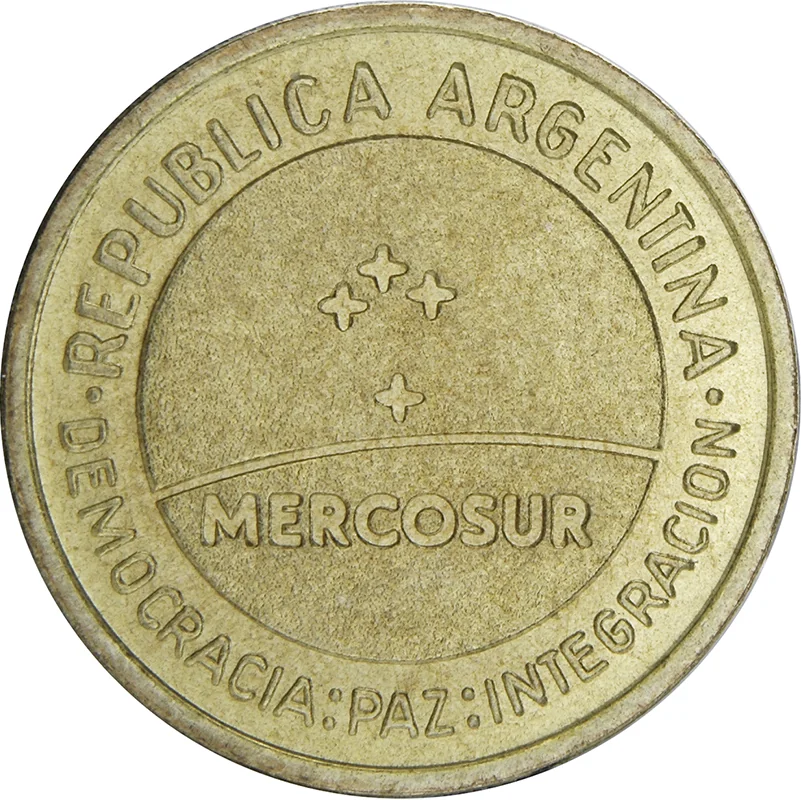
Obverse
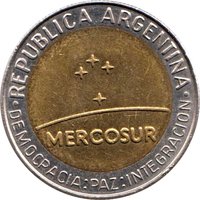
Description:
Mercosur flag illustration
Inscription:
·REPUBLICA ARGENTINA·
MERCOSUR
DEMOCRACIA:PAZ:INTEGRACION
MERCOSUR
DEMOCRACIA:PAZ:INTEGRACION
Translation:
Argentine Republic
MERCOSUR
Democracy: Peace: Integration
MERCOSUR
Democracy: Peace: Integration
Script: Latin
Engraver: Carlos Pedro Rodríguez Dufour
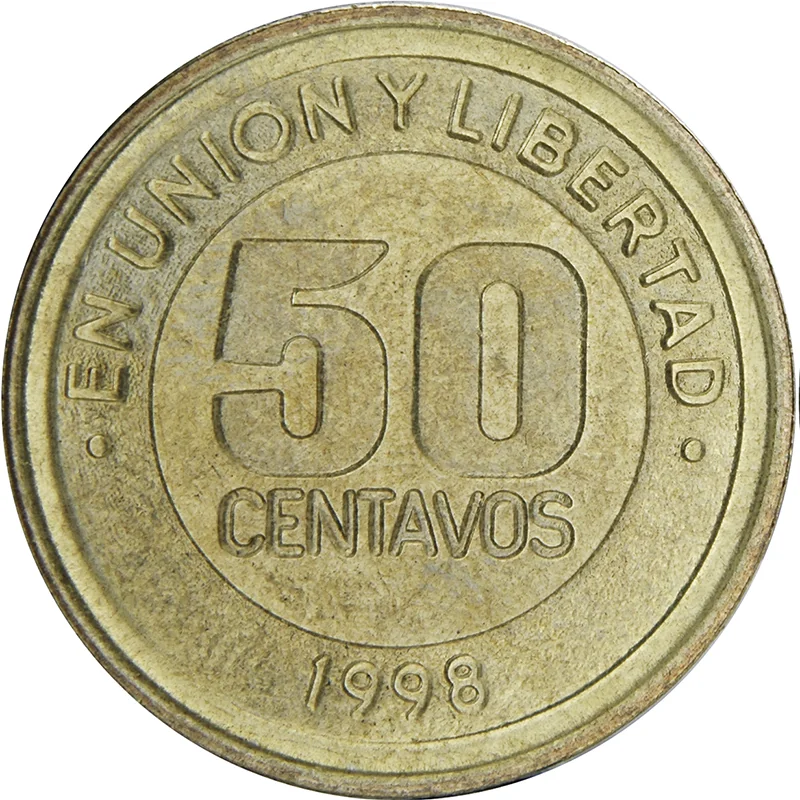
Reverse
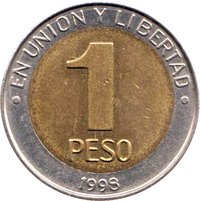
Description:
Value in circle, date beneath.
Inscription:
·EN UNION Y LIBERTAD·
50
CENTAVOS
1998
50
CENTAVOS
1998
Translation:
In Union and Liberty
50
Cents
1998
50
Cents
1998
Script: Latin
Language: Spanish
Engraver: Carlos Pedro Rodríguez Dufour
Edge
Reeded
Mintings
| Year | Mint Mark | Mintage | Quality | Collection |
|---|---|---|---|---|
| 1998 | — | 1,000,000 |
Historical background
By 1998, Argentina was in the fourth year of its Convertibility Plan, a currency board system established in 1991 to end hyperinflation. This law rigidly pegged the Argentine peso to the U.S. dollar at a one-to-one rate and required every peso in circulation to be backed by a U.S. dollar in the central bank's reserves. Initially, this brought remarkable stability, tamed inflation, and restored confidence, leading to a wave of foreign investment and economic growth in the early 1990s.
However, the rigidity of the peg became a severe liability as the decade progressed. The system left Argentina with no independent monetary policy, unable to devalue its currency to regain competitiveness. This problem was exacerbated by a series of external shocks in the late 1990s, most notably the 1997 Asian Financial Crisis and the 1998 Russian default, which triggered global risk aversion and capital flight from emerging markets. Furthermore, the Brazilian Real's sharp devaluation in early 1999 dealt a crippling blow to Argentina, as its major trading partner's goods suddenly became much cheaper, devastating Argentine exports.
Consequently, by the end of 1998, Argentina was sliding into a deep and prolonged recession. The overvalued peso, combined with high government spending and debt, rendered the economy increasingly uncompetitive. With the currency board prohibiting money printing and global credit drying up, the government was forced into severe austerity measures to defend the peg, further deepening the economic contraction. The situation in 1998 thus represented the calm before the storm, where the structural flaws of convertibility were fully exposed, setting the stage for the profound economic crisis that would culminate in the collapse of 2001-2002.
However, the rigidity of the peg became a severe liability as the decade progressed. The system left Argentina with no independent monetary policy, unable to devalue its currency to regain competitiveness. This problem was exacerbated by a series of external shocks in the late 1990s, most notably the 1997 Asian Financial Crisis and the 1998 Russian default, which triggered global risk aversion and capital flight from emerging markets. Furthermore, the Brazilian Real's sharp devaluation in early 1999 dealt a crippling blow to Argentina, as its major trading partner's goods suddenly became much cheaper, devastating Argentine exports.
Consequently, by the end of 1998, Argentina was sliding into a deep and prolonged recession. The overvalued peso, combined with high government spending and debt, rendered the economy increasingly uncompetitive. With the currency board prohibiting money printing and global credit drying up, the government was forced into severe austerity measures to defend the peg, further deepening the economic contraction. The situation in 1998 thus represented the calm before the storm, where the structural flaws of convertibility were fully exposed, setting the stage for the profound economic crisis that would culminate in the collapse of 2001-2002.
🌱 Common